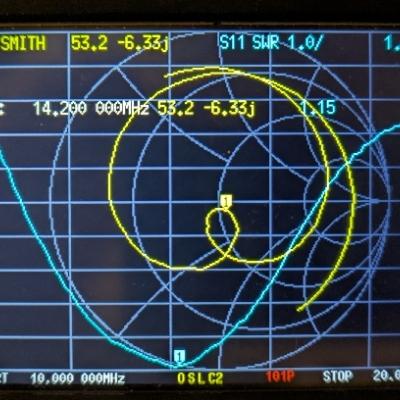
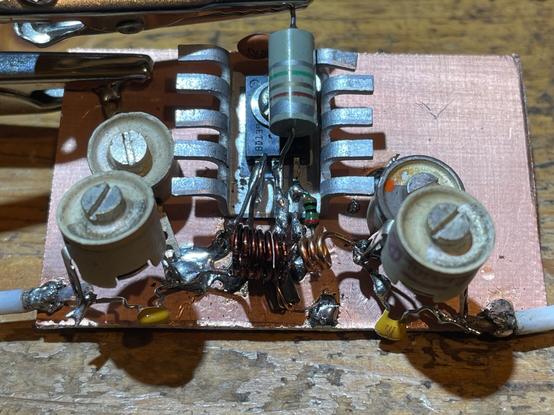
I built my first FM transmitter in the late 1980s using bits that I had lying around, with no real knowledge of RF but a tenacious approach to trial and error. I had a 2N3866 driving a BD139 to get around 1W. BD139s are audio devices and I have a drawer full of them so I thought I would verify that this really works. It does. It’s very stable owing to the meagre 3dB or so of gain. DC efficiency is an excellent 85% for the amplifier in isolation and you have to ignore the fact that the driver is using more current!
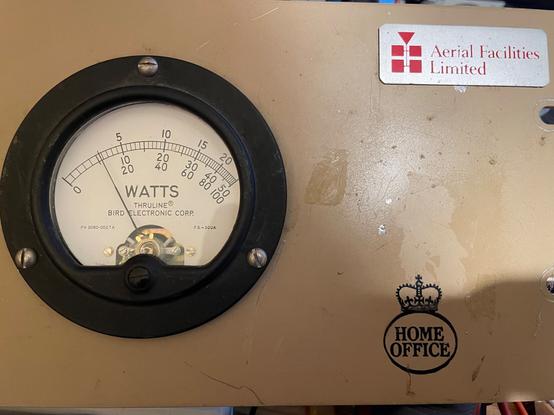
Actually it’s doing a bit more than 1W but not much. (bottom scale divided by ten for my 10B element)
I'm sure my original had a sniff of bias, which often increases the gain. I might try that, but not tonight.
Yes, that's a Home Office logo on my power meter's 19" panel. It was from a decommissioned emergency services radio site, sold at, I seem to recall, the McMichael rally when it was still held in Burnham at the community centre.
Nearly 2W out with it running from 24V. Pretty sure I didn't try this back in the 80s.
@synx508 Ah! I've used so many BD139s for HF stuff They are just at this neat niche of power capability and ft. But for VHF you probably didn't have much current gain margin if any?
@Quantensalat It's probably a lottery, individual samples of BD139 can give useful gain up to 100MHz, this one was better than expected it to be on a 24V supply, 600mW in and 1.8W out. That is almost as good as some of the first generation RF power devices. A few days ago I dug my ft measuring contraption out from storage, so I may try to test some BD139s with that.
@synx508 Does the ft depend on bias or operating point a lot?
@Quantensalat It does depend on collector current and my tester uses a fixed bias setup. The rules for measuring it seem to vary a lot. The way my tester works (IIRC) is that it uses a fairly low swept frequency (up to 80MHz) to find the -3dB point, at which point it stops the sweep and you multiply that frequency by 20.
@Quantensalat I remember being quite annoyed with myself after I finished making it because I'd wasted a lot of time designing two matched diode detectors when I should've used a 4066 to switch the reference/measured signal to a single detector. Also, it was suggested that I should use a DDS chip instead of a dc-80MHz mixer based oscillator (one vco mixed with fixed xtal overtone oscillator). But I originally wanted to do it all without a MCU, the whole circuit is controlled by a 555!
@synx508 @Quantensalat I hope you document it, I've toyed with building something to measure ft, but have yet to melt solder.