Meet Ξcc+, a new charming proton-like particle discovered by smashing particles at CERN’s Large Hadron Collider beauty (LHCb) experiment.

Pronounced Xi-c-c-plus, the new fleeting particle contains 2 heavy charm quarks and 1 down quark, while the more familiar proton contains 2 up and 1 down quark.

Mass: ~4x that of the proton
Mean lifetime τ: 45 femtoseconds (4.5e-14 seconds)
Charge: +1
Of interest to: Theorists in quantum chromodynamics 😎⚛️

https://home.cern/news/news/physics/lhcb-collaboration-discovers-new-proton-particle
https://lhcb-outreach.web.cern.ch/2026/03/17/observation-of-the-doubly-charmed-heavy-proton-%CE%BEcc/
1/n

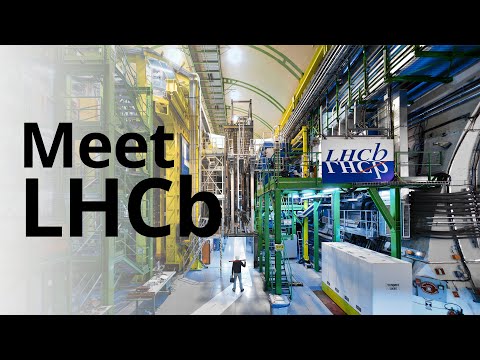
The LHCb (Large Hadron Collider beauty) experiment is a particle physics detector at the Large Hadron Collider at CERN.

The 5600-tonne LHCb detector sits 100 metres below ground in the LGC tunnel near the town of Ferney-Voltaire, France.

The LHCb experiment uses a series of subdetectors to detect mainly forward particles – those thrown forwards by the collision in one direction.

https://www.youtube.com/watch?v=8lbQUa8z3M0
https://en.wikipedia.org/wiki/LHCb_experiment
https://home.cern/science/experiments/lhcb
2/n

What is the LHCb Experiment at CERN?

YouTube

How does one detect a particle whose mean lifetime is a fleeting 45 femtoseconds (4.5e-14 seconds)?

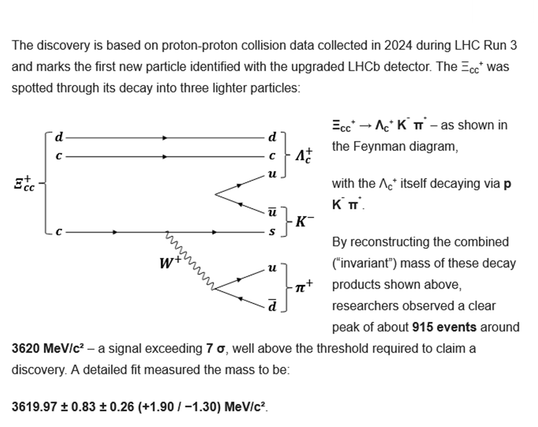
It is done by detecting the lighter particles Ξcc+ decays into, as shown in the graphic below.

https://lhcb-outreach.web.cern.ch/2026/03/17/observation-of-the-doubly-charmed-heavy-proton-%CE%BEcc/
3/n

@AkaSci

I took my particle physics exam 30+ years ago and never touched the subject again. Nevertheless, I wonder if we should call these things particles, or just some a bit more stable resonances, or whatever fancy word one can think of in order to get a grant approved.