
I have a question about plug in solar panels 🙋‍♀️

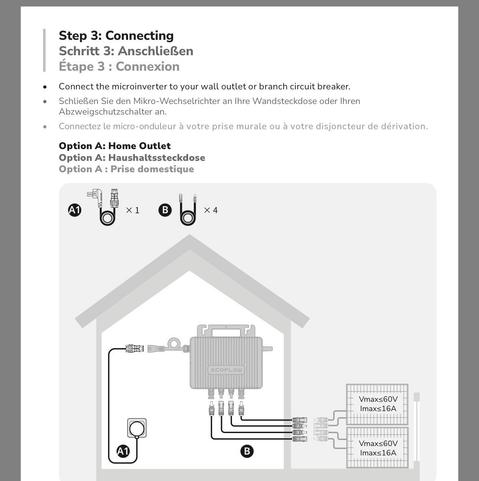
Looking the ones available in Europe, the idea seems to be solar panels -> micro inverter-> plug into wall.

I feel like I’m missing something fundamental about household circuits. Why / how does plugging a power source into a normal plug socket work? And second question, would it work the same in the UK?

#solar #fediAsk #question

@CurlyParakeet @PetraPhoenix There's no difference between plugging in an inverter and having one wired in, except for the socket.

The way they work is the same, it's just a device that monitors the input (to sync to it, and for safety) and then injects electricity into the system.
Other devices don't care where the power is coming from, just that it's there. So inverter/battery/mains, it's just electricity to the devices using it.

The safety part the same for both systems, but for more reasons for a plugin unit.
As someone else said, the device monitors the grid feed to make sure when you unplug it (and so it can't "see" the grid) it turns off it's output so you don't get a shock or worse.

@CurlyParakeet @PetraPhoenix
The other side of this (which wired in inverters do too) is a direct feed inverter (ie: designed not to operate with out the grid) use that feed in from the grid to a) sync up their sine wave to the gird, because if your system is say, 1Hz off the gird, this is Bad(TM).
And b) so if the grid fails, you don't back feed it and kill the poor tech down the line fixing it!

@chloeraccoon

Thank you for your reply!

I think it answers my question(s). I think maybe I was struggling with the “yes, it’s that simple” part. It almost feels like there should be more to it!

@PetraPhoenix

@CurlyParakeet @chloeraccoon @PetraPhoenix One other point: for safety, it needs to be on it's own breaker. No possible loads on the same circuit. That stops an idiot plugging in five of them plus five three-bar fires and the washing machine, and overloading the wires embedded in the wall.

@donburi @CurlyParakeet @PetraPhoenix Hard wiring also makes isolation easier to wire in, given the size of most isolation switches!
To give you an idea, due to the location of my inverter with regard to the distribution board, the cabling/switches goes:
Distboard breaker -> isolation switch -> cabling -> isolation switch -> inverter (then DC isolation switch on the panel side).

Sometimes you just need the space to fit it all ;)
