 A🔻atar of 🔻engeance
How a disinformation network is destabilising the Alliance of Sahel States — Modern Ghana [2026-03-20]
How a disinformation network is destabilising the Alliance of Sahel States — Modern Ghana [2026-03-20] - Lemmy
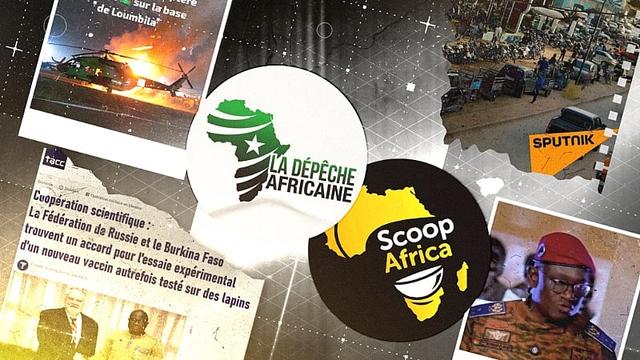
::: spoiler Expand article Since late 2025, a vast ecosystem of fake social media accounts has been targeting countries in the Alliance of Sahel States and their junta leaders. RFI’s Fact-Checking Unit and France 24’s Observers have been investigating this network, which is spreading disinformation across West Africa. Several social media accounts – with names such as Scoop Africa, La Dépêche africaine and La Voix du Faso – have been impersonating media outlets in order to discredit the governments of Burkina Faso, Mali and Niger – the three members of the Alliance of Sahel States (AES), the military and political pact formed in September 2023. In a segment shown on Burkina Faso [https://www.rfi.fr/en/tag/burkina-faso/]’s state television (RTB [https://www.rtb.bf/]) the day after the start of the war initiated by the United States and Israel against Iran on 1 March, a presenter announced that the head of the ruling junta, Ibrahim Traoré, had decided to deploy “two infantry battalions to Tehran” to support Iran. This video, which appears to be a genuine evening news broadcast, was actually produced using artificial intelligence (AI [https://www.rfi.fr/en/tag/artificial-intelligence/]), as confirmed by several AI detection tools. RTB quickly disowned the clip on its Facebook page, but despite this it was shared thousands of times. One post on X (formerly Twitter) from the account La Dépêche africaine surpassed 500,000 views. ## Coordinated campaigns La Dépêche africaine, which presents itself as an “unfiltered” source of African news, was among the first to share the RTB deepfake at 1:08am on 1 March. The footage had first been published at 1:04am by Scoop Africa, which says it covers “the biggest news stories in the world”. Scoop Africa and La Dépêche africaine appear to be the main players in coordinated disinformation campaigns targeting the AES countries. They are part of a broader ecosystem of profiles that have also attacked Russia’s presence in the Sahel [https://www.rfi.fr/en/tag/sahel/] region. How Moscow is reinventing its influence machine across Africa [https://www.rfi.fr/en/africa/20250819-how-moscow-is-reinventing-its-influence-machine-across-africa] Mali, Burkina Faso and Niger [https://www.rfi.fr/en/tag/niger/] have all cultivated closer relations with Russia [https://www.rfi.fr/en/tag/russia/] since their military leaders took power in a series of coups between 2020 and 2023, cutting ties with the West. The impersonation of legitimate media outlets and use of disinformation echoes the methods of Russian interference operations observed in recent years on the African continent and against Western countries. An analysis of the subscribers and the shares and likes of posts by Scoop Africa and La Dépêche africaine reveal a network of around 10 similar accounts active on X, Facebook and TikTok. ## Impersonating Russian media On 29 October, 2025, an account on X in the name of Nikolai Piotr Melnikov, who presents himself as a “Russian political scientist, whistleblower and investigative journalist”, claimed that Russia had called on its nationals to leave Mali because of a deterioration of the security situation around Bamako, linked to the presence of Islamist [https://www.rfi.fr/en/tag/islamist/] groups. The post, written in Russian, uses an image that impersonates the Russian state-owned media outlet Sputnik. The Russian embassy in Mali [https://www.rfi.fr/en/tag/mali/] quickly denied the information. Previously inactive, the Melnikov account then began posting more frequently. In the following weeks, it regularly published false information about current events in the Sahel. Several of these posts were shared by La Dépêche africaine, which was also among the first accounts to share the fake image attributed to Sputnik. But since February, the Melnikov account has been operating under the name Scoop Africa. Prior to that, the account went by the name Le Continent, sharing hostile posts about the AES. Harouna Drabo, a journalist specialising in information influence strategies in Francophone Africa, says this activity increased during the failed coup attempt [https://www.rfi.fr/en/africa/20251208-france-condemns-attempted-coup-in-benin-as-president-says-situation-is-under-control] in Benin last December. “This acceleration occurred as massive disinformation [and] was spread by pro-AES accounts during this event, targeting Beninese President Patrice Talon,” he told RFI. ## Millions of views Since the end of October last year, the list of anti-AES disinformation operations on social media [https://www.rfi.fr/en/tag/social-media/] platforms has been growing. One of the most recent was the false announcement in early February of the sale of a Burkinabe power plant to Russia. The claim was based on a doctored report from RTB, with the presenter’s voice manipulated. The original report had aired a few days earlier and made no mention of such a sale. Published by La Dépêche africaine in early February, the disinformation was inadvertently shared by several observers. Wagner replaced in Mali by Africa Corps, another Russian military group [https://www.rfi.fr/en/africa/20250609-wagner-gets-replaced-in-mali-by-africa-corp-another-russian-military-group] Despite having a limited audience – Scoop Africa has 2,000 followers on X and 20,000 on Facebook, while La Dépêche africaine has 10,000 on X and 1,800 on Facebook – their disinformation campaigns have reached millions of users. “Some of their fake news is sometimes picked up by journalists,” Drabo explains. “Through my contacts on the ground, I see that this content reaches end users, whether in the Sahel or in neighbouring countries.” Other fake news accounts presenting themselves as legitimate media in the region have proliferated since May 2025 – including Ouaga FM, La Voix du Faso, Info CivikTogo and La Voix du Togo. ## Fake clinical trials According to RFI and France 24’s joint investigation, this network has participated in at least 10 disinformation campaigns. The Ouaga FM page, with 2,000 subscribers on Facebook, also spread the false information about the sale of the Burkinabe power plant, as well as a deepfake targeting the chief of staff of the Burkinabe Armed Forces, Célestin Simporé, originally published by La Dépêche africaine. An account under the name of Dr. Jean Baptiste Zongo, described as being from Burkina Faso, it actively shares misinformation from Scoop Africa and La Dépêche Africaine with its 12,000 followers on X. Sahel countries navigate uncertainty following split from Ecowas bloc [https://www.rfi.fr/en/africa/20250731-sahel-countries-navigate-uncertainty-following-split-from-ecowas-bloc] In mid-February, it shared a screenshot claiming to show a dispatch from the Russian news agency TASS [https://tass.com/], falsely claiming that Burkina Faso had agreed to participate in clinical trials of a Russian vaccine that had supposedly only been tested on rabbits in a laboratory. This false information was also disseminated on TikTok by La Voix du Faso, which has an audience of more than 13 million on the Chinese-owned platform. ## ‘Informational chaos’ It is difficult to determine who is behind these profiles. According to information provided by Facebook, most of the pages flagged by the RFI/France 24 investigation are located in Côte d’Ivoire [https://www.rfi.fr/en/tag/c%C3%B4te-d-ivoire/]. “In several countries such as Côte d’Ivoire, constantly attacked by pro-AES disinformation agents, some players have clearly decided to respond with the same weapons. In Burkina Faso, for example, we know that those spreading disinformation are linked to the junta,” said one regional expert who asked to remain anonymous. “However, we don’t know precisely who is behind this ecosystem based in Côte d’Ivoire. There is no way to attribute it with certainty.” Sahel juntas in online bid to disrupt polls in Côte d’Ivoire [https://www.rfi.fr/en/africa/20251015-sahel-juntas-in-online-bid-to-disrupt-polls-in-c%C3%B4te-d-ivoire] Philip Brant, a researcher specialising in jihadism [https://www.rfi.fr/en/tag/jihadist/] in West Africa, says this spread of disinformation complicates the monitoring and documentation work of experts in the region. “All this content discredits information published by journalists that might be critical of the juntas,” he told RFI. “For example, if these accounts constantly spread false information about massacres of civilians, when such massacres actually occur this information loses all credibility.” Journalist Drabo echoed this, saying: “The risk is ending up in total informational chaos, where the population will no longer understand what is true or false.” This article was adapted from the original version in French [https://www.rfi.fr/fr/afrique/20260318-comment-un-r%C3%A9seau-de-d%C3%A9sinformation-tente-de-d%C3%A9stabiliser-les-pays-de-l-aes] by Grégory Genevrier and Nathan Gallo. ::: > Since late 2025, a network of fake social media accounts—including Scoop Africa, La Dépêche africaine, and La Voix du Faso—has been impersonating media outlets to spread disinformation targeting the Alliance of Sahel States (Mali, Burkina Faso, Niger). A deepfake video purportedly from Burkina Faso’s RTB claimed the junta was deploying troops to Iran during the US‑Israel conflict; “RTB quickly disowned the clip on its Facebook page, but despite this it was shared thousands of times.” The accounts have also fabricated stories about Russia evacuating nationals from Mali, a fake sale of a Burkinabe power plant, and a fictional Russian vaccine trial. Many of the pages are traced to Côte d’Ivoire, but the operators remain unknown. Experts warn of “total informational chaos, where the population will no longer understand what is true or false.”