 Fiona
Fiona 

Another look at #Rust, another two disappointments:
The standard library specifies that its string type is encoded in UTF8 (good!), but provides no way to work with grapheme clusters and the documentation just points at crates.io… Seriously?
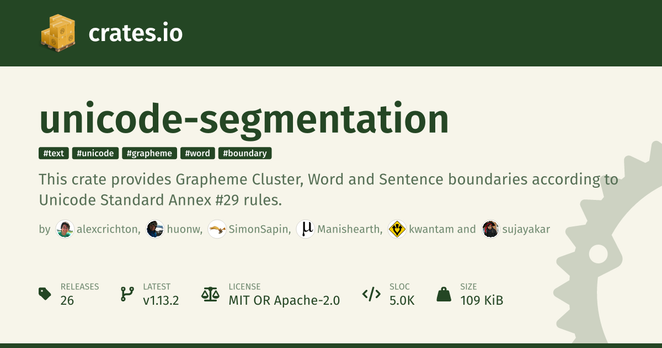
At least the unicode-segmentation-package that seems to be a popular way to get that functionality has a version that indicates that it may be usable for production (that is version ≥ 1.0.0), six owners of which a non-zero number even manage to pass a basic vibe check, and only has dev-dependencies, making this something I’d actually consider using.
Still: This should really be part of the standard library!
Another thing I was then looking at was the random number facilities, which were another disappointment: Not only is it still fully experimental, it is also woefully incomplete and cannot even create a random integer between 1 and 10. This is something extremely basic that should be possible.
I’m not even talking about things like uniform floating point distributions here, let alone stuff like a normal distribution, all of which C++ btw supports directly in the standard library! (Not saying C++ does it all perfectly, but it’s good enough to be useful. This isn’t!)
#Rustlang
The standard library specifies that its string type is encoded in UTF8 (good!), but provides no way to work with grapheme clusters and the documentation just points at crates.io… Seriously?
At least the unicode-segmentation-package that seems to be a popular way to get that functionality has a version that indicates that it may be usable for production (that is version ≥ 1.0.0), six owners of which a non-zero number even manage to pass a basic vibe check, and only has dev-dependencies, making this something I’d actually consider using.
Still: This should really be part of the standard library!
Another thing I was then looking at was the random number facilities, which were another disappointment: Not only is it still fully experimental, it is also woefully incomplete and cannot even create a random integer between 1 and 10. This is something extremely basic that should be possible.
I’m not even talking about things like uniform floating point distributions here, let alone stuff like a normal distribution, all of which C++ btw supports directly in the standard library! (Not saying C++ does it all perfectly, but it’s good enough to be useful. This isn’t!)
#Rustlang
 Benjamin Geer
 Kraftwerk-Das Model Collapse