 James Smith 💾
I have these six dice on my desk (from a recent purchase of the Warhammer Spearhead launch mag) and every now and again I roll them, hoping to get 1-2-3-4-5-6…
I think it might take a while…
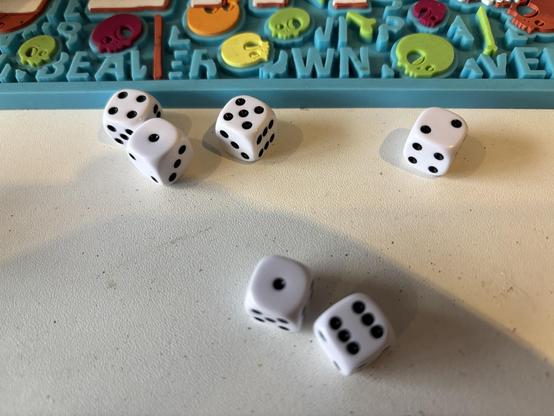
I have these six dice on my desk (from a recent purchase of the Warhammer Spearhead launch mag) and every now and again I roll them, hoping to get 1-2-3-4-5-6…
I think it might take a while…
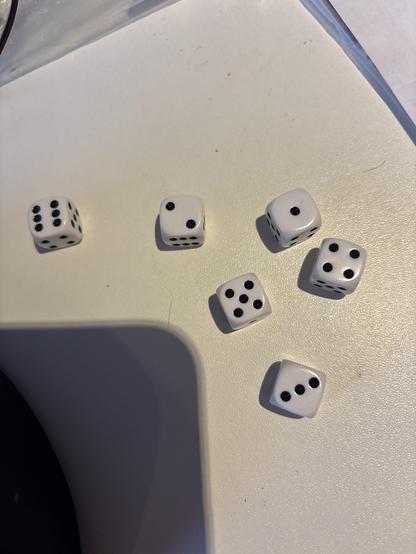
although, I just rolled twice and got only one duplicate in each, so maybe not as long as I think...
Probability is hard.
Now I think, and maths people could correct me here, that it's like rolling a series of dice, with a decreasing chance of getting a number not already rolled on each one:
1 * 5/6 * 4/6 * 3/6 * 2/6 * 1/6 = 0.015
So about 1-2% chance. Is that right?
@Floppy Yes. if you throw them all together, you have 6^6 total possible outcomes. 1..6 can be arranged in 6! ways. So you have 720 out of 46,656 possibilities that match your desired outcome. That is 1.54%.
So if you want for something to keep you busy, throw a single dice and try to get 1..6 in order. Wrong number: start over. Now you can expect to need about 46,656 throws.
[Edit: I mistakenly added an extra factor of 6 to the "serial" version]
It's the difference between combinations and permutations
https://www.mathsisfun.com/combinatorics/combinations-permutations.html
 EJ
EJ Arthur van der Harg
 SeanBurlington 🌈 🕊️