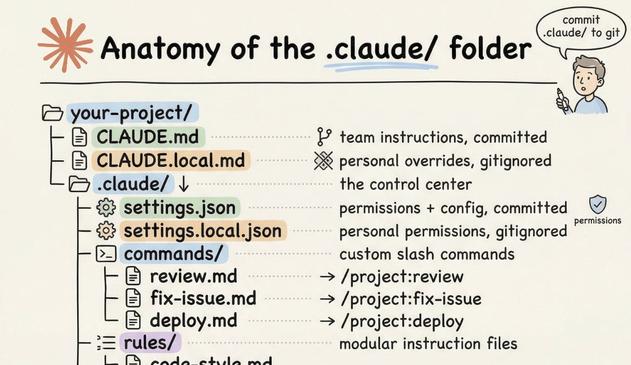
freedomben
Anatomy of the .claude/ Folder
https://blog.dailydoseofds.com/p/anatomy-of-the-claude-folder
Anatomy of the .claude/ Folder
https://blog.dailydoseofds.com/p/anatomy-of-the-claude-folder
Here's a question that I hope is not too off-topic.
Do people find the nano-banana cartoon infographics to be helpful, or distracting? Personally, I'm starting to tire seeing all the little cartoon people and the faux-hand-drawn images.
Wouldn't Tufte call this chartjunk?
LinkedIn loves these, even if they're broken.
But they had already lost me at all the links, and the fact there's not a red wire through the entire article.
The first thing my eyes skimmed was:
> CLAUDE.md: Claude’s instruction manual
> This is the most important file in the entire system. When you start a Claude Code session, the first thing it reads is CLAUDE.md. It loads it straight into the system prompt and keeps it in mind for the entire conversation.
No it's not. Claude does not read this until it is relevant. And if it does, it's not SOT. So no, it's argumentatively not the most important file.
Yes, but as soon as you start checking in and sharing access to a project with other developers these things become shared.
Working out how to work on code on your own with agentic support is one thing. Working out how to work on it as a team where each developer is employing agentic tools is a whole different ballgame.
Is there a completely free coding assistant agent that doesn't require you to give a credit card to use it?
I recently tried IntelliJ for Kotlin development and it wanted me to give a credit card for a 30 day trial. I just want something that scans my repo and I tell it the changes I want and it does it. If possible, it would also run the existing tests to make sure its changes don't break anything.
The article starts off really weak:
>Claude Code users typically treat the .claude folder like a black box. They know it exists. They’ve seen it appear in their project root. But they’ve never opened it, let alone understood what every file inside it does.
I know we are living in a post-engineering world now, but you can't tell me that people don't look at PRs anymore, or their own diffs, at least until/if they decide to .gitignore .claude.