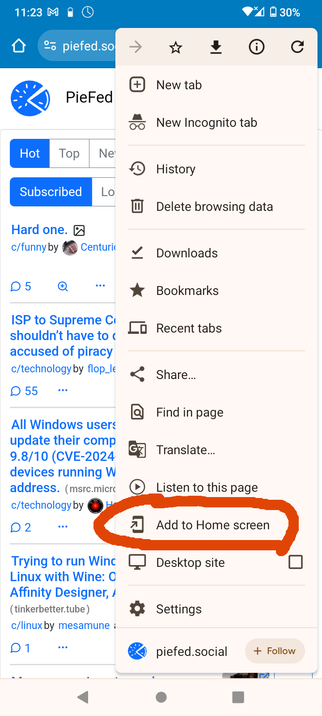
I’d explain it like this. I hope that that works.
An easy analogy
View the fediverse like a few forests, linked by many wild bridges. PieFed might be one forest, Peertube and Mastodon yet other ones. These forests have a lot of different trees.
An instance is like a single tree. And a community a branch. Users are leaves. You can help keep the tree alive, by giving donations as nutrition.
Some parts of the fediverse allow leaves to move and join another tree.
Traditional social media, on the other hand, are comparable to a single, isolated and big tree, far away from other trees. You cannot jump to other trees, and cannot easily go to a forest.
More technical explanation
Social media are built on ‘protocols’. Protocols tell for example social media what they can do and how to ‘talk’ to each other.
The Fediverse is a group of social media that use ActivityPub, Diaspora, or AT Protocol. These three protocols allow something special that ‘traditional’ social media like Facebook and Instagram don’t: they can communicate across each other, without using a centralised server for hosting content.
It’s comparable to email; you can mail to someone not using your mail provider, and vice versa.
On one of these fediverse social media, people self-host or join a self-hosted group. Such a group is called an ‘instance’. Each instance functions independently and can have its own policies.
Instances (and users) can decide with which other instances they allow their own content to be seen. They can also decide what instances their users can see content from. An instance that is connected to another instance is said to be ‘federated’ with the latter. If that is not the case, they are ‘defederated’. Instances are supported through donations.
Within each instances, there are many communities. There’s a community for Linux, a community for cat pictures, a community for nature, and so on. Users can subscribe to many of them, receiving their content.
 Ek-Hou-Van-Braai
 lime!
lime!
 leoj
leoj DJ Putler
 OpenStars
 Miles O'Brien
 wonderingwanderer
 Az_1
Az_1 schnurrito
 Foni
Foni RobotToaster
 Vittelius
 Grail
Grail Vogi
Vogi