 John Regehr
I'm fundamentally a tool builder, and LLM coding agents work one million times better if you give them good tools, and I wrote a thing about this
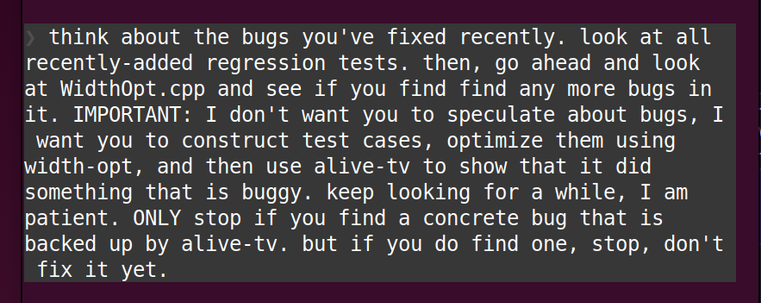
I do enjoy using these things in ways that don't plagiarize and don't inflict slop on people. for example, when debugging an LLVM pass, this kind of thing can actually work. like, this actually found a miscompilation bug just now, and may find more if I ask it to keep going. it's an absolutely fresh LLVM pass, there is no chance that the LLM was trained on anything it's seeing here (much less on bug fixes to it).
 Andrea (Drea) Tamar Pinski
@regehr Part of it is looking into patterns of previous passes and looking into patterns of creating LLVM IR and then it is just matching it up that way.
So it is plagiarizing but in a more interesting way.
Plus running a secondary program to do the acceptance criteria. Alive2 is the anti-slop part here really.
I have done something similar with some passes before where I was able to match a known pattern inside the pass and then create a testcase out of that.
Basically what LLMs are doing in this case is limiting what kind of testcases to produce. It using pattern matching what the code could to limit its search. This is why it found something that Csmith could not in a reasonible time frame.
Now this might be one of the only uses of LLMs which can prove very useful BUT only because it is not about creating something which will ever be used outside of a test env. It might actually reduce the amount of energy used overall.
BUT it is NOT even close to any usecase that is being pushed by anyone.
Note in this use case the plagiarization is in my mind would be fair use. Basically testing all programs is fair use on the compiler.
@pinskia I think I agree with all this. still trying to figure it out.