The amount of FOSS developers using Claude (or any other proprietary/closed services) instead of using (and pushing forward) local and open weight solutions is...

I have no polite way to say this. You've sold your souls. And if it doesn't even bother you, it means you've left aside the whole point of FOSS ages ago.

Doing stuff together, for the common good.

It's even worse than 30 years ago. You are now literally giving your thoughts and code and reasoning to companies and private entities, to make that system "better". Their sole interest is profit, not the good of humanity. You are literally addicts who are not even aware of your condition.

There's no way we'll have good, open, efficient, and available for all LLM and coding agents if you carry on using and promoting those services.

@bilboed I'm afraid you're trying to get between drug dealers and their clients. Keep trying, but... good luck with that. Same goes for hosting FOSS projects on GH... just "too convenient".
@bilboed yeah, totally agree. Going further Im actually surprised LLM like https://allenai.org/olmo is not more common in FOSS circles , which is not only openweight but the data to train it is open as well (even if is not as good as others but still I think is more aligned with Foss)
Olmo from Ai2

Our fully open language model and complete model flow.

@jjardon Great, you've nerdsnipped me. I'll give olmo a try. Was already using the various qwen models, mistral ones, and apertus (all local).

As for "not as good", the question is really "good at what" and "good as what" ?

Obviously, local/open models aren't going to be as "good" at deep knowledge as models 100 or 200 times their size. And which have been trained on more content. But do you really need a system that can reliably spit out that obscure specification virtually no-one uses, or do you need it to have a good enough common base of knowledge and reasoning, so that it can be useful on the context you provide it ?

A lot of current open models are great for summarizing, brainstorming, searching (in your codebase or knowledge base), reasoning, translating, spellchecking, ... That alone is a great way to gain time.

A lot are also becoming multi-modal also, I.e. can understand and reason on an image (a design you scribbled on a piece of paper or a whiteboard, a screenshot of a failing web page). Add speech to text and text to speech and we have a system that can (locally) help impaired users !
@jjardon oh, one other interesting and useful thing to do is ask a model to explain your code.

If it tells you something out of place, ask it why. More often than not, it's a sign that your code isn't obvious. Might be missing a small comment, variable/function could be better named, documentation might be outdated, etc... Or maybe the design/flow is not obvious.

Doesn't require a massive model, on the contrary. Doesn't take that long, but is a massive gain for the future.

@bilboed @jjardon

This is a big topic in itself, and we-the-FOSS-community should define the language, concepts, and pretty much everything to figure out what it means to do free software in a world with generative AI tools.

Also, turns out you can actually ask "reasoning" AI models what code was used as a reference, and what licenses it used etc.. To give credit, and to honor licenses. It is not "clean room", it reads stuff when reserching and you can ask where it came from.

@bilboed @jjardon This is not open content.

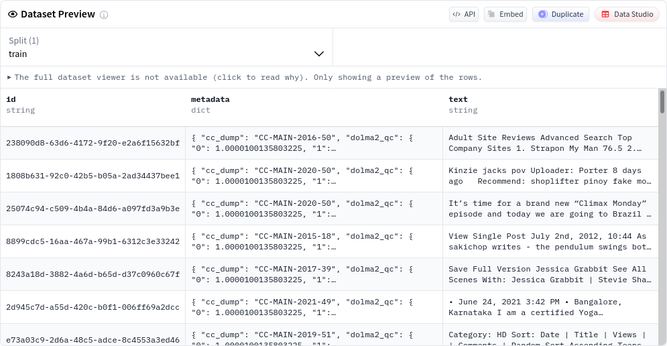
A quick look at their standard pool shows porn sites as the thing that shows up first: https://huggingface.co/datasets/allenai/dolma3_pool

As usual, loads of unlicensed, copied web content.

@bilboed I quite agree with you here. I think we indirectly largely contributed to it by publishing our work and all the steps we went through to get there. In fact, I strongly believe that if these things mostly work, it is largely be because of open-source projects, and our transparency, showing all the steps and reasoning publicly.
@bilboed and while I do give it a try, because someone else paid me an account, I'd be a lot more comfortable using and contributing to Open Source models. I still enjoy not using it, doing my slow coding that I've been doing for years, and that I enjoy. I review a lot of human written code all the time, I don't really want to replace my coding with only machine produced code ...
@ndufresne I think we have an opportunity in the FOSS world to innovate and come up with a completely different way of using these systems as "assistant" (and not replacement).

There are still no good solutions out there where you can still be coding/designing but you have this assistant just there which can bounce ideas and suggestions when you're coding, detect gaps in the documentation/code, etc...

Something akin to how LSP have been a real boost in productivity, while still leaving you in control.

I.e. "augment" your work, not replace it