 Vagina Museum
Today feels as good a day as any to talk about anteater vaginas! So let's take a look at the uterus, uterine tubes and vaginas of giant anteaters (Myrmecophaga tridactyla), in both females and males. Because both sexes of anteater have these organs...
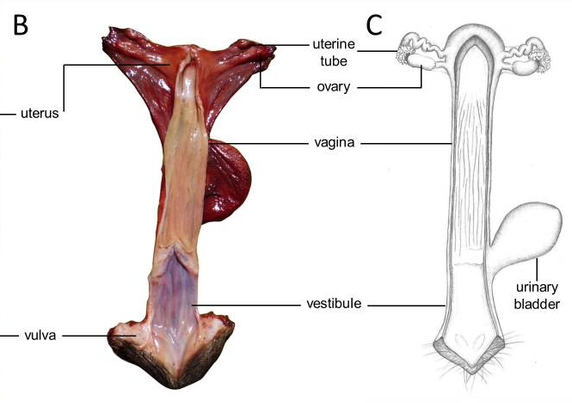
We'll start with females. A female anteater's genital tract starts with a conical vulva, and a vestibule into which the urethra also empties. The internal organs go pretty much straight up in a tube without a cervix delineating the vagina and uterus, right until the uterine tubes which separate.
Now let's look at the male anatomy. There's a lot going on here. The tract starts with a conical penis, similar in shape to the vulva. Then there's a ton of stuff going on, unlike the straight-shot tube in the female organs, before we finally hit the internal testes at the top.
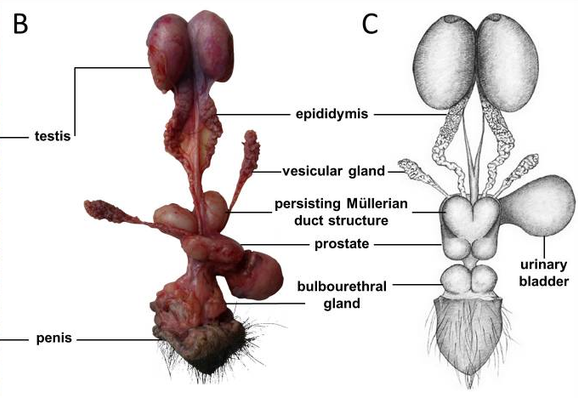
The part that's of interest to us, a Vagina Museum, is the bit where the system goes wild with knobbly, bobbly bits, labelled "persisting Mullerian duct structure". That's the male anteater's vagina. And uterus. And uterine tubes.
To comprehend the vagina of the male anteater, first we must return all the way to embryos and how babby is formed. Every embryo starts out with two sets of tubes: the mesonephric ducts (sometimes called Wolffian) and the paramesonephric ducts (sometimes called Müllerian).
If an embryo goes on to develop as female, the paramesonephric ducts will develop as the uterus, uterine tubes and upper vagina. The mesonephric ducts recede.
If an embryo goes on to develop as male, hormones will make the paramesonephric ducts recede, and the mesonephric ducts turn into parts such as the epididymis and vas deferens.
For whatever reason, in male anteaters, the paramesonephric duct does not recede anywhere near as much as it does in other mammalian species. A lot of it sticks around, and on a cellular level the cells can be identified as vaginal cells, uterine cells, and uterine tubes.
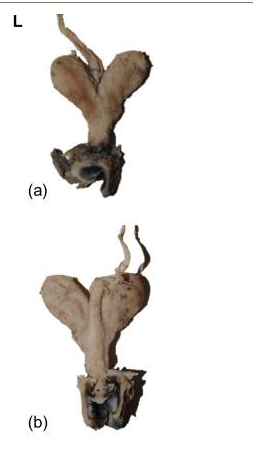
Here's a clear look at a male anteater's vagina, uterus and uterine tubes. The heart-shaped section is the vagina, the noodly bit in the top photo is its uterus, and the two noodly bits on the lower photo are its uterine tubes.
Here's a fun fact that we just made up: the song "Heart Shaped Box" was written because Kurt Cobain knew all about male anteater vaginas and wanted to tell the world about them.
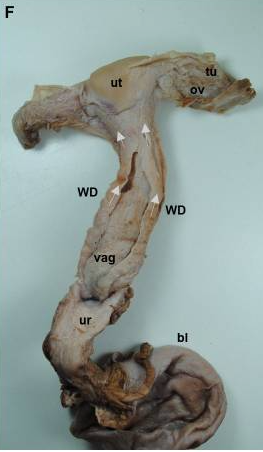
And in case you're wondering if female anteaters have a similar set-up and have somewhat defined persisting mesonephric duct structures... yes they do! They have two epididymis-like structures running up the side of their vaginas. They're labelled WD in this photo.
Are you inspired to learn more about anteater genitals? All photos included in this thread can be found in this 2021 paper by Lilja Fromme and colleagues, along with a much deeper dive into anteater fannies. https://pmc.ncbi.nlm.nih.gov/articles/PMC8364315/
 Eye
EyeLearning is GREAT with my favourite museum!
 Stephen Cox Author
Do gender critical anteaters exist?
 Faraiwe
 AL (not Al)
@vagina_museum @purplepadma Words I never thought I’d say to myself: There is too much information about anteater genitals in my timeline today.
 esc key
@vagina_museum @miriamrobern Given what Ive read about Kurt Cobain I had to go read the rest of the thread before I was able to determine that this was just a joke
 Flittermouse 🎸🥁🎹🏳️⚧️🐩
@vagina_museum
What is true is that Kurt was literally in the closet while he worked on that song. No, I mean, he and Courtney had a large closet and he'd use it for practice and composition.
What is true is that Kurt was literally in the closet while he worked on that song. No, I mean, he and Courtney had a large closet and he'd use it for practice and composition.