 Eragon
 Antanicus
You can't make this shit up. The double standard is unreal.
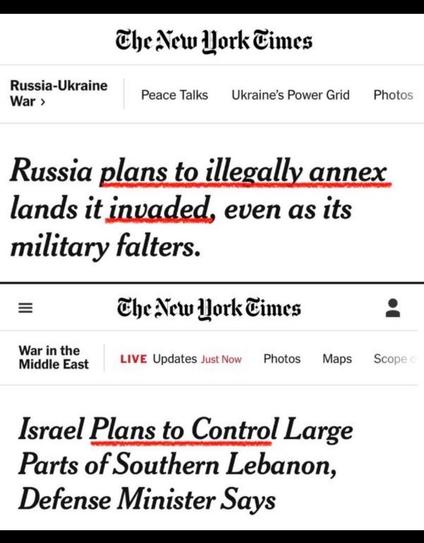
You mean that if someone doesn´t say they plan to annex an area, you´d still have to report that they did?
@sibrosan oh but they are indeed planning to:
"I say here definitively … in every room and in every discussion, too: The new Israeli border must be the Litani,” [Smotrich] said, referring to the Litani River, a critical waterway that cuts through southern Lebanon, about 30km (19 miles) from the border with Israel."
The headline is about what the defense minister said. If the finance minister said something else, should that be attributed to the defense minister as well?
@sibrosan okay but you are just making the exact point op is getting at.
the russian minister didn't use the word annexe either, i’d warrant. how come old mate gets taken at his word despite, y’know, all the actions, whereas russians are presumed dastardly without given the opportunity to positively frame their own actions and then have them laundered by the masthead?
@antanicus
OP apparently blocked me, so I can't see the post anymore.
But if I understand you correctly, the issue was that the second headline was factual, but the first one not?
I'm not sure what you mean.
I had assumed the issue was with the second headline.
If the Israeli Defence Minister didn't say "annex", is the Times supposed to write that he did?
Of course, if no Russian official spoke of annexation plans, but the Times presents such plans as a fact, it would be a double standard to not twist the words of the Israeli Defence Minister as well.
Maybe I don't understand correctly what you're saying, but I have the impression that you are contradicting yourself.
Is, in your opinion, the role of media to accurately report what they *know* (i.e. what they know to be facts)?
Or to misrepresent facts, when it fits better to their perception that e.g. the person they're misquoting is a liar?

The ignorance of this post is breathtaking.
Damn the New York Times
@antanicus If you're the same person who's posted stuff like this before (I don't keep track; I have a life to lead), then you don't understand what you're reading.
The first is a direct assertion -- a claim of fact -- by the organ itself. The second is requoting other people, and makes no assertion of fact.
The first says, "This is what WE say is going on." The second says, "This particular guy is making this particular claim".
 Pescheria Marechiaro.
 Sibrosan
 unlogged
 trademark
 WesDym
 johnny anhedonic
 Spycrab
 Rob
Rob
 Mastodon Migration
 Daniel AJ Sokolov
 Official Kakistocracy Jester 🪓
 Greg
Greg