Swift 6.3 Released

Swift is designed to be the language you reach for at every layer of the software stack. Whether you’re building embedded firmware, internet-scale services, or full-featured mobile apps, Swift delivers strong safety guarantees, performance control when you need it, and expressive language features and APIs.

Swift.org
> Swift 6.3 includes the first official release of the Swift SDK for Android.
That is going to be used... less than Swift for the servers

I don't know. Could be nice for those developers that prioritize iOS and now they could keep writing Swift also for Android.

Is it gonna be what you primarily use if you wanna write an Android app? Probably not.

Is it gonna displace react Native? Probably not. Is it gonna reach the levels of flutter? Maybe.

The language doesn’t really matter. The underlying SDK/framework is where the action is at.

However, I suspect that we may not be too far off, from LLMs being the true cross-platform system. You feed the same requirements, with different targets, and it generates full native apps.

Interestingly, Kotlin has a pretty solid cross-platform story.

I'd pick it over Swift if targeting Android since it can build and run in the JVM as well as natively -- and has Swift/ObjC interop. Its also very usable on the server if you wanted to, since you can use it in place of Java and tap into the very mature JVM ecosystem. If that's what you're into.

And I have a lot more faith in JetBrains being good stewards of the language rather than Apple, who have a weird collection of priorities.

Anything similar for Windows and Linux?

For Windows there's a 5 year old blog post: https://www.swift.org/blog/swift-on-windows/

For Linux there's a guide for GNOME: https://www.swift.org/blog/adwaita-swift/

It would be really nice if instead we could just do one style of development and then ship a set of libraries as used to work for OpenSTEP (which was why it had "OPEN" in the name).

Introducing Swift on Windows

The Swift project is introducing new downloadable Swift toolchain images for Windows! These images contain development components needed to build and run Swift code on Windows.

Swift.org

> Swift is designed to be the language you reach for at every layer of the software stack.

It's a nice lang for sure, but this will never be true with the way things are. Such wasted opportunity by Apple.

How so? I can indeed target every layer of the software stack using Swift, today.

E.g. ClearSurgery[0] is written fully in Swift, including the real-time components running on the Linux boxes.

[0] https://clearsurgery.vision

ClearSurgery | Spatial Computing for Surgeons

ClearSurgery brings spatial computing into operating rooms with Apple Vision Pro-ready workflows for modern surgical teams.

I don't know why anyone would want to use Apple tools if they are not developing for Apple platforms. Apple barely maintains compatibility for their own platforms, using Swift on a non-Apple platform is setting yourself up for doubule pain.

I _can_ do the same with Rust, doesn't mean it's "the language I reach for" for making e.g. a website. Because the tooling, ergonomics, hireability factor, etc. are still very harshly against it.

Same with Swift, but I'd call that more of a wasted opportunity because Apple, unlike Rust Foundation, has a mountain of money to make it happen, and yet they don't seem to care.

> Swift 6.3 introduces the @c attribute, which lets you expose Swift functions and enums to C code in your project. Annotating a function or enum with @c prompts Swift to include a corresponding declaration in the generated C header that you can include in your C/C++ files

Why did this take so long to be added? Such strange priorities. Adding an entire C++ compiler for C++ interoperability before adding... C exports. Bizarre.

They had it earlier, as an underscored attribute.

C++ interop got attention because it helps Apple absorb low-level codebases that already moved past pure C. Exporting Swift to plain C mostly means more DIY FFI spaghetti.

Once enums, ownership rules, and nullability cross that boundary, the generated header stops looking like a neat bridge and starts looking like one more place for ABI bugs to hide. Closures make it weirder fast, because now your error handling and calling conventions can drift just enough to produce the kind of bug that wastes a whole afernoon.

good to see incredible stuff being shipped in Swift. Haven't used it since v3 though.

around 2015-17 - Swift could have easily dethroned Python.

it was simple enough - very fast - could plug into the C/C++ ecosystem. Hence all the numeric stuff people were doing in Python powered by C++ libraries could've been done with Swift.

the server ecosystem was starting to come to life, even supported by IBM.

I think the letdown was on the Apple side - they didn't bring in the community fast enough whether on marketing, or messaging - unfortunately Swift has remained largely an Apple ecosystem thing - with complexity now chasing C++.

Maybe Chris Lattner leaving and creating Mojo also didn’t help in that regard.

Swift for TensorFlow was a cool idea in that time …

Lattner probably left because Apple didn't give the team any breathing room to properly implement the language. It was "we must have this feature yesterday". A lot of Swift is the equivalent of Javascrip's "we have 10 days to implement and ship it":

https://youtu.be/ovYbgbrQ-v8?si=tAko6n88PmpWrzvO&t=1400

--- start quote ---

Swift has turned into a gigantic super complicated bag of special cases, special syntax, special stuff...

We had a ton of users, it had a ton of iternal technical debt... the whole team was behind, and instead of fixing the core, what the team did is they started adding all these special cases.

--- end quote ---

I Interviewed The Creator Of LLVM, Clang, Swift, and Mojo

YouTube

That's my read too.

Swift was feeling pretty exciting around ~v3. It was small and easy to learn, felt modern, and had solid interop with ObjC/C++.

...but then absolutely exploded in complexity. New features and syntax thrown in make it feel like C++. 10 ways of doing the same thing. I wish they'd kept the language simple and lean, and wrapped additional complexity as optional packages. It just feels like such a small amount of what the Swift language does actually needs to be part of the language.

Which keywords would you get rid of and why? You don't have to use all of them!
You can take this approach in personal projects - with teams you need to decide on this and then on-board people into your use of the language. This does not work.

I'm not a Swift user, but I can tell you from C++ experience that this logic doesn't mitigate a complex programming language.

* If you're in a team (or reading code in a third-party repo) then you need to know whatever features are used in that code, even if they're not in "your" subset of the language.

* Different codebases using different subsets of the language can feel quite different, which is annoying even if you know all the features used in them.

* Even if you're writing code entirely on your own, you still end up needing to learn about more language features than you need to for your code in order that you can make an informed decision about what goes in "your" subset.

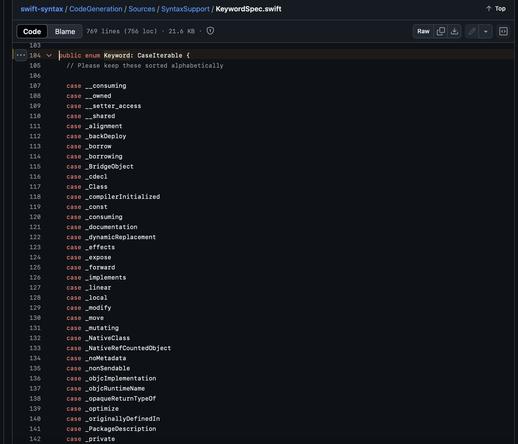
1. You don't have to use it all, but someone will. And there are over 200 keywords in the language: https://x.com/jacobtechtavern/status/1841251621004538183

2. On top of that many of the features in the language exist not because they were carefully designed, but because they were rushed: https://news.ycombinator.com/item?id=47529006

Jacob Bartlett (@jacobtechtavern) on X

In case you forgot, Swift has 217 keywords now

X (formerly Twitter)

But you have to know all of them to read other people's code.

To answer your question: I would immediately get rid of guard.

Also, I think the complexity and interplay of structs, classes, enums, protocols and now actors is staggering.

> Swift could have easily dethroned Python

No way something that compiles as slowly as Swift dethrones Python.

Edit: Plus Swift goes directly against the Zen of Python

> Explicit is better than implicit.

> Namespaces are one honking great idea -- let's do more of those!

coupled with shitty LSP support (even to this day) makes code even harder to understand than when you `import *` in Python.

Re: module name selectors, wasn't this already possible, e.g. ModuleA.getValue()? Though I suppose this disambiguates if you also have a type called ModuleA.