 MrBruh
The EU still wants to scan your private messages and photos
So... if we all care so much about shooting down the bad idea, why is nobody proposing opposite legislation: a bill enshrining a right to private communications, such that bills like this one would become impossible to even table?
Is it just that there's no "privacy lobby" interested in getting even one lawyer around to sit down and write it up?
Or is there at least one such bill floating around, but no EU member state has been willing to table it for discussion?
Quoting from the Charter of Fundamental Rights of the European Union, https://eur-lex.europa.eu/legal-content/EN/TXT/?uri=CELEX:12... :
"Article 7
Respect for private and family life
Everyone has the right to respect for his or her private and family life, home and communications.
Article 8
Protection of personal data
1. Everyone has the right to the protection of personal data concerning him or her.
2. Such data must be processed fairly for specified purposes and on the basis of the consent of the person concerned or some other legitimate basis laid down by law. Everyone has the right of access to data which has been collected concerning him or her, and the right to have it rectified.
3. Compliance with these rules shall be subject to control by an independent authority."
You know that those pieces of paper mean nothing.
In theory, governments are made up of citizens. In practice, once the citizens are corrupted into corporate shills, they become politicians. They have traded their humanity for business class seats and dining at restaurants that cater to those whose entire personality is talking about their investment portfolio.
It clearly states here in 2 “consent of the person concerned OR some other legitimate basis laid down the law”, any random law will trump personal consent
It doesn’t remove the “right to the protection of personal data concerning him or her.” The law cannot be random, it must ensure “fair processing” and be limited to “specific purposes”, and the European Court of Justice as well as the ECHR will decide what constitutes a “legitimate basis” in that context. Furthermore, “Everyone has the right of access to data which has been collected concerning him or her”, which ensures transparency of what is being collected.
Last but not least, a number of EU countries enshrine https://en.wikipedia.org/wiki/Secrecy_of_correspondence in their constitution.

Secrecy of correspondence only applies to sealed physical letters, so it has zero applicability to this law and provides zero protection against scanning of private messages.
Also it isn't respected in most types of criminal trials. If a sealed physical letter is opened and proves fraud, for example ...
Secrecy of correspondence still has exceptions. That's what is always lost in these discussions -- every right of every person is not absolute. Just because you have a right to personal property, doesn't mean you don't have to pay taxes or store nuclear material in your basement. That's the hard part.
But end to end encryption with forward secrecy at no cost to user makes your right to private communication absolute. It's a new thing and the balancers can't balance it against other rights of other people, so this happens.
One of the reasons international human rights law is so worthless in actual practice, is that half of it is framed like this. "Everyone has the right to X, except as duly restricted by law." Cool, so that's not a right at all then.
Ditto the Canadian Charter of Rights and Freedoms, with its 'notwithstanding' clause. (Though they're presently litigating over that, so we'll see what happens!)
Any constitution or human rights instrument full of exemptions, 'emergency powers', 'notwithstanding' clauses, or 'states of exception' is not worth the paper it's written on.
Let's parse this a little.
Article 7 codifies "respect for [one's] private life" and "respect for [one's] private communications". Well, "respect" is a vague notion. This does not clearly imply that the government is not allowed to read your communications, or otherwise spy on you, if it believes it has good reason. It will do so "respectfully", or supposedly minimize the intrusion etc.
As for article 8: Here it is "protection of personal data" and "fair processing". It does not say "protection from government access"; and "processing" is when the government or some other party already has your data. In fact, as others point out, even this wording has an explicit legitimization of violation of privacy and 'protection' whenever there is a law which defines something as "legitimate basis" for invading your privacy.
You would have liked to see wording like:
* "Privacy in one's home, personal life, communications and digital interactions is a fundamental right."
* "The EU, its members, its bodies, its officers and whoever acts on its behalf shall not invade individuals' privacy."
and probably something about a non-absolute right to anonymity. Codified exceptions should be limited and not open-ended.
> This does not clearly imply that the government is not allowed to read your communications, or otherwise spy on you, if it believes it has good reason. It will do so "respectfully", or supposedly minimize the intrusion etc.
Which is... okay? Government gonna government, that's what we pay it to do.
It already violates Articles 7 and 8 of the EU Charter which is supposed to prevent stuff like this.
The reality is that they'll just keep pushing it from different angles, they only have to get lucky once, we (or EU citizens, we left and have our own issues) need to be lucky every time - much like an adverserial relationship where you are on the defending side from a cyberattack...funny that really.
(I mentioned this in another comment)
Because the people voting it down are the elected MEPs, whilst the people putting it up to parliament are the European Commission. The EC are appointed, rather than elected. Which means the powers that be just appoint people who are going to push through laws like this, that they want. The MEPs can't put up bills to be voted on.
If you're ever unsure about whether a proposed EU regulation may be good or bad, just look at whether Hungary supports it: if so, it's bad; if not, it might be good. Egészségére!
I'm Polish and I was positivity shocked that we oppose it. I remember attending some protests against ACTA which as far as I remember was supposed to be something similar, back in my student days. It was -17°C and people still showed up. Apparently we have some culture of opposing censorship and invigilation by state. May come in handy if the democratic decline keeps progressing...
Do you mean "surveillance" by the word "invigilation" here?
Could be a wordplay due to the fact "invigilation" can be translated to and from the Polish word with a _very_ heavy and long connotations to the USSR state surveillance, oppression and abuse.
Surveillance would be a more "modern" (even if more natural or seemingly correct word), without this sort of the implied baggage.
There a practical reason for this? like more alignment with lobbyists, for whatever financial reasons?
Over the last two decades Hungary reversed course from a democracy joining the west to an authoritarian dictatorship in bed with the Russians.
Hence, everything their government does is the opposite of what a typical European Union member would approve of.
Orban is a Putin asset.
Okay so I had to look in to it because the site is not really doing a good job explaining it at all. Turns out[0] that they are voting for the extension of the temporary regulation thats been in effect since 2021 (Regulation (EU) 2021/1232). So this is about the "voluntary scanning of private communications" (which is still bad, but has been in effect for almost 5 years already).
[0]: https://www.europarl.europa.eu/sedcms/documents/PRIORITY_INF...
Here is the regulation that will be voted on: https://oeil.europarl.europa.eu/oeil/en/procedure-file?refer...
Note that the amendment was already amended on 11th March to set expiry to Aug 2027 and to also exclude E2E communications.
I am the creator of Fight Chat Control.
Thank you for sharing. It is unfortunately, once again, needed.
The recent events have been rather dumbfounding. On March 11, the Parliament surprisingly voted to replace blanket mass surveillance with targeted monitoring of suspects following judicial involvement [0]. As Council refused to compromise, the trilogue negotiations were set to fail, thus allowing the Commission's current indiscriminate "Chat Control 1.0" to lapse [1]. This would have been the ideal outcome.
In an unprecedented move, the EPP is attempting to force a repeat vote tomorrow, seeking to overturn the otherwise principled March 11 decision and instead favouring indiscriminate mass surveillance [1, 2]. In an attempt to avoid this, the Greens earlier today tried to remove the repeat vote from the agenda tomorrow, but this was voted down [3].
As such, tomorrow, the Parliament will once again vote on Chat Control. And unlike March 11, multiple groups are split on the vote, including S&D and Renew. The EPP remains unified in its support for Chat Control. If you are a European citizen, I urge you to contact your MEPs by e-mail and, if you have time, by calling. We really are in the final stretch here and every action counts. I have just updated the website to reflect the votes today, allowing a more targeted approach.
Happy to answer any questions.
[0] https://mepwatch.eu/10/vote.html?v=188578
[1] https://www.patrick-breyer.de/en/the-battle-over-chat-contro...
[2] https://www.europarl.europa.eu/doceo/document/OJQ-10-2026-03...
[3] https://www.europarl.europa.eu/doceo/document/PV-10-2026-03-...
You're doing God's work mate.
It's really surprising to me that this issue keeps coming up time and time again, until I realised that it's non-voted in parties actually trying to pass this stuff!
I didn't realise that the EU parliament simply says yes or no to bills and doesn't actually propose new laws, whilst the EU Commission are appointed and decide on what bills to push through.
Where are all those "as an EU citizen" commenters? You are but a subject of an ultra-national government whose sole objective is ever increased control over your life and euros.
As an EU citizen I have to remind you that as a (most likely) US citizen, you've had the Patiot act sanction the NSA to have free reign for this sort of thing for the past 25 years.
We've shot it down before, and we'll shoot it down again, regardless of how relentless Palantir lobbying gets.
> you've had the Patiot act sanction the NSA to have free reign for this sort of thing for the past 25 years.
This is not true. No part of the Patriot Act required all people all private messages and photos to be scanned or have a backdoor to encryption. You're saying this to minimize what's about to happen to Europe, which is not helpful. The NSA made deals with private companies to tap lines, and used its influence and US intelligence's secret ownership of a Swiss encryption company to encourage us to use broken algorithms.
> We've shot it down before, and we'll shoot it down again, regardless of how relentless Palantir lobbying gets.
I wish you luck. But there's nothing keeping the EU from doing, and having always done, what the NSA has also done. What you're trying to stop is the requirement to serve your communications to your rulers on a silver platter.
As a EU citizen, it pisses me off that the US is (with others outside the EU) trying this hard to lobby to undermine our democracy and freedom of speech.
https://digitalcourage.social/@echo_pbreyer/1162053712243153...
And I’d still take this clusterfuck over the alternative current state of the US. At least this situation we can (and have been) striking down, despite all the naysayers on HN. Here’s to hoping we’re able to do so again!
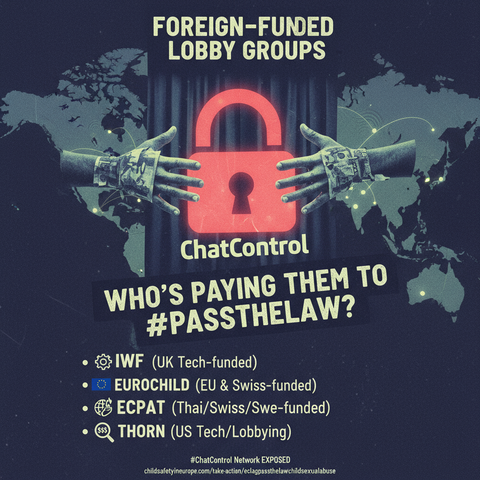
Patrick Breyer (@[email protected])
Attached: 1 image 🇪🇺 1/7 🌍 Foreign-funded lobby groups from outside the EU are pushing #ChatControl with misleading propaganda. They want to #PassTheLaw to scan your chats, but who are they and who's paying them? Let's expose the network. Thread 👇