The EU is looking for short fixes to reduce gas demand and has failed to find any.
https://www.euronews.com/my-europe/2026/03/23/eu-pushes-early-gas-refills-while-easing-storage-targets-on-iran-war

China is expected to consume some 450 Gm³ in gas in 2026.
https://www.reuters.com/business/energy/chinas-lng-imports-set-recover-2026-though-not-2024-level-2026-02-10/

China installed 110 GWp of solar in May 2025 alone.
https://prometheus.org/2026/03/20/global-solar-pv-installations-reached-647gw-in-2025/

Has anyone estimated how much it would cost (per GWp or Gm³) to pay China to accelerate the installation of, say, 100 GW of solar power, to reduce gas demand on the world market? Surely inventories suffice.
#EnergyCrisis

EU pushes early gas refills while easing storage targets on Iran war

Goal is to avoid panic buying while ensuring that EU countries' gas storage is replenished by next winter. The European Commission also told member states to refill below the 90% level set by law in 2022. #EuropeNews

euronews
From a legal/realpolitik perspective, this would be pretty easy to arrange, no legislation is needed. There is a precedent in a 10 G$ deal with Indonesia (which then got stuck over price haggling). Some ministerial statement or Council recommendation sets the political direction. EIB group (or similar entity) proposes a voluntary capital subscription of, say, 10 G€ for an ad hoc fund. The fund injects capital into a JV with China. JV borrows 10x as much from Chinese banks and buys PV projects.

As for oil, #PaulKrugman points out there's no way to significantly reduce oil usage in the short term, other than by reducing personal use of petrol-powered cars.
https://paulkrugman.substack.com/p/how-to-burn-less-oil

Doing it on the supply side is prohibitive (you'd need fuel prices to increase by, say, 100-200 % in the USA; or, even less likely, ration fuel). On the demand side I guess you can pay people to commute by bike or public transport. Both options are probably cheaper than the usual #FossilSubsidies.

How to Burn Less Oil

Reducing our dependence should be easy. But it will be hard to do it fast.

Paul Krugman

@nemobis
I can't see beyond the paywall so I can't see the arguments.
However I am a little sceptical that personal transport makes up most of the use of oil, and while reducing the use of cars is laudable, if not essential, I'm doubtful it would achieve the stated desires.
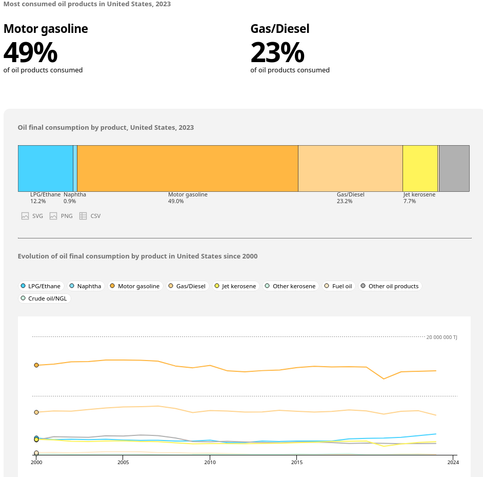
I'd like to see a breakdown in oil use which encompasses air travel (broken down into personal business travel/ private jets, leisure travel and freight), shipping ( broken down into freight, cruise lines and other), military use, as well as personal vehicles, heating oil.

I'm no apologist for motorists but I wonder if they are seen as a soft target when the Pareto Principle might yield more reduction in oil use.

@MikeFromLFE There you go: https://www.iea.org/countries/united-states/oil

Transport is 74 % of oil use in the USA and motor gasoline is 49 %.