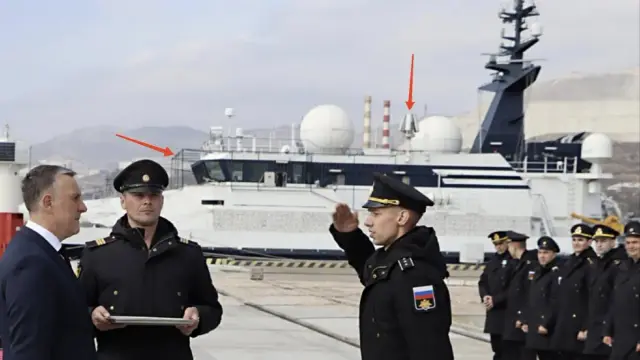
long response also see subcomments with examples of how The Battle Of Lake Eyrie and the St. Nazaire Raid relate directly to this moment
Why do Drones make people’s brains go to mush about swarms?
What the hell do you think Dive Bombers in WW2 attacking ships were?
What do you think the dense formations of level bombers in WW2 were?
What do you think the military strategy of China has been for awhile now since before drones even proliferated?
No, this isn’t the same thing as torpodoes. Torpodoes are very high value precison guided munitions.
Yes, the threat of the “swarm” is always real, but the idea of naval power since before any of these technologies ever came into being was already in consideration of this force you claim is new. Naval power is about extending organized power over vast distances, with resiliency, duration and unimpeded ability to expedition.
The force of resistance a power such as this will encounter will always take the form of a “swarm” coming from some littoral context, and thus the question of fighting drones with naval ships isn’t really a new one though it may seem to be.
Even before drones proliferated, most military analysts foresaw a conflict in the Strait Of Hormuz would involve Iran swarming with lots of independent, highly mobile “cheap” agents to overwhelm the US military. I don’t point that out to negate the reality of the threat, but to emphasize that this isn’t some radical new consideration but rather an acceleration of an old tactic.
[2002]
>
Red, commanded by retired Marine Corps Lieutenant General Paul K. Van Riper, adopted an asymmetric strategy, in particular, simulating using old methods to evade Blue’s sophisticated electronic surveillance network. Van Riper simulated using motorcycle messengers to transmit orders to front-line troops and World-War-II-style light signals to launch airplanes without radio communications in the model.
> Red received an ultimatum from Blue, essentially a surrender document, demanding a response within 24 hours. Thus warned of Blue’s approach, Red used a fleet of small boats to determine the position of Blue’s fleet by the second day of the exercise. In a preemptive strike, Red launched a massive salvo of cruise missiles that overwhelmed the Blue forces’ electronic sensors and destroyed sixteen warships: one aircraft carrier, ten cruisers and five of Blue’s six amphibious ships. An equivalent success in a real conflict would have resulted in the deaths of over 20,000 service personnel. Soon after the cruise missile offensive, another significant portion of Blue’s navy was “sunk” by an armada of small Red boats, which carried out both conventional and suicide attacks that capitalized on Blue’s inability to detect them as well as expected.
…
> **After the war game was restarted, its participants were forced to follow a script drafted to ensure a Blue Force victory.
[The Following “Virtual Cope Cages” Were Implemented–>] Among other rules imposed by this script, Red Force was ordered to turn on their anti-aircraft radar in order for them to be destroyed, and during a combined parachute assault by the 82nd Airborne Division and Marines air assaulting on the then new and still controversial MV-22, Van Riper’s forces were ordered not to shoot down any of the approaching aircraft.[8][9] Van Riper also claimed that exercise officials denied him the opportunity to use his own tactics and ideas against Blue Force, and that they also ordered Red Force not to use certain weapons systems against Blue Force and even ordered the location of Red Force units to be revealed.[10] The postmortem JFCOM report on MC02 would say “As the exercise progressed, the OPFOR free-play was eventually constrained to the point where the end state was scripted. This scripting ensured a blue team operational victory and established conditions in the exercise for transition operations.”[11]
en.wikipedia.org/wiki/Millennium_Challenge_2002
“Cope Cages” aren’t a new concept, it is just in the past they weren’t usually so literal.
A Naval ship with a cage around the wheelhouse is not projecting power, it is a target, if somebody was in charge who was actually well versed in Naval Strategy on the russian side they would know that you have to
set the conditions to build a Navy before you can do so.
If you cannot defend your own littoral waterways and high value ports against small unit enemy incursions and sabotage, you have not set the conditions to build a Navy. It does not matter if you already possess ships and submarines,
you still have not set the proper strategic conditions to begin to build a Navy and thus those vessels are worse than useless as they will distract the public into thinking they possess a Navy when they do not.
This has been true since navies used Triremes, it is just reflected into a new context journalists like to hallucinate as new instead of as part of a long developing story that was ignored by some until they had no choice but to learn it the hard way.
Contrast this with Ukraine acquiring Minesweepers as a very intentional choice.
en.wikipedia.org/wiki/Alkmaar-class_minehunter
--------------
A note on “swarms” and how they won the Battle Of Midway.
en.wikipedia.org/wiki/Douglas_SBD_Dauntless
> At the Battle of Midway, Marine Corps SBDs were not as effective. One squadron, VMSB-241, flying from Midway Atoll, was not trained in the techniques of dive bombing with their new Dauntlesses (having just partially converted from the SB2U Vindicator).[13] Its pilots resorted to the slower but easier glide bombing technique. This led to many of the SBDs being shot down during their glide, although one survivor from these attacks, now on display at the National Naval Aviation Museum, is the last surviving aircraft to have flown in the battle. The carrier-borne squadrons were effective, especially when they were escorted by Grumman F4F Wildcats.[14] The success of dive bombing resulted from one important factor,
>> Unlike American squadrons that attacked shortly before one at a time, allowing defending Japanese Zero fighters to concentrate on each squadron to shoot them down or drive them away from the carriers, three squadrons totaling 47 SBDs (VS-6, VB-6, and VB-3), one squadron of 12 TBD torpedo aircraft (VT-3), and six F4F fighters (from VF-3) all arrived simultaneously, with two of the SBD squadrons (VS-6 and VB-6) arriving from a different direction from the other squadrons. Without central fighter direction, the approximately 40 Zeros concentrated on the TBDs, with some fighting the F4Fs covering the TBDs, leaving the SBDs unhindered by fighter opposition in their approach and attack (although most of the TBDs were shot down).[15]
The concept of The Swarm is not new…
 supersquirrel