
RE: https://mastodon.social/@impactology/116289053150470382

One theme that I keep detecting from this is that your mind sharpens when it experiences structured variation, so the educator's job is to expose them to variation by different constraints and feedback

Your mind sharpens when it is repeatedly placed in situations where it must notice:

What is changing
What is staying the same
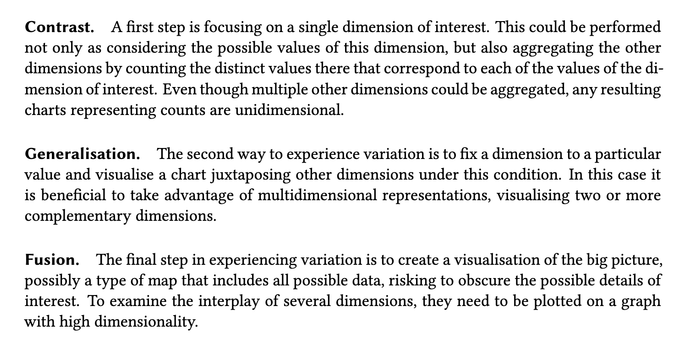
If nothing varies, nothing new becomes perceptible. So even if you’re reading, thinking, or reflecting, your perception isn’t being disturbed enough to reorganize itself.

That’s why it feels like stagnation.

It’s not that people in elite environments have fundamentally different brains. What they have is constant exposure to variation.

Different people disagree. Different contexts clash. Feedback exposes gaps. Situations change quickly.

All of this creates a continuous stream of:
contrast (this vs that)
shifts in context (same idea, different situation)
contradictions (things that don’t fit cleanly)

Those forces make it impossible for your current understanding to remain stable. Your mind is constantly being pushed to refine itself.
When you hold something constant and vary something else, new aspects become visible. When you compare multiple cases at once, hidden patterns emerge. When things don’t fit together, your current concept breaks and has to be rebuilt.

Take one concept and stay with it.

Expose that one concept to variation.
You compare a few contrasting cases.
You isolate one dimension and vary it while keeping others stable.
You look for what remains consistent across situations.
You combine multiple factors and see how they interact.

Then you pause and ask:

What became visible that wasn’t visible before?

What compounds is not just knowledge, but discernment : the ability to see differences, boundaries, relationships quickly and reliably.

Lets apply this to explain hashing

Starting Point: The Naive Understanding

Imagine a simple system where a website stores your password exactly as you typed it.

If your password is mypassword123, that exact string sits in the database. Anyone who accesses the database can read it directly. Now imagine a second system where instead of storing the password, the system stores a transformed version something like 5e884898da....

At first glance, both systems “store a password,” but something fundamental has changed. The difference is not just about “security” in a general sense. The real difference is that in the first case, the original input is directly retrievable, while in the second case, it is not.

That distinction introduces the first important boundary:

Hashing is not just about hiding data. It is about making the original input non-recoverable through direct reversal.

Making the Critical Dimension Visible (Separation)

Now hold everything constant except one thing.

Keep the same user, the same password, and the same system. Only change whether the system uses hashing or not.

In the plaintext case, the password can be read directly. In the hashed case, you only see the output of a function that cannot be reversed in practice.

By isolating this difference, one dimension becomes visible:

The concept of hashing is fundamentally about one-way transformation, or irreversibility.

This is much more precise than saying “it is secure.” It tells you what kind of operation hashing actually is.

Stabilizing the Concept (Generalization)

Next, vary everything else while observing what stays the same.

Use different passwords, different users, and different systems. Despite all this variation, a proper hash function always behaves in a few consistent ways. The same input always produces the same output. The output is always of fixed length, regardless of input size. And the process is deterministic.

Now the concept becomes clearer:

Hashing is a deterministic, fixed-length, one-way mapping from input to output.

At this point, you are no longer relying on a vague idea. You are starting to see the structure.

Breaking the Concept (Introducing Contradiction)

Now comes the most important step: forcing the concept to fail.

Imagine two users who both choose the password 123456. If the system simply hashes their passwords without any additional mechanism, both users will end up with exactly the same hash stored in the database.

This creates a problem. An attacker can notice that two accounts share the same password, even without knowing what that password is.

Even worse, attackers can precompute hashes for common passwords and match them quickly.

Now the earlier idea “hashing secures passwords” starts to break. Hashing alone is not sufficient. It leaks structure.

This failure is not a mistake. It is the point. The concept is revealing its limits.

Rebuilding the Concept (Fusion)

To fix this, systems introduce another element: salt.

A salt is a random value added to the password before hashing. Now even if two users have the same password, their inputs to the hash function are different, and therefore their outputs are different.

At this stage, you are no longer looking at hashing in isolation. You are seeing how multiple dimensions interact: one-way transformation, uniqueness, and resistance to precomputed attacks.

The concept has now evolved into something more accurate:

Secure password storage is not just hashing. It is the combination of hashing, salting, and choosing appropriate algorithms.

Notice what happened.

You did not memorize a better definition. Instead, you exposed the concept to contrast, isolated a key dimension, stabilized what remains invariant, forced a contradiction, and then rebuilt the concept by combining dimensions.

The result is not just more knowledge. It is a different way of seeing.

If someone now asks whether a specific hashing algorithm is secure, you will not rely on vague intuition. You will think in terms of reversibility, collisions, uniqueness, and how the system behaves under variation.

This is the essence of the method.

You did not learn hashing by being told what it is. You learned it by forcing the concept to reveal its boundaries through variation.

Mental sharpness is not about holding more information. It is about becoming sensitive to differences, to invariants, and to where a concept breaks under pressure.

That sensitivity is what allows you to truly understand something technical, instead of just recognizing it.

Force variation of a concept until the invariant/essential principle of it reveals itself, then force contradiction until the boundary breaks, then rebuild.

The educator's job then becomes to provide structured contrast, isolation, and contradiction of attributes/properties/dimensions of a concept

A good educator does not transfer knowledge. They construct situations where differences become visible, boundaries break, and a new way of seeing becomes unavoidable.

They sequence experience of variation that make critical aspects of a concept discernible, so that the learner is forced to notice what they previously could not see

https://mastodon.social/@impactology/115860924650590229

I think the best way to do that this sequencing is by introducing a scenario where something has gone wrong/is broken and needs fixing