 WE AND THE COLOR
Jevany Villa Proves a Forest Slope Is the Best Building Material You Have
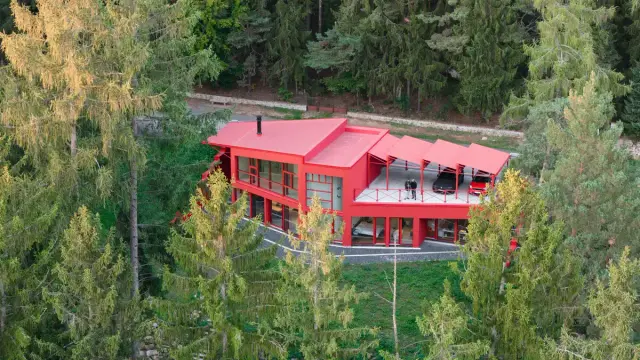
The Jevany Villa started with a pit in the ground, a descending slope, and a wall of mature spruce trees. Most architects would treat those conditions as design obstacles to navigate carefully. David Kraus of Prague-based studio Architektura treated them as the actual material of the house. That distinction is precisely what makes this project worth your full attention. Located in a wooded village outside Prague, the Jevany Villa occupies a long forest plot with a north-to-south drop in elevation. From the street, it barely registers — low, embedded, almost invisible against the hillside. From the garden below, it transforms entirely into a tall, glazed, and generously proportioned building. That duality is not accidental; it drives every spatial and formal decision in the entire design.
What Does It Mean for a House to Become a Forest Organism?
The brief called for a modern house with an industrial character, and Kraus delivered that with real conviction. But the Jevany Villa goes further than fulfilling a brief — it proposes an architectural thesis. Architecture, it argues, does not need to dominate a natural setting in order to express power. Instead, it can absorb that setting and let the forest become the primary spatial experience. David Kraus describes the house as an organism, and that framing turns out to be remarkably precise. The building shifts silhouette with the changing light and transforms entirely with the seasons. Moreover, the mature spruce trees growing below the building site are not a backdrop — they are active participants in every spatial experience inside. Those trees rustle, move, and rise like living sculptures toward the open sky. The house frames them, listens to them, and reflects them back through walls of glass.
So what does it really take for a house to earn that description? The answer, in this project, is a combination of precise site reading, material honesty, and a refusal to separate inside from outside. The Jevany Villa does not treat the forest as a view to be managed. It treats the forest as a room without a roof. That conceptual shift runs through every level of the building.
The Slope Inversion Principle: One House, Two Completely Different Readings
One of the sharpest conceptual moves in the Jevany Villa is what I call the Slope Inversion Principle. The building exploits a roughly 3.5-meter height difference between the road level and the garden to perform a visual disappearing act from above and a full architectural reveal from below. From the north, at street level, the house reads as a modest single-storey structure embedded in the hillside. From the south, facing the forest, it reads as a two-storey glazed building of considerable spatial presence. Kraus didn’t choose between privacy and openness — he stacked them vertically along the section of the slope. That decision alone sets the Jevany Villa apart from most contemporary residential architecture being built in Central Europe today. Furthermore, the setback of nearly five meters from the adjacent road creates a generous entrance terrace that reinforces the sense of arrival rather than diminishing it.
The Sawtooth Roofscape as Industrial Threshold
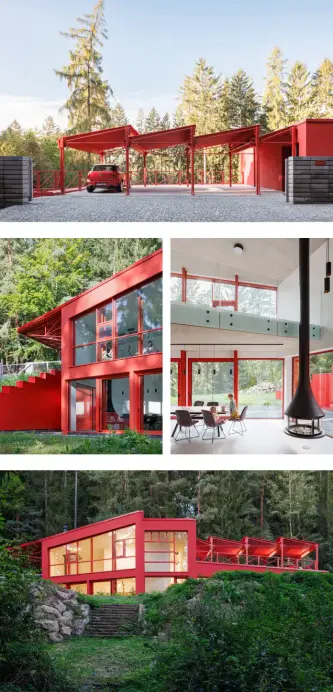
The entrance sequence of the Jevany Villa begins not at a front door but on a roof. Cars park on a terrace sheltered by a sawtooth roof structure, and the industrial reference is immediate and entirely deliberate. Three of the four structural “teeth” shelter parking spaces, while the fourth marks the building’s main entrance. Beneath the raw red steel frame, cars of different colors sit in constantly changing configurations. Kraus treats this as a living composition — the chromatic arrangement of vehicles is never the same twice, which gives the otherwise serious entry sequence an element of lightness and unpredictability. Additionally, the sawtooth form responds directly to the client’s brief for a house that reads more like a craft workshop or light industrial building than a conventional suburban residence. That commitment to the brief, carried through to the roof structure, is what gives the Jevany Villa its confident identity from the very first approach.
Jevany Villa by ArchitekturaTorso Architecture: How a Staircase Hall Organizes an Entire Building
The central staircase hall is the spine of the Jevany Villa — or, in Kraus’s own terms, its “torso.” It connects the western and eastern wings, links the day zone to the night zone, and provides the organizational logic that makes a house spread across five operational levels feel coherent rather than fragmented. Upon entering from the carport, the forest appears immediately through tall, irregularly divided glazing that references the compositional rhythms of Mondrian. That visual axis — from entrance directly into the tree canopy below — is the core spatial experience of the entire project. A straight staircase descends through a 3.5-meter-high space, past a curved wall that redirects movement into the living area. That curve is the only soft gesture in an otherwise angular building, and it earns its place by making the spatial transition feel choreographed rather than merely functional. Additionally, an illuminated recessed railing runs alongside the stair, subtly marking the descent without competing with the view beyond.
The Torso Method, as a concept, has broader relevance beyond this single project. When a house is organized around a single dominant connective space — one that carries the spatial drama, the primary views, and the vertical circulation — it gains a clarity and memorability that distributed corridors simply cannot provide. The Jevany Villa demonstrates that principle at its best.
The Study Level: A Quiet Room Between Two Worlds
Just a few steps below street level, still within the upper portion of the house, sits a bright study that functions as a flexible room. It opens both toward the forest and downward into the living zone, making it simultaneously private and spatially connected. This room can serve as a guest room, a gym, or a dedicated work space, depending on the household’s current needs. That kind of designed-in flexibility is something more residential architecture should consider seriously. Moreover, its position between the entrance level and the main living floor gives it a quality of in-between-ness — neither fully public nor fully private — that makes it surprisingly adaptable.
Chromatic Tension: How Red Steel and Green Forest Define the Jevany Villa
Color is not decoration in the Jevany Villa — it functions as structure. The red steel window frames and raw red structural elements throughout the house form the building’s primary visual identity. Against the irregular green silhouettes of the spruce forest, that red reads with absolute tonal clarity. This is what I define as the Chromatic Tension Framework: two complementary colors — red and green — deployed not as accent choices but as opposing forces in permanent visual dialogue. The kitchen reinforces this logic with reddish stone surfaces set against black shelving, white cabinet doors, and a steel fireplace suspended above the finished floor. Raw concrete ceilings with visible formwork imprints and black suspended pendant lights complete the material palette. Furthermore, the white walls throughout the house prevent the weight of raw materials from tipping any room toward darkness, maintaining a careful balance between industrial seriousness and spatial generosity.
Think about what it takes to make a color feel architectural rather than decorative. Red, in most residential interiors, reads as an accent. Here, it reads as a load-bearing decision. The steel is red because the forest is green, and the house needs that tension to remain legible against the trees. That is color thinking at a genuinely structural level, and it is rare.
Interior Design as Shared Authorship
The interior of the Jevany Villa was developed in close collaboration with designer Jan Waltr. That partnership mattered because Waltr shared Kraus’s precise understanding of what the house needed — not a softened domestic interior, but a consistent extension of the building’s raw material logic into every furnished surface. Consequently, nothing inside the house feels imported from a showroom or added as an afterthought. Every element earns its place within the same formal and material system. The multicolored kitchen, with its deliberate clash of surfaces and materials, is perhaps the most vivid expression of that shared authorship.
Five Operational Levels: How the Jevany Villa Manages Daily Life
The Jevany Villa organizes itself across five distinct spatial levels, and understanding that structure helps explain why the house feels both complex and entirely legible. At the uppermost level, the sawtooth carport and main entrance lead into the central connecting hall. One level down, the bright study occupies a position between the entrance zone and the main living floor. Below that, the day zone opens into a large, double-height space for living, cooking, and relaxing, with full glazing toward the forest. Adjacent to the day zone, the night zone contains the parents’ bedroom with a walk-in closet and bathroom, plus the children’s rooms, all connected to forest views. Finally, the residential corridor terminates in a garden exit that will eventually serve as an independent entrance for older children. That forward-thinking spatial logic is characteristic of the design approach throughout — the Jevany Villa is built not just for the family’s present life but for the changing rhythms of the years ahead.
The Living Zone as Double-Height Landscape Frame
The living area is the most spatially ambitious space in the Jevany Villa, and it justifies that ambition completely. It spans two full floors, with raw concrete ceiling structures above marked by formwork imprints and the red steel window structures directly facing the forest below. Looking upward from this space reveals the honest record of how the building was constructed — the concrete did not arrive finished; it arrived wet and was shaped by timber boards whose grain now reads permanently in the ceiling. Looking outward shows the spruce forest through a continuous wall of glass. Both views are equally powerful, and the room holds that tension without collapsing into spectacle.
The Garden as Found Landscape: Minimum Intervention, Maximum Confidence
The garden of the Jevany Villa is essentially what was already there when construction ended. Landscape interventions were limited to the immediate surroundings — the south-facing terrace, the upper entrance zone, and a side staircase connecting the levels. The most striking landscaping element required no design at all: massive stones discovered on the plot during demolition of the original building were left in place beside the new structure as found objects. They sit there now — ancient, heavy, and entirely at home in a contemporary architectural setting. That restraint is as confident a design decision as any formal move in the building. Furthermore, the mature trees provide complete visual screening from the road while leaving the south-facing view toward the forest and ponds below entirely unobstructed.
There is a lesson in that restraint. The temptation, with a house this architecturally considered, is to extend the design language into every square meter of the surrounding plot. Kraus resisted that temptation. The garden belongs to the forest, not to the house, and the house is better for acknowledging that boundary.
Why the Jevany Villa Matters Beyond Its Specific Site
The Jevany Villa makes a strong case for a specific approach to residential architecture that remains genuinely rare in practice. It argues that topography is an opportunity, not a complication. Furthermore, it argues that industrial materials — raw steel, exposed concrete, black metalwork — can feel warm and livable when applied with precision and real conviction. It argues that color, specifically the tension between red and green, can carry emotional and structural weight simultaneously. Above all, it argues that a family house can hold the spatial ambition of an institutional building without sacrificing the conditions that make daily domestic life actually enjoyable. David Kraus credits the result to the clients’ open and almost artistically tuned minds, the mutual trust between client and architect, and the exceptional construction quality delivered by contractor Radek Trojánek. Those conditions do not guarantee architecture this good, but they create the space in which it can happen.
Photography by Matej Hakár captures all of this with corresponding intelligence — the images understand the building, which is not something you can always say about architectural photography. The shots of the red steel carport with its shifting car colors, the staircase descent toward the trees, and the living zone facing the forest all communicate the Jevany Villa’s thesis with clarity and force.
Three Concepts Worth Borrowing from This Project
The Jevany Villa introduces at least three conceptual tools that other architects and designers can genuinely apply elsewhere. First, the Slope Inversion Principle: exploit vertical height differences to generate two radically different spatial readings from opposite approach angles. Second, the Torso Method: organize an entire house around a single dominant central space that carries the circulation, the views, and the spatial drama. Third, the Chromatic Tension Framework: identify the complementary color relationship between the building’s primary material and its dominant natural context, then commit to it as a structural design decision rather than a palette preference. None of these tools requires a forest plot or a Czech village to work. They are transferable precisely because they are conceptual rather than contextual.
Frequently Asked Questions About the Jevany Villa by Architektura
Who designed the Jevany Villa?
The Jevany Villa was designed by David Kraus of Prague-based studio Architektura. The interior design was developed in close collaboration with designer Jan Waltr. Construction was carried out by contractor Radek Trojánek. Photography is by Matej Hakár.
Where is the Jevany Villa located?
The Jevany Villa is located in Jevany, a village in the Central Bohemian Region of the Czech Republic. The site sits within a densely wooded residential area on a long forest plot with access from an upper road and views toward a series of forest ponds below.
What is the central architectural concept of the Jevany Villa?
The central concept is the visual axis and spatial descent into the forest landscape — the idea that the house functions as an organism embedded within its natural environment rather than simply placed upon it. The design exploits the north-to-south slope to create two entirely different spatial readings of the same building from opposite directions.
What materials define the character of the Jevany Villa?
The Jevany Villa is defined by raw red steel structures, white walls, black metalwork accents, and raw concrete ceilings with visible formwork imprints. The kitchen uses reddish stone surfaces contrasted against black shelving and white cabinetry. A suspended steel fireplace and black pendant lights complete the palette.
What is the sawtooth roof in the Jevany Villa used for?
The sawtooth roof covers the rooftop carport and marks the main entrance to the building. Three of the four structural teeth shelter parking spaces, and the fourth defines the entrance threshold. The raw red steel structure beneath creates an industrial first impression that sets the architectural character of the entire house from the moment of arrival.
How does the Jevany Villa relate to its forested landscape?
The Jevany Villa treats the forest as a spatial participant rather than a scenic backdrop. The central staircase hall provides a direct visual axis toward the tree canopy from the moment of entry. The red steel window structures in the living zone frame the irregular green silhouettes of the spruce trees, creating a continuous visual tension between built structure and natural form throughout every season of the year.
All images © Matej Hakár and Architektura. Feel free to find other inspiring architecture projects from around the globe here at WE AND THE COLOR.
#architecture #Architektura #CzechRepublic #villa