 fossilesque
That's how the world works.
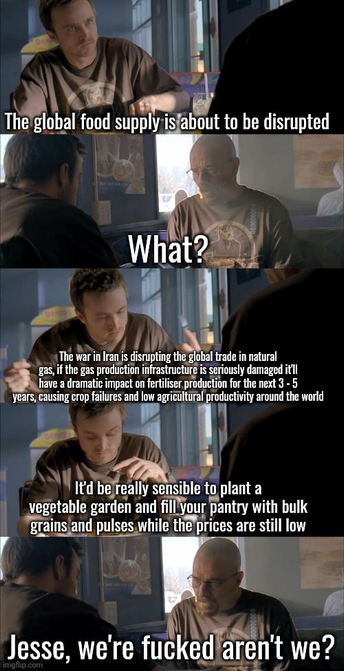
Natural gas is used to produce hydrogen, which is then used in the Haber-Bosch process to produce ammonia from nitrogen in the atmosphere. Only about 6% of natural gas is used to produce hydrogen, so even if the price were to rise substantially, we could divert natural gas from other uses and have plenty for making ammonia. We also have other ways of producing hydrogen, it’s just that natural gas is more established.
PEM electrolyzers paired with cheap solar in countries with high insolation can now produce hydrogen for less than the cost of natural gas, but we’re only recently starting to see the construction of the large-scale green ammonia plants needed to accomplish this. Egypt is currently constructing a 100-MW green ammonia plant powered by solar energy. Even if you didn’t have enough PEM eletrolyzers you could still just pass current through some salt water and produce hydrogen, albeit much less efficiently.
It’s not going to be a catastrophic issue.
Thank you for explaining the process, because the pro-fuel-cell pact doesn’t understand that hydrogen isn’t free.
“Oh it comes from ammonia”. Alright, where does the ammonia come from???
But why not just make electricity from renewable energy?
Like, I get the benefit of fuel cells, but people need to realize that hydrogen closer to a battery than a fuel source itself. You’re expending energy now to make storage of energy that can be tapped later.
It’s good for places where vehicles can’t tap into the grid and need dense energy storage (i.e. transoceanic freighters), or where long charging times are infeasible (like long-range trucking).
And probably good for grid-level storage, too.
But for a typical family car/commuter? There’s really no point. You’re adding more steps in energy conversion, and losing efficiency at every additional step (thanks to basic physics), and to gain what? A faster refueling time on a long road trip? An experience closer to what we were used to with ICE-cars? An experience that really isn’t that great anywhere that has a winter.
Maybe for people who can’t have a charger at home, even an L1, but there are better solutions for that (like…adding an outlet? Making landlords responsible for providing power whenever there is parking? More municipal charging locations?)
Some startups are trying to synthesize edible fats from non-biological feedstocks, using just energy, water, carbon monoxide, and hydrogen, through the Fischer Tropsch process.
Personally I’m more interested in seeing whether that can expand into just manufacturing hydrocarbons with excess solar energy, rather than synthetic food, but it’s still cool to see that people can do it.
 cogitase
 Hypx
Hypx