 John Regehr
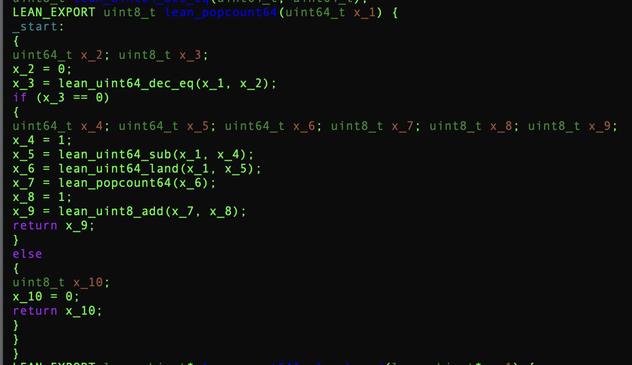
wow so glad I can extract this minimal and efficient C++ from my verified Kernighan popcount in Lean 😅
https://gist.github.com/regehr/3461027009efbe9452d8a5c343174443
wow so glad I can extract this minimal and efficient C++ from my verified Kernighan popcount in Lean 😅
https://gist.github.com/regehr/3461027009efbe9452d8a5c343174443
Neat! I feel as though I should try to learn lean one of these days.
Previously I've used CBMC to prove the equivalence of these two C implementations of popcnt (under the assumption that unsigned is uint32_t or smaller, I guess)
int pop(unsigned x) {
   x = x - ((x >> 1) & 0x55555555);
   x = (x & 0x33333333) + ((x >> 2) & 0x33333333);
   x = (x + (x >> 4)) & 0x0F0F0F0F;
   x = x + (x >> 8);
   x = x + (x >> 16);
   return x & 0x0000003F;
}

inline int proof_popcnt(uint64_t u)
{
    int r = 0;
    for(int i=0; i<64; i++)
        if(u & (1ull << i)) r ++;
    return r;
}
using code like
int main() {
    unsigned u = nondet_unsigned();
    int i = pop(u);
    assert(i == proof_popcnt(u));
}
but when the assertion holds it provides no insight into why, and when CBMC fails to prove or disprove an assertion in a reasonable length of time, it's not clear to me how to guide it.
@regehr @stylus I'd one-up this and say that's the future of software period, not just verified software.
It will be a 10+ year transition, but people will increasingly move to writing software in languages with built-in support for meta-programming & verification. A language like Rust already feels crippling. If it all compiles down to LLVM anyway and you (can) get good performance, why would you use a less powerful language? Even if you don't intend to verify, having the option to is good.

 Stylus
 George Pîrlea
 ash
ash