 vostochnodvorskij
 Prof. Stefan Rahmstorf
Every responsible decision maker in politics, industry etc. should read this. Or better yet the original WMO report it’s about (linked in the article).
And then think very seriously:
What am I doing to stop this?
Is it enough?
How do I want to be remembered?
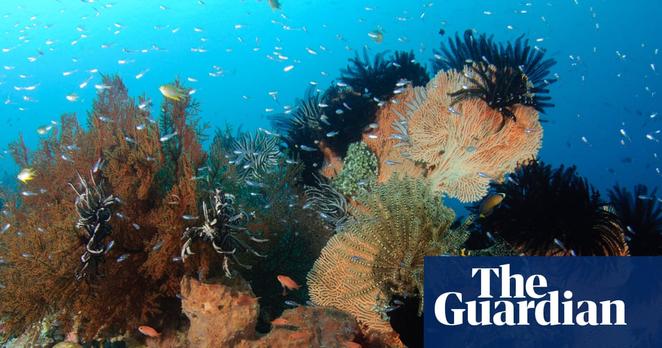
A note about the fact that 91% of the energy warming the Earth is taken up by the oceans and only 1% by the atmosphere: that simply is because the heat capacity of water is so much larger than that of air, so it takes far more energy to warm the oceans. Temperature is rising less in the oceans than in the atmosphere, and mostly in the upper layers.
 Thoralf Will 🇺🇦🇮🇱🇹🇼
@rahmstorf Probably very naive and unscientific question:
Could the global warming possibly trigger a stronger water exchange in the oceans?
Meaning: Could the stronger heating of the upper layers cause a stronger exchange with the lower levels due to some effect that I do not know about/understand or will the layers stay pretty much segregated?
Background: That could have (at least) 2 effects:
1. Devastating warming of lower levels in the oceans
2. Slowing the climate change
 Jean-Baptiste "JBQ" Quéru
@thoralf @rahmstorf In that direction I'd also love to know whether watching deeper layers could increase sea level rise through additional dilation.
 anlomedad
Did you hear climate scientists speak of Dead Zones? What they mean is that the water layers get so stratified that oxygen can't pass through to lower layers anymore due to warming of the upper layers. So Dead Zones grow – where nothing grows.
Because warmer water can't hold gases as good as cooler water: https://www.bbc.com/news/science-environment-50690995
It doesn't answer your question directly. It's more of an "Beware what your wish for".
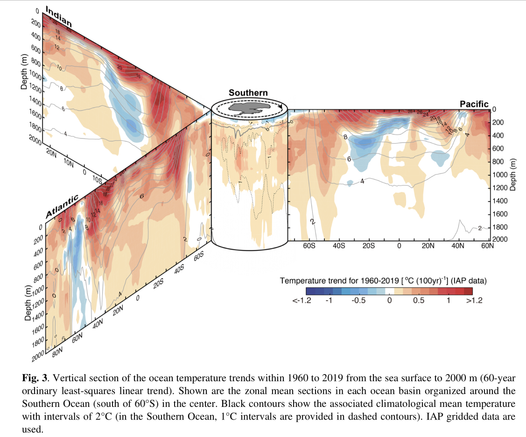
The God Of Ocean Heat Uptake, Lijin Cheng, often visualises trends in this cool chart https://link.springer.com/article/10.1007/s00376-021-0447-x
As free PDF https://link.springer.com/content/pdf/10.1007/s00376-020-9283-7.pdf
What the chart tells me: The ocean basins do not take up heat uniformly. There are local or regional mechanisms at play that cause stronger or weaker uptake into lower layers. Could be things like mountain ranges on the sea floor that enable updraft, like they do on land with air parcels?
Whether, as you hope, some of the mechanisms might accelerate or get stronger as the climate warms further is beyond my shallow grasp. I guess, for most of the oceans, they continue at the same pace of heating up as the atmosphere.
And leave Dead Zones in Exxon's wake…
 aspragg
@rahmstorf Yeah, I'm struggling to understand why it's "bleaker" that the oceans have a higher heat capacity than the atmosphere? Or if it's only the case "at present" that "humans and other life forms on the surface directly suffer only a small fraction of that energy", how is this expected to change in the future? And why?
 Lord Caramac the Clueless, KSC
@rahmstorf If any humans survive this madness at all, they will be living in a damaged world which doesn't support large population and civilisations, only small tribes. And they will be telling gruesome tales of the Machine Men who tried to live outside the real world in a fake one they built, until the fake world had eaten almost all of the real world and fell apart.
 Qole
Qole@rahmstorf @dgoldsmith
The problem is that the leaders here in Canada have stopped talking about the climate crisis. They don't mention it in their election platforms. And people voted for the leader who promised to roll back carbon taxes. I don't think that the leaders are worrying about it at all. 😕
The problem is that the leaders here in Canada have stopped talking about the climate crisis. They don't mention it in their election platforms. And people voted for the leader who promised to roll back carbon taxes. I don't think that the leaders are worrying about it at all. 😕