 ReylanWolf
 Massimo
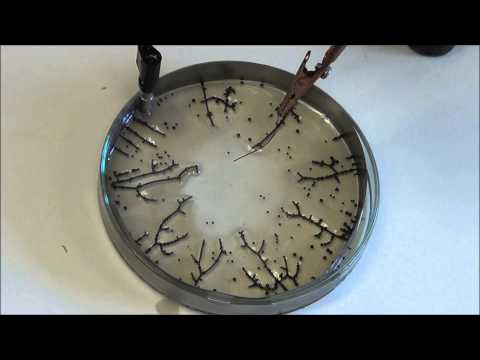
If you take a Petri dish, castor oil and some ball bearings and put all in an electric field, you might happen to spot an interesting behavior: self-assembling wires who appear to be almost alive
[📹 Stanford Complexity Group]
If you take a Petri dish, castor oil and some ball bearings and put all in an electric field, you might happen to spot an interesting behavior: self-assembling wires who appear to be almost alive
[📹 Stanford Complexity Group]
here is a more detailed video of the experiment - you need 20 000 volts for it to happen - it is likely that magnetic fields are attracting the balls, although the paths they take are still under investigation (unfortunately Professor Alfred Hübler passed away in 2018).
It *is* possible to try it at home if you can get a 20 kV supply and have the space and knowledge to do the experiment safely 😉
@vfrmedia @shadowdancer @Rainmaker1973
The overlap between complexity theory and chaos theory must be fascinating.
Eagerly awaiting more papers on these subjects!
@vfrmedia @shadowdancer @Rainmaker1973 Before there is the connecting path there is no current so no magnetic fields. The conducting balls are moved by electrostatic fields. Those fields change when the balls move and touch.
Then when a connecting path is formed (percolation) maybe the magnetic fields are strong enough to move the balls in a different direction so that the path gets broken up again?
yikes!!!!!
 Netraven
 panu
panu Alex@rtnVFRmedia Suffolk UK
 Nicole Parsons
 mrg
mrg Pieter Kuiper 🌍🇳🇱
 Mx. Chara Aznable (they/them) of Pnictogen
 rtn
rtn Lazarou Monkey Terror 🚀💙🌈
 Embrace Civil Disobedience
 peachfront
 viernullvier
 Willow 🏳️⚧️🏴🇵🇸
 Pino Carafa
 955_36
 Adrian W
 bit101
 TripTilt /// tt