 TheReturnOfPEB
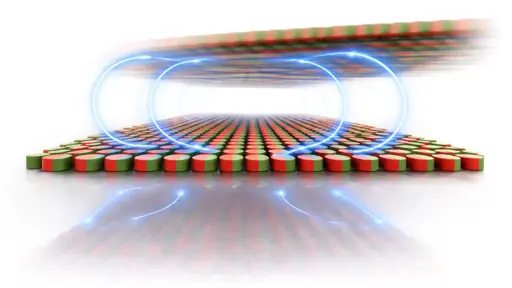
Friction without contact discovered as magnetic forces break a 300-year-old law
 neidu3
Is it really friction, though? It seems to more like a case of one layer inducing mechanical work in the other, which in turn results in loss of efficiency due to inertia and actual friction within the layer.
In other word, I read this akin to an inductive coil moving through a magnetic field and drives a motor with a load. This will cause the coil to resist the movement, but it can hardly be called friction.
 Zachariah
My uneducated understanding/intuition: Mechanical resistance to movement between two surfaces that touch. This resistance is partially caused by imperfections in the two surfaces that cause the surfaces to slightly mesh. Also, partially, I am sure there’s some electromagnetic laws at play on the molecular level that resistance the movement.
You brushed against the real truth there. Haha. Stupid joke, sorry.
The truth is that surfaces never “touch”. How do you touch an atom? Even an atom in a tight lattice or molecule is held in place only loosely by electromagnetic forces. The electron shells are a convenient idea more than they’re real, they’re not a real boundary for another atom to bump against. And the nucleus is so much tinier than the innermost shell it’s hard to wrap your mind around.
Basically, surfaces don’t truly exist. In reality the surface is just a fuzzy area where things are limited in how close they can get before the forces between the electromagnetic layers push back.
So friction is just when one electromagnetic fuzzy thing interferes with another electromagnetic fuzzy thing’s lateral motion, and that interference atom to atom creates movement in the lattice of each which creates heat.
This finding is just that in special circumstances those electromagnetic fuzzy things can be a lot further apart when they interfere with each other.
 teft
teftThis finding is just that in special circumstances those electromagnetic fuzzy things can be a lot further apart when they interfere with each other.
Reading the article it seems this research is about Amonton’s first law which is about the way friction increases with load. This experiment shows that in certain scenarios the friction can be low when the distance is close or far but at a medium distance (not sure the exact distances here) the friction increases thus breaking Amontons’ first law.
 Impronoucabl
Sorry, I’m still not seeing the merit in this article/paper.
This finding is just that in special circumstances those electromagnetic fuzzy things can be a lot further apart when they interfere with each other.
I don’t see what’s new? Bulk magnetic forces vs atomic magnetic forces have been known to have different strengths for a very long time now.
I refer you to @[email protected] 's excellent summation. My conclusion on the meaning of the research was faulty.
It seems more like a case of one layer inducing mechanical work in the other, which in turn results in loss of efficiency due to inertia and actual friction within that layer.
Now, define friction.
I know that sounds like just a pithy response without much thought put to it. But actually, that may be what friction is. I’ll also note that nothing about physics and the interactions of matter is actually as intuitive as it appears. For example one might say, “well friction is when two materials touch and rub against each other” but remember, materials never actually touch, the molecules of each material are only ever near each other at best. So what is happening that causes that resistive force?
The atoms repelling each other via the strong nuclear force… is that what causes resistive force? I don’t know, just asking,
Yeah, I think that pushes them apart, keeps them from actually occupying the same space. So that’s definitely involved. But why does dragging molecules past each other cause them to lose momentum? I could make a guess, but I’m not actually certain. Like I said, physics tends to be pretty unintuitive at this scale.
(Technically I suppose they’re exchanging momentum for heat)
I have a private theory that it’s just fields all the way down. E.g., no electrons (as in separate things), just observable points in the one electromagnetic field. This helps me intuit the idea that energy transfers between things — with “transfer” simply being a kind of interaction between separate fields.
Electrons moving past each other slowing down? Can that be reproduced with an electron gun, or would this be based off a larger mass that includes other subatomic particles as well?
That is string theory fyi
 Paranoid Factoid
Atoms repel by electrostatic forces. Essentially, electro-magnetism. The strong nuclear force acts on subatomic particles distances far shorter.