 Possibly linux
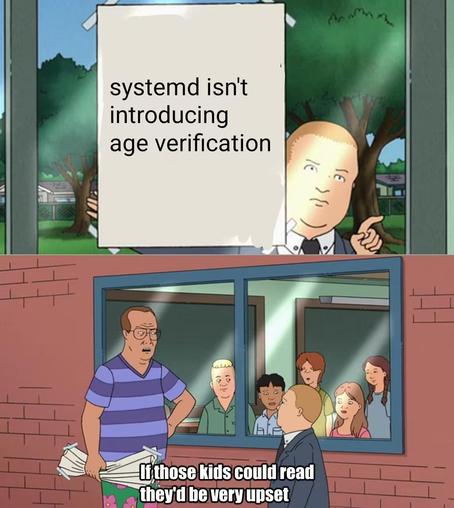
You guys fell for clickbait
The source is the source: github.com/…/acb6624fa19ddd68f9433fb0838db119fe18…
Takes a birth date for the user in ISO 8601 calendar date format. The earliest representable year is 1900. If an empty string is passed the birth date is reset to unset.
That’s it. That’s all it does.
Whatever was discussed in the PR, the code does precisely nothing to implement any kind of verification. It’s just an optional birth date field, like tons of electronics have had forever.
it’s in one place that any third party can reference.
But why would I want that?
Even if you ignore the whole “this doesn’t verify anything” discussion, why would I want to give third parties easy access to personal and potentially sensitive information? I personally am not interested in simplifying data collection for corporate entities who definitely do not give a shit about the safety of my personal data, let alone hypothetical children. I do not know why this data collection needs or would be desired to be implemented within systemd, besides being a direct response to age verification laws saying its an OS providers responsibility to collect it. Arbitrary data collection by private entities is not “useful”. My personal data has no business being referenced by random asshats that ask for it. There are so few things in the world that “justify” needing my age that I would suggest it would be easier to make my birth date a permanent data point on my PC. Same goes for the other personal details that systemd already supports. Crazy to imagine anyone actually using those on a personal machine.
I’m Jeremy from System76. We are in talks with legislators and there are likely to be amendments to the age verification bills, as well as conflicting requirements in different jurisdictions. It may even be the case that open source operating systems are exempted entirely. I detailed this on the xdg mailing list here:
https://lists.freedesktop.org/archives/xdg/2026-March/014797.html
I have other concerns about this specific implementation. By relying on systemd, which is decidedly unportable to non-Linux operating systems, and not used across all Linux operating systems either, it will force at least one alternative implementation to exist. If these implementations end up having to collect jurisdiction specific requirements, that makes it much harder for complihttps://github.com/systemd/systemd/pull/40954#issuecomment-4032221990
 peacefulpixel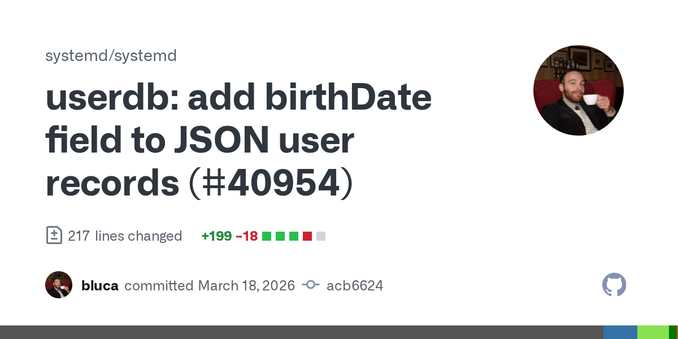
 caseyweederman