"Marginal Pricing" is kinda insane. Why would entire nations agree to subject themselves to it?

"The UK’s electricity market operates using a system known as “marginal pricing”. This means that all of the power plants running in each half-hour period are paid the same price, set by the final generator that has to switch on to meet demand, which is known as the “marginal” unit."

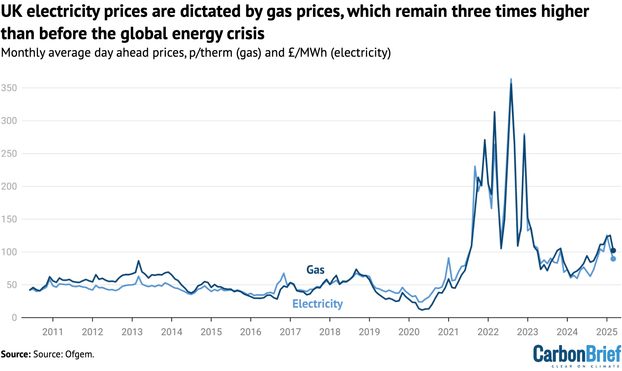
"Natural' gas sets the wholesale price of electricity in the UK 98% of the time."

https://www.carbonbrief.org/factcheck-why-expensive-gas-not-net-zero-is-keeping-uk-electricity-prices-so-high/

Factcheck: Why expensive gas – not net-zero – is keeping UK electricity prices so high - Carbon Brief

The UK’s high electricity prices have become intensely political, with competing claims over the cause of rocketing bills and how best to get them down.

Carbon Brief

And this is why UK households end up paying for their electricity AS IF fossil gas powered the entire nation.

Doesn't matter than Scotland often generates more than 100% of its electricity needs from renewable sources.

Even if fossil gas tops off the last 1% of the nation's electricity, the price for everyone is set by that.

It's insane.

https://www.carbonbrief.org/factcheck-why-expensive-gas-not-net-zero-is-keeping-uk-electricity-prices-so-high/

That doesn't sound like "energy security" to me.

"UKERC estimates that, despite only supplying a third of the country’s electricity, gas-fired generators set the wholesale price of power around 90% of the time in 2025.

A surge of new clean power means that gas would only set wholesale power prices 60% of the time by 2029, UKERC says, adding that this would cut the nation’s exposure to “gas price shocks”. "

https://www.carbonbrief.org/expensive-gas-still-biggest-driver-of-high-uk-electricity-bills-says-ukerc/

Expensive gas still biggest driver of high UK electricity bills, says UKERC - Carbon Brief

High gas prices are responsible for two-thirds of the rise in household electricity bills since before the global energy crisis.

Carbon Brief

It makes sense to incentivise the building of renewable generation.

But it was done in a gas-brained* way.
"These older schemes, built under a policy known as the “renewables obligation”, are paid a top-up subsidy in addition to the wholesale power price, linking their receipts to high gas prices."

That made sense when gas was the dominant source. But now? Just a third, and hopefully dwindling.

This scheme needs a sunset.

* like car brain but for fossil gas

"UKERC argues that the government [needs to shift] older renewable plants onto fixed-price “contracts for difference” (CfDs).

Newer renewable projects with CfDs get a fixed price, which is not linked to wholesale electricity prices or the price of gas power that drives it."

Still an incentive, but not a crazy incentive.

https://www.carbonbrief.org/expensive-gas-still-biggest-driver-of-high-uk-electricity-bills-says-ukerc/

And then households can celebrate the building of more clean energy generators: that will, finally, lower their bills.

Expensive gas still biggest driver of high UK electricity bills, says UKERC - Carbon Brief

High gas prices are responsible for two-thirds of the rise in household electricity bills since before the global energy crisis.

Carbon Brief

Right now, this is the bottom line:

“It is still true that higher gas prices are the main reason for higher energy bills for most British households when you look at the whole bill. Gas is not the only culprit, but it is still the biggest one.”

https://www.carbonbrief.org/expensive-gas-still-biggest-driver-of-high-uk-electricity-bills-says-ukerc/

Ditch the gas.
Get lower electricity bills.
Lower healthcare bills.
Less climate damage.
Lower home insurance bills.

Just ditch the gas.
It's too expensive.

Expensive gas still biggest driver of high UK electricity bills, says UKERC - Carbon Brief

High gas prices are responsible for two-thirds of the rise in household electricity bills since before the global energy crisis.

Carbon Brief

In Europe also,
"Wholesale electricity prices are determined by the most expensive fuel needed to meet demand, so using even a small amount of expensive gas or coal means bills can balloon.

But: Gas is only needed to cover demand during 15 percent of an average day in Spain, compared to nearly 90 percent in Italy.

“When gas only drives your electricity price 15 percent of the time, a sudden 50 percent-plus spike in gas costs barely registers,” Rosenow said."

https://www.politico.eu/article/spain-low-energy-bills-eu-domestic-power/

What the EU can — and can’t — learn from Spain’s low energy bills 

Madrid says a renewables boom is shielding its citizens from soaring fossil fuel costs. But that’s not the full story.

POLITICO

If European governments are serious about helping families with their energy bills, they need to restructure how the wholesale price of electricity is set.

“We generate about 90% of our annual consumption from renewables,” said Austrian Chancellor Christian Stocker. “But we pay the price for electricity as generated by gas power plants. That’s almost twice as much.”

If gas contributes 10% of the electricity mix, why, WHY should it determine 100% of the wholesale price?

https://www.politico.eu/article/spain-low-energy-bills-eu-domestic-power/

What the EU can — and can’t — learn from Spain’s low energy bills 

Madrid says a renewables boom is shielding its citizens from soaring fossil fuel costs. But that’s not the full story.

POLITICO
@CelloMomOnCars exactly the same situation in Scotland, where we generate 130% of our electricity consumption from renewables, but our price is calculated using the astronomical cost of electricity generated from gas.

@peterbrown @CelloMomOnCars

The truth is, the people of Scotland should be paying nothing for electricity. NOTHING. No monthly electric bills. The revenue from the sale of the unused 30% of electricity generated is enough to reduce the cost to those living in Scotland to zero.

@mark_ohe @peterbrown

Honestly the situation in Scotland is how I first learned about how the insane way the electricity rates are set.

But now I'm finding that it's the same all over Europe.

There must be some rationale for doing it that way, but right now utilities need to step away from that, even if temporarily. You'd think they would learn from gas prices spiking from the Ukraine war.

@CelloMomOnCars @peterbrown

You probably follow, or are aware of, Chris Nelder and his podcast, The Energy Transition Show? I’m no expert but I’m almost certain Nelder has explained this in easy to understand terms at some point. Probably an early episode. There are over 200 at this point.
https://www.podbean.com/podcast-detail/z9avg-3f74c/The-Energy-Transition-Show-with-Chris-Nelder-Podcast

The Energy Transition Show with Chris Nelder Podcast | Free Listening on Podbean App

Straight talk about the world’s transition from fossil fuels to renewables with energy expert Chris Nelder

@CelloMomOnCars @peterbrown

Again, no expert here, but I think in a nutshell the price of electricity is (maddeningly) based on the price of baseload backup power. The backup power for wind or solar (only when needed of course, which can be almost never) is often supplied by electric generators fueled by methane gas. Sometimes nuclear, but nuclear can often not ramp up quickly enough. This a big part of why renewable advocates push for battery backup solutions.

@CelloMomOnCars One side effect from the war will be that so many countries other than the U.S. will pivot away from fossil fuels.