Thalia Archibald
It's serial debugging day!
I need to get at least one of these teletypes working over RS-232 with UNIX V4 and V7 in SIMH. The SIMH docs are notoriously bad. Help would be appreciated.
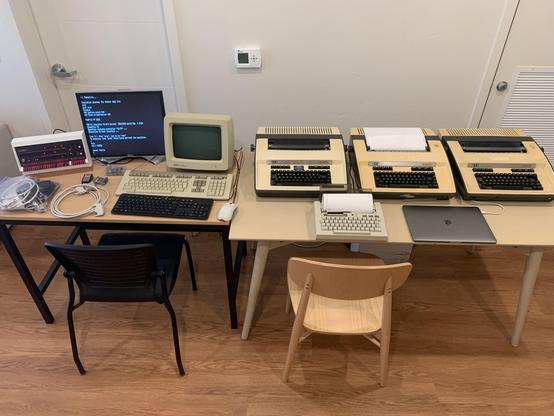
It's serial debugging day!
I need to get at least one of these teletypes working over RS-232 with UNIX V4 and V7 in SIMH. The SIMH docs are notoriously bad. Help would be appreciated.
@thalia I have. And the answer is ... complicated. It's very hard to connect the caps-only Teletypes to modern Linux machines, because modern versions of getty (and maybe the Linux terminal driver?) no longer support case conversion. You can use older Linux distributions (perhaps which virtual machines) to achieve this; certainly up through the mid-2000s this was still supported.
1/
@thalia The Silent 703 is easier. I have a symlink on one of my machines from /etc/systemd/system/getty.target.wants/[email protected] to /etc/systemd/system/[email protected], and it Just Works for serial logins at 9600 baud (which the VT100 on that port is configured for). Other baud rates require editing the config file; copy that file and change the agetty command line (for the Silent 703, use /sbin/agetty 300 %I ti703).
2/
@thalia I didn't reply to the SIMH question because I don't rightly remember, but I don't recall it being difficult once I figured it out. You will certainly need to be in the dialout group on Debian-derived distros (or whatever passes for that on your distro), and you need to edit the simh configuration. I want to say it's something like SET DLI1 SERIAL=/dev/ttyS0, but I don't remember for sure.
3/
@thalia I know I had to read quite a few different bits of SIMH documentation, and I don't think the hints were in the PDP11 documentation at all. It turns out the PDP11 serial port stuff delegates almost all of the work to core SIMH functionality that actually supports more options than the PDP11 stuff seems to indicate. Look around in SHOW SERIAL, HELP ATTACH, SET DLI, etc. and see what you can find. I also think some of the help strings were wrong?
I realize this is not super helpful.
4/
@thalia I vaguely recall that the PiDP-11 Pi OS images had some .ini files that were helpful to me in this quest.
Final note -- your other bane will be parity! For connecting to Linux directly, agetty has no parity configuration and CLAIMS to figure it out on its own, but it's not very good at it. It can matter what key you hit first!
5/5
@me_ All of my teleprinters use RS-232 over DB-25 and can communicate with my Raspberry Pi using `screen`, to some extent. My 703 works most reliably. My 43s have various issues, but still appear to be RS-232.
There were several variations of the 43. Teletype Model 43 KSR AAC and AAD use RS-232C (see https://bitsavers.org/communications/teletype/43/368_43_Teleprinter_Installation_and_Routine_Servicing_Basic_KSR_Terminals_Mar78.pdf, page 7). I think parts were swapped in mine, so I'm not sure which sub-model numbers I have, but they all have DB-25 connectors, which, from what I've seen, indicates RS-232 (as opposed to modem use).
nice Pi-dp11
(I'd love to have an 8 for the stylish colours)
@thalia this is relevant to my interests! should i be surprised simh docs are not fit for purpose? no! i found https://github.com/simh/simh and cruised around, you've got your work cut out for you.
i used some intel computers as dumb terminals and xterminals in the 90s when my bff and i lived in chicago. he had a dual pentium pro that everything connected to. felt like running a real enterprise as a 20yo heh never had an actual teletype in my hands though.
 Ethan Blanton
 Michael Engel
 Rob Norris
 Luca Sironi
 Emory
Emory Space Hobo