 fossilesque
That's how the world works.
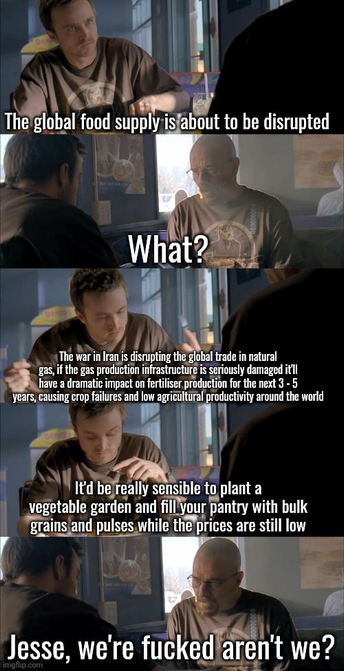
just a reminder that none of us can sufficiently “doom prep” and avoid the consequences of large catastrophes like those being discussed
beyond typical disaster preparedness: www.ready.gov
probably the best thing would be to develop community ties - get to know your local weirdo farmers doing a CSA, make friends with EMTs, get to know your neighbors, get connected with a local community garden, etc.
We will survive or die together, individual prepping is not going to save you.
EDIT:
to more directly answer the question of what should be in your emergency kit, and how much food to store:www.ready.gov/kit The basics: - Water (one gallon per person per day for several days, for drinking and sanitation) - Food (at least a several-day supply of non-perishable food) - Battery-powered or hand crank radio and a NOAA Weather Radio with tone alert - Flashlight - First aid kit - Extra batteries - Whistle (to signal for help) - Dust mask (to help filter contaminated air) - Plastic sheeting, scissors and duct tape (to shelter in place) - Moist towelettes, garbage bags and plastic ties (for personal sanitation) - Wrench or pliers (to turn off utilities) - Manual can opener (for food) - Local maps - Cell phone with chargers and a backup battery The extras: - Soap, hand sanitizer and disinfecting wipes to disinfect surfaces - Prescription medications. About half of all Americans take a prescription medicine every day. An emergency can make it difficult for them to refill their prescription or to find an open pharmacy. Organize and protect your prescriptions, over-the-counter drugs, and vitamins to prepare for an emergency. - Non-prescription medications such as pain relievers, anti-diarrhea medication, antacids or laxatives - Prescription eyeglasses and contact lens solution - Infant formula, bottles, diapers, wipes and diaper rash cream - Pet food and extra water for your pet - Cash or traveler’s checks - Important family documents such as copies of insurance policies, identification and bank account records saved electronically or in a waterproof, portable container - Sleeping bag or warm blanket for each person - Complete change of clothing appropriate for your climate and sturdy shoes - Fire extinguisher - Matches in a waterproof container - Feminine supplies and personal hygiene items - Mess kits, paper cups, plates, paper towels and plastic utensils - Paper and pencil - Books, games, puzzles or other activities for children Probably most people already have a pantry with several days of non-perishable foods - think canned foods, etc. Make sure that you are rotating your food - don’t have a separate cache as your “emergency food”. Instead, have a backstock of foods you already eat, and continue to rotate and eat from your pantry so you don’t create waste by purchasing “emergency food” you never eat and then let go bad in your pantry. You might ensure that you could feed 2,000 calories per person in your household. White rice is around 1600 calories per pound, so a 10 lb bag is 16,000 calories, so that’s 8 days of 2,000 kcal per day (obviously you wouldn’t eat just white rice, ideally beans and rice would be paired together). It depends on what you already eat, but I eat plenty of beans and have a decent stock of dry and canned beans, as well as rice. I probably have more than 8 days of food in my pantry, which is sufficient for emergency preparation. Also note that refined foods store better than “whole” foods - so white rice will last longer than brown rice, bleached white flour will last longer than whole wheat flour, etc. (It’s because refined foods tend to just have the carbs extracted from the food; whole foods have more natural components like oils that will go rancid, etc.). So when you buy whole foods, buy smaller amounts and rotate through them faster. Don’t buy a 10 lb bag of brown rice for just you and a partner, maybe buy a small 1/2 lb bag or less.
Individual prepping is only meant to bridge the gap between distaster and community or national assistance/cooperation.
So have some emergency food, water, but prepping properly is actually things like learning to garden well, save seeds, learn to preserve, learn how to forage, build community connections.
Gardening and foraging won’t get you anywhere if you live in an urban area. You need an absurd amount of arable land per capita if you want to survive. A vegetable garden is useful in times of war not for raw calorie input but for supplements (either for specific nutrients not commonly found in rationed food supply or for taste).
The good news is that food production is a “solved” issue. Any industrialized country is capable of producing enough calories to feed itself and then some, even without gas imports. Worst case you just stop growing bioethanol and beef to double the amount of available arable land at no tangible human cost.
Those who’ll get fucked by Trump’s war are not Americans or Europeans, it’ll be poor economies that can barely support industrial agriculture in the best of times. Their ability to buy fertilizer is very price-sensitive, which we already saw in 2022, though at the time the US had leadership willing to intercede and guarantee grain shipments.
This time, millions will die, but not in a prepper fantasy kind of way, but in a “they live in a ‘shithole country’ and we won’t care to help because our money finances ICE and bribes now” kind of way.
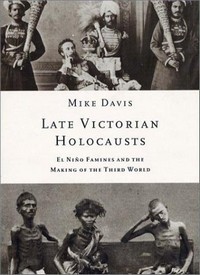
I think this somewhat ignores the way markets kill people during times of famine - see the Late Victorian Holocausts or the Great Famine, in both of which there was plenty of food available, but the problem was the introduction of markets and artificial austerity measures that failed to distribute food to people dying of famine
so, food production might be a solved issue (I think that’s a bit more debatable given soil degradation and the threats to supply chains necessary for the industrial inputs needed to keep those food production systems going in their current, post-Green-Revolution format), but the distribution issue has not been solved and will likely result in many of us dying due to lack of economic power to afford food that will simply expire and rot in storage and then be destroyed and disposed of in a way that denies us access to the waste
Both your examples are pre Haber-Bosch. Not that it entirely invalidates your point, but daily calorie consumption for a Westerner is orders of magnitude cheaper than it was for a Victorian coal miner. In fact what we generally struggle with nowadays in rich countries is an overabundance of (poor quality) food.
It’s not out of the question for poor people to lack calories in rich countries, but that’s a monumental policy failure. And critically it happens to socioeconomic classes that have neither the time nor the land area to dedicate to things like doomsday prepping (i.e. poor and marginalized communities in urban areas). The only solution to food insecurity is social programs, not doomsday prepping or grain hoarding.
I guess my point was more that in both cases of the Great Famine and the Late Victorian Holocausts, there was sufficient food in storage to feed the people dying of starvation - it was the introduction of markets and the resulting false austerity that prevented the otherwise typical food distribution systems during times of famine from happening, and then lots of deaths occurring. In a sense markets are a policy choice to let the poor die. If you can’t afford food, you do not deserve to live. That is the logic of capitalism.
So my point is that even if we see food production as “solved”, we shouldn’t forget the problems of food distribution - and sure, they’re related, to your point over-production (through the development of fertilizer and other industrial methods of food production) under capitalism we can reduce prices and make distribution more accessible, … but when production occasionally fails, it is the economic system that starves people first (not necessarily the lack of food, which can also happen as in the cases of many other famines).
In pre-capitalist societies when food production failed, stocks of food were usually released and distribution was ensured in ways that marketized & capitalist societies have not done (where for example in Syria around the time of the Arab Spring, we saw grocers dying from starvation because they couldn’t make enough money selling food to afford to buy food for themselves).
And yes, starvation when food is abundant is a monumental policy failure - this is something we should be driving home more to people, that the US chooses to have starving and homeless people as a policy choice.
Completely agreed that social solutions are the only way to solve food insecurity, individual action like doomsday prepping is a distraction that primes us to victim-blame people who die for not “preparing” adequately.
 Emi
Emi dandelion