Serious ask:

I need a crash-course in AI.

Context: my line manager has been asked to evaluate the use of AI at work. He's come to me to ask if I want to help, as he knows I hate it (and he does too), but I'm...vaguely aware...that not all things that are called "AI" are equal.

(like, the "AI" of NPCs in a game is not the same as the "AI" used to create the type of image we generally call "slop", right?)

We want to make sure we're armed with decent knowledge, because we don't want people to say "Oh, ignore them, they're just haters" if we're talking about something that maybe isn't the "bad" kind of AI (if such a thing exists - I don't know enough to be confident right now)

At the moment, *to the best of my currently limited knowledge*, our AI usage is pretty much limited to people using Gemini to create emails and transcripts of meetings.

(I hope that makes sense)

@neonsnake The world of AI is much broader than Generative AI. If there's a use for directed neural nets, machine learning, computer vision etc then be open to it. One way of shutting down being a forced sloperator is to use other AI where appropriate to "tick the box"

@ingram Thank you

Would you be able to explain "neural nets, machine learning, computer vision" in VERY layman's terms to me?

And would it be possible for me - not very techy - to recognise them vs LLMs?

@neonsnake I'm not an expert, or even moderately skilled in the areas but have been to a course...

Neural networks have "weights" been neurons and the different methods have different ways of determining the weights. The undirected nets are basically self guided with a set of inputs and known outputs. The computer figures out based on probability. This is how a computer knows if the photo is a dog or a cat etc, or if cells are cancerous or normal.

(1/3)

@neonsnake In my opinion AI tools are best suited for interpolation working within the known things. Gen AI extrapolates and that's where the hallucinations happen.

The AI tool I've found most useful is audio transcription. I run the Whisper model on my low end Nvidia GPU and it turns rough audio into surprisingly good text.

Image classification and computer vision to identify good/bad products on a manufacturing line is another good use.

(2/3)

@neonsnake It's technical but the WP page on Neural Nets is good. https://en.wikipedia.org/wiki/Types_of_artificial_neural_networks?wprov=sfla1 (3/3)
Types of artificial neural networks - Wikipedia

@ingram "Image classification and computer vision to identify good/bad products on a manufacturing line is another good use."

That makes sense to me - and is also something roughly relevant to what I actually do for a living, so I can picture it a lot easier than some other examples!

Audio transcription makes sense to me as well - am I understanding correctly that "Whisper" is run completely locally?

(not sure if this helps, but it feels a bit like when I used to use Photoshop to remove an unwanted object in a photo, and all of the "clever" stuff was done on my own PC? Is that an accurate analogy?)

@neonsnake Yes, you can run Whisper locally. I use pinokio to run it, and it's pretty much point and click. I think it runs on CPU alone, but Nvidia GPU makes it faster.
https://github.com/pinokiofactory/whisper-webui
GitHub - pinokiofactory/whisper-webui: Pinokio Installer for Whisper-Webui

Pinokio Installer for Whisper-Webui. Contribute to pinokiofactory/whisper-webui development by creating an account on GitHub.

GitHub

@neonsnake @ingram Wiki has a good overview. Machine learning is the automated statistical analysis of existing data that allows you to perform tasks on new data without explicit programming. eg: by looking at x-rays of people with and without cancer being able to look at new x-rays and determine if the person has cancer or not. ML has been done for decades and there are many techniques.

https://en.wikipedia.org/wiki/Machine_learning

Machine learning - Wikipedia

@neonsnake @ingram Neural networks are a type of ML which roughly simulates how the nerves in a brain works, using clever tricks to establish the correct "connections" between nerves. Machine vision is a broad range of techniques used to analyse images and extract meaning from them, typically via neural networks. LLMs are _very_ large neural networks that allow you generate text that is a likely response based on an input prompt. "Spicy autocomplete".
@neonsnake @ingram So LLMs and chatbots are a subset of ML. The question is what are you trying to achieve and how might machine learning help you.

@bjn @ingram

"Machine learning is the automated statistical analysis of existing data that allows you to perform tasks on new data without explicit programming"

Crikey!

@neonsnake @ingram ML can be anything from very simple curve fitting that allows you to estimate an output for a new input value, to the insane complexity of an LLM. The wiki article is a nice overview.

@bjn @ingram

Sorry, but I don't know what "curve fitting" means in this context. I'm not able to use this in a conversation in the context of my original post.

Linear Regression in Machine learning - GeeksforGeeks

Your All-in-One Learning Portal: GeeksforGeeks is a comprehensive educational platform that empowers learners across domains-spanning computer science and programming, school education, upskilling, commerce, software tools, competitive exams, and more.

GeeksforGeeks
@bjn @ingram I dont know what that means.
@neonsnake @ingram Read the link I provided.
@bjn @ingram how much do you know about supply vs demand and how it manifests itself in promo cycles?

@bjn

Can you let me know please, as this is really, really important to the context within which I asked the question, as per my original post?

@ingram

@neonsnake @ingram It’s not a thing I have more than a passing understanding of sorry. My background is elsewhere. I’m not at all sure what background reading to suggest.

@bjn

Of course. No worries.

@ingram

@neonsnake as you've alluded to "ai" is a very vague term. but most commonly it now means llm-as-a-service. all the other "ai" types: general automations, machine learning, ... have their place and should be used as needed. an LLM (large language model) is a a statistical model of language tokens (not words but that's close) that is used to generate a statistically plausible response to an input
@neonsnake so if you care about the text you produce being more than statistically plausible you should avoid it. that's just the very basic technical view, the social, political, environmental, and ethical issue would take much longer. i recommend the book "the ai con" as a starting point

@mensrea So, I'm "reasonably" aware of the arguments against LLMs (with undoubted huge blind spots), in as much as I know that the output is questionable at best, and I have a base level of understanding of the ethical and social issues with it (which is why I don't like it).

I'm more worried that I'm going to have a reflexive "AI! NOPE!" reaction to something - you and someone else have both mentioned "machine learning" as something potentially useful, but I'm not sure I know what that is?

@neonsnake so LLMs are a facet of machine learning, which is a facet of data science, ... . but because you're looking at the expanded tool kit, you can find better tools for the job. that only holds true if you're looking at a technical problem though. if the problem is "writing emails better" you have a cultural problem and no tech is a solution
@neonsnake and i forgot to mention the legal unknowns of copyright, liability, and so on of any generated text

@neonsnake It’s probably worth saying a bit about the history.

AI as a field gets started in the 50s at the same time as control theory and cybernetics with a lot of cold war funding. It has a weird relationship with psychology.

There are two broad approaches ‘expert systems’ and ‘neural networks’ which dominated at different periods.

So the ‘perceptron’ neural net was invented in 1958 and is in direct continuity with the deep learning of the 2010s and LLMs of today.

So you have:
AI: The field as a whole
Neural nets and learning: Broad strategy
Expert systems: Broad strategy, videogame NPCs are and example of this
LLM: One technique in the neural nets approach
Transformers: Implementation details of LLMs but also used elsewhere

@neonsnake

In the 2010s we had ‘big data’ and the rise of cloud compute, this made learning techniques competitive in a way they hadn’t been in decades since each layer in the network adds lots more computing cost. Models with many layers became known as ‘deep learning’.

This gives you a lot of useful stuff, image classifiers, anomalies detection, NLP, Robotics, generally anything where you can solve a problem by approximating a function.

A lot of the specific techniques that later go into LLMs are developed in this period. The most important is imo the wordsToVec paper that develops embeddings.

@neonsnake

LLMs get started with the transformer encoder/decoder architecture which leads to GPT on one hand and BERT on the other.

LLMs leapfrog existing approaches on NLP tasks but also increasingly on vision.

Embeddings and somantic/vector search take off (This has blackbox bias problems too but is very useful e.g. https://www.leebutterman.com/2023/06/01/offline-realtime-embedding-search.html)

Wikipedia search-by-vibes through millions of pages offline

What is this?

Little Short Bulletins
@RevPancakes I'm afraid I don't know what NLP is in this context - I know the acronym as Neuro-Linguistic Programming, which I'm more than passingly familiar with, but doesn't seem to fit?
@neonsnake sorry it’s Natural Language Processing

@RevPancakes

When I say "layman", I *do* mean "layman" - i'm not quite at putting "how rotate PDF?" as my Facebook status, but...I'm probably close 😜

(far gone are the days when I was programming the VCR for my mum and dad, lol)

@neonsnake haha I din’t want to spam you with walls of text *too much*

So in practice NLP would be: Scanning documents and converting handwriting to text, converting speech to text and text to speech, classifying texts based on various criteria such as emotional tone, generating text, extracting features or summarising text, various things from linguistics that I don’t understand

@RevPancakes That makes sense, and feels like it's done locally.

(FWIW, I'm of an age where I used to be able to dick about with the config.sys and autoexec.bat to get it to run X-Wing, but when people talk about BERT, I'm thinking "is that the Muppet?" 😂 )

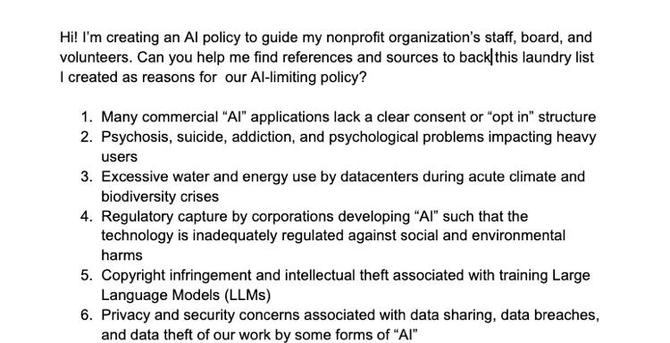
@neonsnake adjacent to what you asked for, but this is someone doing similar at their workplace and made a nice, concise list of reasons one might want to avoid AI use. It's very broad, but could be a great starting-point for reading more? There's a LOT of good links in the comments.

https://alaskan.social/@seachanger/116281340936546500

wet forest moon folklorist (@[email protected])

Attached: 2 images I’m working on an AI policy for my org that allows us to opt out of AI note taking and prohibits AI in our comms/storytelling. here is my list of reasons for the policy, but my board is asking me to cite sources. Can you help me with any good references you would cite for any of these? (Or an edit or restatement where I’ve gotten it wrong or inaccurate?) *if you want to argue about why I shouldn’t have this policy kindly crawl into a hole in the ground and cover yourself with soil

Alaskan Social

@xanna
@seachanger

This is really, really helpful - thank you!

The more technical explanations from some of the other folks (and thank you all, that's a lot of work you've all put in to help me!) are going somewhat over my head, but the general gist appears to be that the output is *at best* shoddy - which is something I sort of "knew", from memes like the "doctors say to eat two rocks per day", but it's really helpful to understand "why".

From what I've gathered, here and from earlier conversations I've had, it's because it just *cannot* assess for accuracy, only for "plausibility".

In the case of supply and demand planning, that's not actually a problem - even the best human planner in the world can only ever get to "plausible". I'm not sure if LLMs of the "slop" variety exist to do this, I'm thinking not. For now, without further info, it feels like this might be "machine learning", which a couple of folks have noted as being materially different.

Given that I work for a company owned by venture capitalists, the "ethics" argument is going to be tricky at best.

BUT - there's two on here that feel usable; 6 and 10. Data breaches and theft? Hellz yeah, I can sell that. That puts "us" on the hook, legally.

10, also - it doesn't save time.

One of the uses that has been suggested is to write "copy" (think: specifications, features and benefits etc), which we currently do manually. If we end up spending more time in checking and correcting then it's a waste - I also suspect that we won't pick up all the errors - with the best will in the world, people are just going to click "accept" when busy, which is also hugely problematic and could, again, leave us on the hook legally.

Thank you to both!

(and everyone else who has contributed)

@neonsnake oh good, glad it was a helpful thing to connect. Good luck!

@xanna Thank you - fingers crossed.

I think it's going to be damage control. I think that we just *are* going to end up using it, at best my manager and I might be able to limit it to hopefully the "least bad" versions.