 timberwraith
I have no issues with celebrating the death of a terrible person.
None at all.
I have no issues with celebrating the death of a terrible person.
None at all.
I learned that lesson with my father's passing.
His bigotry and emotional abuse kept me living in fear. It would have been years more before I ever came out and moved forward in my life as his transgender daughter.
There was a strong likelihood that I would have been physically in danger from him if I had come out while he was a live.
He died 37 years ago this month.
I celebrate his death.
I celebrate his death because my life was made possible by his passing at the start of my adult years
If he had continued to live, I might have taken my life. I was severely depressed in the years leading up to his death. That cleared after he passed away and I was able to come out for the fist time in my life and simply be myself.
I celebrate his death.
Sometimes, when a terrible person stops drawing breath, the world becomes a better place, if only by a small degree.
And if so, that death held a positive outcome and a positive meaning.
Something worth celebrating, I think.
So, I don't begrudge others when I see them celebrating the passing of a terrible person.
I understand. I've been there. The passing of a terrible person shaped my life in profound ways. Good ways.
Let us raise a glass to the passing of scoundrels, to the perishing of foul people with foul hearts.
In their passing, we get to live another day. Hopefully better days.
Postscript:
What function does this response serve, emotionally?
It helps me personally lay down a boundary against my abusers, past and present. I acknowledge that they hurt me, and I acknowledge that my life is made better in the absence of their harm.
And this is a way in which I push back against the sentiment that one should not speak ill of the dead.
Let us tell the full story of the dead. Do not hide their awfulness out of respect for a corpse in a box at the head of the room.
If they did foul deeds, let us spill out the full tale of those they hurt. Bring forth an accounting for a life lead in abuse and violence so that other abusers may take note.
You will not be remembered with kindness. We will push back and oppose others like you in your memory. Let there be no others like you.
If the dead did ill in their lives, speak ill of the dead.
One does not earn respect for a disrespectful life just because one stops breathing.
And why not celebrate life by celebrating the passing of someone like this?
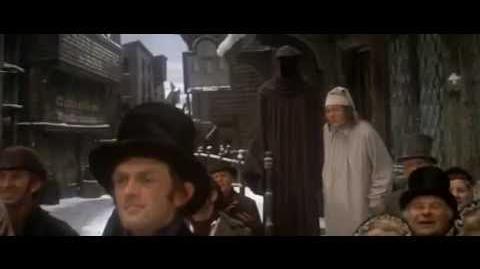
"Thank You Very Much" is a song from Scrooge. In the Christmas Yet To Come sequence, Scrooge hears a crowd singing it, with the bouncy tune causing him not to realize they are celebrating the occasion of his death. Scrooge thinks instead from misheard talk that this song is in jaunty tribute to him, instead of release from the debts owed to him (or in some versions, at least the transfer of these debts to a less odious lender). At the end, after his reform, the same man who would have begun...
 gnaddrig
 cwicseolfor
 anniethebruce