 fossilesque
Wonder what their cousins liked to snack on...
“Feen” is slang that means to want something obsessively or to have a strong desire for it.
fiend An evil spirit; a demon.
I guess both would be correct
Oh, what a good rabbit hole!
I use fiend in exactly the same way: “I’m fiending for a cigarette,” etc.
Yeah, in think I remember them not being lizards but something close, right?
The other part of my comment is still true though.
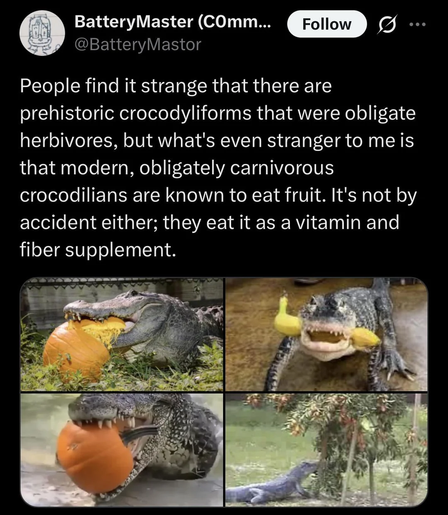
Interesting! But how do we know the crocs eat the fruit specifically as mineral or fibre supplement and not just for sustenance or for the fun of death rolling a pumpkin?
And how do the crocs know which fruit to eat? I guess for them to eat anything with the intention of being provided with minerals or fibre they need to know their fruits? And how do the scientists know about this?
I have so many questions.
With humans it’s the same (cravings), you need potassium & maybe crave a banana milkshake. If you explore your craving further, eg ask yourself if you would like to drink milk or eat a banana, it might get more clear what you need (it also helps exclude carbs bcs usually we don’t need them, but the self-preservation & long winters of the past usually means most humans don’t have much limit on carbs, bcs why not more of them, just to be safer). It’s a trained skill to some extent, especially in the modern era.
We associate nutrients with food tastes we get from our meals (which are usually a mixture of things & might even be wrong/false with ultra-processed foods).
I have no idea how this works in ancient crocks. Is it a learned (try all the foods when growing up?), observed (yo, why Silly Goose the neighbouring crock eating a jack-o’-lantern), or “instinct” (ie only crocks that ate pumpkins survived)?
… especially given that even the current “true crocodiles” predate squash/pumpkins by 40+ million years :D.
There was a human study in the 1920s by Clara Davis where they followed a group of children in self led eating habits. They offered a range of healthy foods each day and let the kids choose what they ate - generally kids fed themselves a healthy diet with appropriate portions as long as the food offered was healthy. They would even eat fish oil voluntarily and maintained good vitamin D and omega 3 levels.
Now the author never had the opportunity to try it with processed foods or junk foods, so this may not hold true when items specifically formulated to keep you eating come into play. However, it’s entirely possible that the crocodile in the image has some instinct that drives it to eat a healthy diet. Or you’re correct, maybe it is playing and using the pumpkin as a toy, but it is unusual that it would consume it then
I’ve specifically tried to get in touch with my body’s feedback over the past few years, and i’m 100% convinced that the ability to sense what nutrients you get from food and then want that food when you need those nutrients, is a fundamental thing to any animal that can actively seek out specific foods.
My recommendations to get in touch with this ability is to limit snacking and try to get as hungry as possible before eating (so you have a chance to calibrate yourself, feel the difference between eating things out of habit vs actually craving them) and to try as many foods as possible even if you think you don’t like them, in as many different ways of preparation as possible.
There are so many things i thought i didn’t like until i tried them in a specific way, and there are many things i thought i liked but i’ve realized it was a very surface-level enjoyment. These days when i follow my cravings i’m filled with a borderline spiritual feeling of well-being, the food really feels like it’s good for me (and that includes desserts/sweets, because i’m very specific about which ones i like and how much of them i eat).
Yes, I’m totally with you there! For all the recommendations I’ve seen about snacking throughout the day, I have not found that it works well for me to be able to listen to my body’s hunger cues. Similarly, longer gaps between meals seem to promote better self-cleansing of the small intestine, improved nutritional absorption, and better hormonal regulation.
I find there is a big psychological component to food enjoyment as well. If you decide you don’t like a food in advance, you will go in hating it. Make the grimace that a 4 year old makes eating kale and bite into anything - the muscle activation sets off a cascade of emotional reactions that could make you hate your favorite food. I have enjoyed learning to cook and trying different ways to prepare foods that can be more difficult to love - now I enjoy the Brussels sprouts that I hated so much as a child.
My ground rule that helped me most with weight loss was to avoid single serve packaging and any foods that are shelf-stable that should not be without many added preservatives. If I’m craving sweets, I will make my own granola bars or banana bread - and likely with a fraction of the sugar of a pre-packaged alternative. But when I’m only choosing less processed foods, my body seems to know what to eat when the added-sugar noise is mostly eliminated.
And how do the crocs know which fruit to eat?
Instinct i guess? The digestive tract is a chem lab that analyzes the nutrient content, among others. You’ve eaten it once, you get a craving once you require something of it.
The crocodile whips her tail
Water sluices from leather scales,
An eye pokes up out from the mire
Sighting the prey that’s her desire.
It cannot run, it cannot hide
With the croc nearby its side.
Wariness now is quite futile
It can only wait to see what she’ll do.
The time has come; her muscles coil
Springs from below, the water roils.
And so death comes in such a manner,
And with a leap, she eats bananner.
Another fun reptile fact!
Tortoises are mostly herbivorous. However, many species of tortoises will not stop munching on leaves where snails are sitting. They are happy to eat snails for the protein. And also to demonstrate the snails that turtles are significantly faster!
(Also I wish I had one particular video at hand, of Galapagos tortoises eating pumpkins)
Relevant poem, a little longer than I could post here, but fun to read:
 stoy
stoy CarbonIceDragon
 Swedneck
 Aquilae [he/him, they/them]
 ☂️-
☂️- wonderingwanderer
 Rose
Rose
 starman2112