 Anarcho-Bolshevik
The Polish People’s Republic bestowed miners with truly outstanding rewards
The Polish People’s Republic bestowed miners with truly outstanding rewards - Lemmygrad
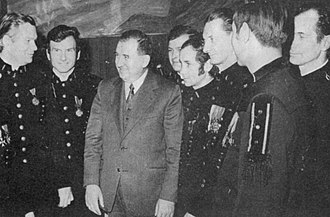
(This takes four minutes to read, but the paper itself is thirteen pages long and it can take nearly two dozen minutes to read.) >After the Second World War, the seizure of power in Poland by the Communists resulted in the dominant ideology of the superiority of the working class over all social groups. Even the name of the party of the Polish communists contained the term ‘workers’ — the Polish United Workers’ Party. > >The miners were elevated to the status of élite amongst the workers. Just as in the inter-war years, […] coal was the main Polish export commodity. Its sale provided the […] economy with foreign currency, which is why — as was often said — coal was ‘the most important Polish currency’. > >At the same time, the Soviet Union demanded ever greater supplies of coal. The pressure on coal was so great that as much as possible was extracted at all costs. During the entire period of [the Polish People’s Republic], miners working in hard coal mines were, on the one hand, over-exploited, while, on the other, they were granted numerous social benefits. > >The profession of miner was considered the most important and valuable for the country, and the miners themselves were treated as national heroes. On average, Polish coal mines collectively employed a total of around 400,000 miners. > >Over time, miners’ social privileges were increasingly extended. In November 1949, the government adopted a document called the “Miner’s Charter” (Karta Górnika), containing special privileges for miners in the coal mining industry. It provided numerous entitlements for those working in the mining industry. Underground workers and coal mining technicians and engineers received a special quarterly wage of 10 to 20% of their basic salary. > >The employees of the coal mines were decorated with state orders for their faultless and continuous work underground. The type of decoration, from the Bronze to the Gold Cross of Merit, was dependent on the length of service. > >In 1949, the “Distinguished Miner of Socialist Poland” (Zasłużony Górnik Polski Ludowej) decoration was introduced, then changed in 1955 to the “Distinguished Miner of the People’s Republic of Poland” (Zasłużony Górnik Polskiej Rzeczypospolitej Ludowej). This was a distinction for those who, during their many years of work in underground mining, stood out by their achievements in the field of productivity, increase in output, initiation, and development of labour competition. > >The “Distinguished Miner” received a ceremonial traditional miner’s dress, together with a badge, free of charge. He was entitled to 21 days paid holiday, and once a year he and one member of his family received a free train ticket to any destination. > >At the age of 55 and after 25 years of work in the mining industry a miner could receive a pension which was much higher than the average level of statutory state benefit. The pensions of miners who received the “Distinguished Miner” award were raised by a further 10%. Sick pay in mining was also much higher than in other industries (M.P.1949.A-100.1175). > >In 1958, another amendment to the Pension Act introduced further financial allowances for holders of the honorary title “Distinguished Miner”. Gradually the retirement age for miners was lowered. > >From 1986 it was set at 50 years, with a total service of 25 years, including 15 years in mining. From 1989 meritorious miners received a special bonus equal to 25% of their current pension (Przybyłka 2018: 48‒58). > >### 1970s — the period of success propaganda >In the era of the People’s Republic of Poland, the toil of miners was elevated to the status of a national hero. In December 1970, Edward Gierek became the leader of the Polish Communists and, therefore, the most important person in the country. Not only did he himself come from Silesia, but in his youth, he worked as a miner in the French mines in the Lille region. That is why, during the 1970s, miners were treated by the authorities as celebrities, eagerly venerated by artists. > >Miners had a better life than other social groups. They were carried on people’s shoulders, given privileges, glowingly praised in the press, and shown on television. Every year on Miners’ Day on 4th December, there were grand ceremonial galas attended by the most important people in the country. The miners’ banners were decorated with, for example, the Order of the Banner of Labour of the First and Second Class. There were also concerts of miners’ orchestras and marches through city streets. > >The holiday was also a good opportunity to commission housing estates, streets, or other important buildings, and to establish the coal mining plan for the next year — for example, 200 million tonnes of “black gold”. Thanks to these efforts, the rôle of miners in socialist society grew; even children in schools were taught about the demanding work of miners. > >[…] > >Many mines had canteens, separate shops, and service outlets. The mines organised the delivery of staple food products at lower prices (e.g., potatoes). Miners and their family members had swimming pools, sports clubs or libraries dedicated for their exclusive use. An important privilege of the miners was the organization of their own health care. > >Initially there were only doctors at each workplace. Then the Provincial Coal Industry Health Clinic (Wojewódzka Poradnia Ochrony Zdrowia) was established in Katowice. In 1952, the Central Outpatient Clinic for Health Care in the Mining Industry (Centralna Przychodnia Ochrony Zdrowia w Przemyśle Górniczym) was established, to which all mining health centres were subordinated. Subsequently, it was replaced by the Provincial Miners Clinic (Wojewódzka Przychodnia Górnicza) and regional clinics for miners. > >This solution was changed in 1974, when the Mining Health Care Complex (Górniczy Zespół Opieki Zdrowotnej) in Katowice was established, to which field health care teams were subordinated. The mining sector also had its own rest homes and miners’ sanatoriums. These were modern facilities of a high standard. This situation lasted until the end of the People’s Republic of Poland (Przybyłka 2018: 55). (This author is definitely not a communist, so it is surprising what little tosh I had to redact.)