 Lucifuge Rofocale
spreading the message
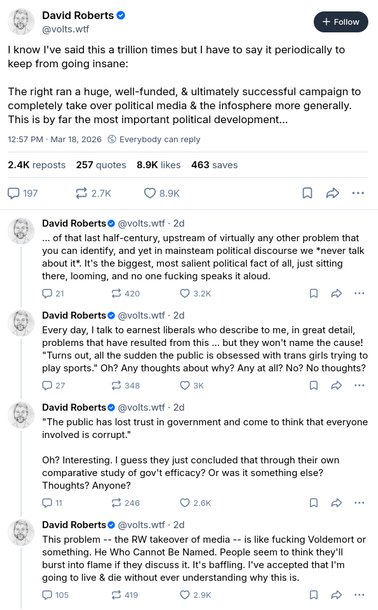
I think part of the issue is that a lot of people who are aware of this know that it’s been happening for a lot longer than since Trump’s first election, and it’s not specifically a right wing takeover. It’s an overall consolidation of power into the hands of an ultra-wealthy few, and right wing is currently the most advantageous position for them to take.
This particular video is from 2018, a year into Trump’s first term, and it shows a large amount of local news stations that were believed to be spread across the political spectrum (at least for US run stations) all reciting the same exact script.
But the movements of Rupert Murdoch, or the Sinclair Media group, or iHeartRadio, or any of the many number of conglomerates didn’t just crop up overnight purely under right wing situations to support right wing movement.
Unless you really think Trump’s first election was some 5D chess thing, he was catching flak from all sides. Before that, the news media gave incredibly kind coverage to Obama’s involvement in the Middle East, his use of drones, his moves to further the rights granted to the US government and intelligence agencies through the Patriot act (started under Dubya, but expanded under Obama), the construction of illegal immigration centers during his tenure… the list goes on for him like it does for most Presidents.
The screws have been tighening for decades, this isn’t something shockingly new to present day, we’re just approaching critical mass.
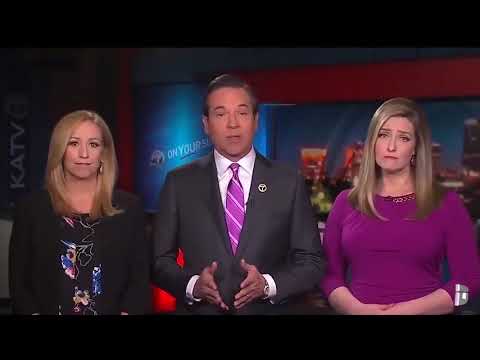
All Sinclair-owned news stations use the same script.
It’s not a right-wing takeover, and it’s not a takeover by the ultra wealthy. It’s more complicated than that.
The NY Times is still the crown jewel of news, and it isn’t owned by a right-winger or an oligarch. It’s a publicly traded company traded on the NYSE. The CEO is a multi-millionaire, but definitely no oligarch. USA Today is also publicly traded. Same with Comcast which owns NBC universal which owns NBC which runs NBC news.
Most of these publicly owned companies have a few rich shareholders, but they have so few shares they can’t exert much control. For example, the CEO of Comcast, Brian L. Roberts does own more than $1b worth of Comcast stock, but Comcast has a market cap of more than $100b, so Roberts owns less than 1% of the company. If you actually look at who owns most of these big public companies it’s always going to be Vanguard, Blackrock, State Street, etc. who all own it on behalf of their investors. Those companies are basically hands off with their ownership, because they basically own it as part of an index fund, so it’s not really them who owns it. But, they do want their investments to keep making money.
Then there’s The Associated Press, which is a not-for-profit cooperative owned by its member newspapers and broadcasters. Reuters is officially a British news agency, owned by a Canadian publicly traded company Thomson Reuters. It’s one of the unusual ones because although it’s publicly traded, the majority of its shares belong to The Woodbridge Company which is owned by the Canadian/British Thomson family. And there’s NPR, PRI, APM, PBS, etc. which are publicly owned, but relatively small. And then there are the international news orgs that have penetration in the US: BBC, the Guardian, etc.
The real problem is that news in the US has always been owned by for-profit companies. This is unlike most of the world where there are for-profit companies, but one of the major players in news is a state-owned company: ABC in Australia, BBC in Britain, CBC in Canada, DW in Deutschland, ERR in Estonia, France Télévisions in France, etc.
When the world went online, and online advertising was captured by the Google / Facebook duopoly and classifieds were captured by Craigslist, it became really hard for news organizations to make money. The ones that suffered most were the ones that used to be newspapers. TV networks had to adjust but not as much. The ones that were owned by oligarchs didn’t have to change because their goal was never about making a profit for the oligarch. But, the ones that were in it as businesses had to scramble because the way they made money had to change.
IMO, where we are now is that we have oligarch-owned media which is mostly right-wing – but “pro-business right wing” not “evangelical right-wing”. Then there’s the for-profit media which is mostly sensationalist news, panel discussions, and other stuff that can be done cheaply. The days when reporters could do month-long investigations are mostly gone. Same with sending a reporter to the city’s meetings. There are a few remaining dedicated news orgs that can afford to fund in-depth reporting, funded by people playing Wordle or similar wierdness.
The dial on the “yellowness” of the news has been turned up, and oligarchs have more influence than they used to. But, it’s not as simple to say that it’s all right wing, or all oligarch owned. It’s more that journalism as a profession has taken a major hit and everything that used to compete with reliable, honest journalism has grown.
 wizardbeard
 merc
merc