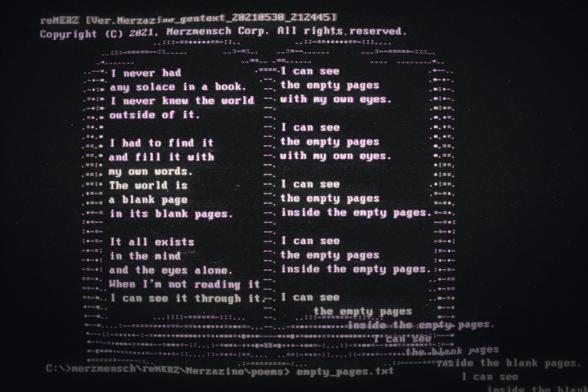
empty_pages.txt
reMERZ is Merzmensch’s long-running attempt to let a machine speak with spirit of his own voice. Since 2016, he has gathered his writing—essays, poems, playful detours—and shaped them into a personal training corpus. More than 500 pieces became a kind of literary Dadaist collage, echoing the spirit of Ernst, Schwitters, and the early days of generative models, mixing topics like postmodernism literature, transmedial narratives, Japan impressions, autobiographic reflections etc. Curated by The Second-Guess on the occasion of Art on Tezos: Berlin, 6–9 November 2025.
The process is straightforward but demanding: mix the texts, train the model, and then curate. Neo-Alchemy. The machine hallucinates, Merzmensch reads. Some results feel like familiar thoughts in an unfamiliar syntax; others resemble messages from a parallel memory. From this overflowing archive in the vein of Aby Warburg, he selects the fragments that inspire him as a Muse, that strike an emotional or intellectual chord—small poetic glitches, sharp insights, uncanny sparks.
Behind reMERZ lies the conviction that creativity is not a human preserve. Machine-generated language becomes an extension of what writing can be, a field where voices merge, distort, and respond to one another—fully aligned with Barthes’s view of text as a dialogue of cultures.
For the Merzazine Edition, Merzmensch chooses exclusively pieces he published in his blog Merzazine – with an urge to create an alternate Merzmensch writing an alternate Merzazine. An artificial twin. Displayed in the aesthetics of early command-line systems, they link past computation with speculative futures—an exploration of memory, perception, and what remains once a thought leaves its author.
“For me, training on my own work means a lot. I want to see what a machine might create based on my knowledge and mindset. It isn’t about my own augmentation — posthumanism is still very anthropocentric. I look beyond the human-centred approach. I want to see what AI can create when trained on my mindset, experiences, and ideas. This perspective is refreshing, inspiring, and surprising.
My reMERZ series, trained on my own texts, delights me every time I read the new generations — such semantic collisions and hallucinations are highly inspirational and motivate me to write new poems, texts, stories, and short films. After all, it’s a conversation with myself; an encounter with AI trained on Big Data is a dialogue with humanity as a whole. Since there is no single opinion among humans, you won’t get any definitive answer from AI.”
 Merzmensch