 John Carlos Baez
The proton, 1836 times heavier than the electron, is made of two up quarks and a down, with two of their spins aligned and one pointing the other way.
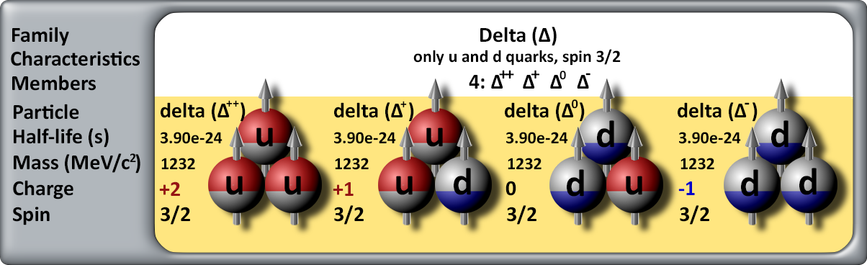
The same quarks with all spins aligned give a new particle, the Δ⁺, that's 2411 times heavier than the electron!
But the Δ⁺ is just the first of many 'excited states' of the proton: particles made of two up quarks and a down, but arranged in different ways, with higher energy and thus more mass. They quickly decay, often turning back into a proton.
There are two main kinds:
• If two quarks have spin pointing the same way and one points the other way, you get a particle with total spin
1/2 + 1/2 - 1/2 = 1/2
It could be a proton, but there are lots of others. Any particle of this kind is called an N*⁺.
• If all three quarks have their spins aligned, you get a particle with spin
1/2 + 1/2 + 1/2 = 3/2
Any particle of this kind is called a Δ⁺.
When we want to be precise, the Δ⁺ I mentioned before is called Δ(1232)⁺, because its energy at rest is 1232 MeV. That corresponds to its mass being 2411 electron masses. But then come a family of increasingly overweight relatives: the Δ(1600)⁺, Δ(1620)⁺, Δ(1700)⁺, Δ(1750)⁺, and so on, all of spin 3/2.
Similarly the proton can be called N(939)⁺, though it'd be like calling water dihydrogen monoxide. Then come the N(1440)⁺, N(1520)⁺, N(1535)⁺, N(1650)⁺, N(1675)⁺, N(1680)⁺, and so on - a seemingly endless series of increasingly heavy relatives, this time all of spin 1/2.
Physicists started studying these excited states, or 'resonances', in 1952. By the late 1960s, people were cranking them out. How to understand them???
(1/n)
 adingbatponder
  👾
👾