 Anarcho-Bolshevik
How Otto von Bismarck inspired the German Fascists
How Otto von Bismarck inspired the German Fascists - Lemmygrad
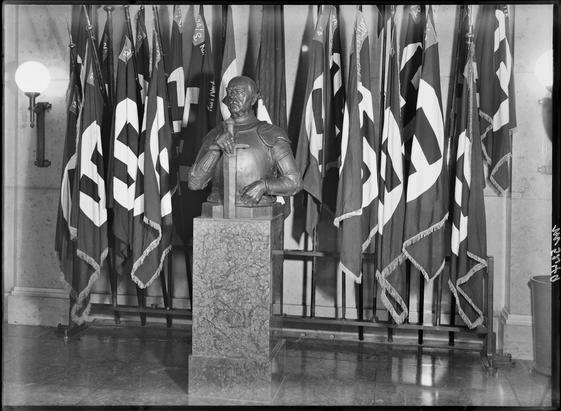
(This takes 8¼–12½ minutes to read. Yes, it’s another one of those threads, I’m afraid.) Quoting Robert Gerwarth’s The Bismarck Myth: Weimar Germany and the Legacy of the Iron Chancellor, page 5: >Very few movements (regardless of their ideological origin) have ever failed to attempt a justification of their aims through often contested historical traditions. The closer a political movement or social milieu comes to establishing its own view of the past as universal, the closer it gets to the state of cultural hegemony. In other words, power lies with those who have mastered the past.¹⁶ The ways wherein the memories of Frederick II [https://lemmygrad.ml/post/6943615] and Otto von Bismarck served ordinary Germans was effectively identical to how the memories of George Washington and Abraham Lincoln serve ordinary Americans: cults of personality developed around them and relatively few people had the audacity to denounce them. Thus, they became symbols effective at unifying the folk, even if in their own times they were divisive. [https://lemmygrad.ml/api/v3/image_proxy?url=https%3A%2F%2Fupload.wikimedia.org%2Fwikipedia%2Fcommons%2F7%2F78%2F242-HF-0866_001_Braunes_Haus_Muenchen_Fahnenhalle_Empfangsraum_mit_Bismarck_und_Fahnen_SA_battalion_flags_standards_swastikas_bust_of_Otto_von_Bismarck_ca_1931-34_NSDAP_Nazi_party_HQ_lobby_propaganda_NARA_id_162123385_Unrestricted_No_kn.jpg] Bismarck in particular, being an antisocialist [https://www.marxists.org/glossary/events/a/n.htm#anti-socialist-law] and specifically a constitutional monarchist who occasionally indulged in anti-Judaism (as we shall soon see), was especially popular among later antisocialists, the German fascists most definitely included. Pages 51–52: >Despite the many ideological and programmatic differences between the highly heterogeneous right-wing movements in Germany’s first [pseudo]democracy, the Weimar right found its common battle standard against the Republic within a couple of months after the collapse of the Kaiserreich: Bismarck.³² No other historical reference point was used more often in public debate to criticize the 1919 Constitution, the Versailles Treaty, and the Republic’s supposed lack of historical legitimacy. > >The Weimar right may have been deeply divided, but adoration for the ‘glorious days’ of the Iron Chancellor and the exemplary character of Bismarck’s charismatic leadership was shared by all right-wing parties and movements. In the Weimar Republic, our enemies emphasised this antisocialist when calling for a return to the status quo. Pg. 54: >Similar, although not identical, emphasis was given to representations of Bismarck by leading politicians of the [so-called] National Socialist German Workers’ Party (NSDAP). The Nazi Party had arisen out of the German Workers’ Party in 1920, and while at first only one among many völkisch and anti-Semitic splinter groups, it soon surpassed its right-wing competitors with a unique radicalism. > >Upon the ‘ruins of that proud Reich which Bismarck’s genius had created’, Völkischer Beobachter declared in early 1921, a new state embracing all members of the German people would have to be created. With frightening clarity the author—none other than Adolf Hitler himself—explained how this inwardly renewed and outwardly expanded Reich would be governed. While under Bismarck ‘risible means’ had been used to combat ‘parties which were hostile to the state’, Hitler [falsely] promised that in future times ‘parasites, exploiters, and agitators’ would be ‘rounded up to the last man’.⁴⁵ > >Although he was critical of Bismarck’s ‘moderate’ domestic policies, Hitler emphasized the importance of this ‘great man’ for the nationalist movement in the Weimar Republic. The name of Bismarck, Hitler suggested, had to remind the German people in a time of national distress that there were good reasons ‘to be proud to call oneself a German’.⁴⁶ > >Hitler’s references to the founder of the Reich had much the same purpose as the idealizing tendencies in conservative circles: Bismarck’s rule was to act as a positive template—a period of national dignity and greatness—against which the unpalatable features of Weimar Germany could be set. In comparison to the Bismarckian Era, the Republic was no more than a transitional period, a momentary nadir in history, which it was the self-appointed duty of the Weimar right to surmount. Now, keep in mind that the NSDAP remained a fringe party during the 1920s, thus Gerwarth logically spent more time betalking the Weimar Republic’s other, more popular ultranationalist parties. Nevertheless, many of these ultranationalists would assimilate into the NSDAP [https://books.google.com/books?id=PwB2DwAAQBAJ&pg=PA370] or its forces in due time. For byspel, the SS Officer Robert Arnold Griesinger was an active member of the Bismarckjugend [https://books.google.com/books?id=km6nDwAAQBAJ&pg=PT88], which was the DNVP’s youth wing. Otto von Bismarck’s own grandsons Gottfried Graf von Bismarck-Schönhausen in addition to Prince Otto Christian Archibald von Bismarck both became NSDAP members, and their relatives Georg von Bismarck as well as Klaus von Bismarck both served in the Axis forces. The 1930s came, and the Fascists were unhappy with the Weimar Republic trying to reclaim Bismarck by means of a commemoration ceremony. Pg. 124: >The NSDAP […] declared that their absence from the commemoration ceremony was an expression of their protest against the political instrumentalization of the Reich’s founder by politicians who had committed ‘treason’ against Bismarck’s legacy.³¹ > >The [Fascists’] position was partly a result of a meeting between Hitler and Brüning on 5 October 1930 which had revealed their fundamental political differences. When Hitler demanded an immediate moratorium on reparations and at least three cabinet posts in return for parliamentary support of Brüning’s policies, the Chancellor refused immediately.³² > >Consequently, the [German Fascists’] rhetorical attacks against the cabinet, often formulated with reference to Bismarck, became noticeably more aggressive. Deutsche Zeitung, for example, credited a [Fascist] student leader with the words that the German people’s current path ‘through the hell of Weimar’ would ultimately lead to salvation, and thus to the ‘Third Reich’. Bismarck would thereby serve as a guiding star: ‘He is with us on our way into the Third Reich of the Germans: Bismarck!’³³ Pgs. 126–9: >Germany was in the middle of a major crisis and the inability of Weimar democracy to solve this crisis encouraged the Bismarckians in their belief that the ‘decisive phase of the struggle’ against the Republic had begun.⁴⁰ > >This assumption proved to be correct and Bismarck was to play a key rôle in the final act of Weimar Germany’s history. More and more Germans were longing for a ‘new Bismarck’ in the face of the political and economic situation after 1929. > >And no one exploited the desire for a Bismarck-like ‘redeemer’ with the same demagogic skill as the leader of the largest right-wing opposition party, Adolf Hitler. His ability to use the Bismarck myth as a propaganda device would prove to be one of the conditioning factors in his rise to power. > >#### Bismarck, Hitler, and the rise of [Germanic fascism] >In February 1939, six years after his ‘seizure of power’ and the dissolution of the Weimar Republic, the German Chancellor Adolf Hitler attended the launching of the battleship Bismarck [https://commons.wikimedia.org/wiki/Category:Bismarck_(ship,_1939)]. In his speech in Hamburg harbour, the Führer explained his reasons for naming Europe’s largest battleship after the founder of the Reich: ‘Of all men who can lay claim to having paved the way to the new Reich [meaning the ‘Third Reich’], one figure stands in awe-inspiring solitude: Bismarck.’⁴¹ > >Hitler’s claim was entirely tenable to the extent that the Führer did not refer to the historical personality of the first Reich Chancellor but to the Bismarck myth. Apart from Frederick the Great, the Iron Chancellor was the historical figure invoked most often in Hitler’s speeches in order to lend support to the Führer’s position.⁴² > >Hitler’s political references to Bismarck (for which there is evidence from the early 1920s) served a number of purposes, the most important of which was to emphasize the overriding rôle of leader figures in Germany’s past, present, and future. > >It has often been pointed out that after 1925 the NSDAP differed from all other political movements and parties in the Weimar Republic in that it submitted completely to the will of its ‘charismatic leader’.⁴³ It was therefore the only party whose inner organizational structure reflected the public demand for strong leadership.⁴⁴ > >However, the Führer principle had not always been the focal point of the party’s ideology and organization. In the early years of the [Fascist] movement—and even, as Albrecht Tyrell has argued, up until 1923—Hitler publicly described himself as the ‘drummer’ of the national cause, rather than as the predestined leader of the German people.⁴⁵ > >Nevertheless, there are indications that Hitler understood the strong public desire for charismatic leadership in the years before his failed putsch of 1923 and that to him Bismarck was synonymous with such leadership. > >In April 1922, for example, on the occasion of a [Fascist] ‘Bismarck festival’, Hitler praised the Iron Chancellor extensively and stated: ‘We must follow in his footsteps.’ Only then would the party succeed in ‘gaining the support of the millions […] And when that time has come, then we will want to say: we bow before you, Bismarck!’⁴⁶ Pg. 143: >Of the manifold causes of the rise of the [NSDAP] to become the strongest party in Germany, there can be no doubt that the public’s longing for a saviour-like ‘Führer’, which had intensified throughout the 1920s, featured prominently. > >By the late 1920s, as a result of the growing political and economic crisis of the depression era, the public’s perception of Weimar democracy as a total failure allowed the idea of charismatic leadership to move from the wings of politics to centre stage. > >It did not escape Hitler’s attention that Bismarck was widely perceived as the ultimate model of such a heroic leadership. As the well-respected Munich historian Karl Alexander von Müller had already exclaimed in 1929, it was Bismarck’s image ‘which appears in front of us, when we hope’ for the ‘future leader’.¹⁰⁹ When this future leader of the German people emerges, Müller concluded, ‘he will greet the man we memorize today as his relative and predecessor’.¹¹⁰ > >In precisely this respect, the Bismarck myth helped to create a political climate which smoothed the way for Hitler’s success. Hitler was cunning enough to seize the political opportunities which were latent in the Bismarck myth. With genuine virtuosity Hitler appealed to existing myths and used them for his own purposes. In so doing, he narrowed the gulf between large parts of middle-class Germany and his own political movement, as is evident from the immediate reactions to Hitler’s appointment. :::spoiler (Emphasis added in all cases. Click here if you have time for more Fascist references to His Serene Highness Prince Otto von Bismarck.) Pgs. 131–2: >In Mein Kampf, which was praised in nationalist circles as the ‘most significant political publication since Bismarck’s Thoughts and Reminiscences’, Hitler’s representation of himself as a ‘second Bismarck’ received only fleeting expression.⁵⁷ Soon after Landsberg, however, Hitler began to suggest that he would fill the void which the Iron Chancellor had left in 1890. Immediately after the end of his imprisonment, for example, he posed for a photograph with a Lenbach portrait of Bismarck in the background.⁵⁸ > >Hitler’s writings and speeches suggest that he began to use the Bismarck myth for his own ends once he had discovered that he himself was the one to lead ‘his’ people. In Hitler’s Second Book, written in 1928 but only published posthumously, this became particularly evident.⁵⁹ > >According to Hitler’s admiring statements, Bismarck’s kleindeutsch solution to the German question was the ‘highest achievement’ which could have been expected ‘within the limits of the possible of that time’. Bismarck in his old age was therefore able to look back upon a mission fulfilled. However, his ‘finished life work’ did not signify the ‘end of the life of the German nation’. In Hitler’s view it had been the ‘task of the post-Bismarck period’ to pursue an ethnic policy [Volkstumspolitik] and furthermore, to solve the acute problem of sustaining the German people through the acquisition of Lebensraum—living space in the East.⁶⁰ > >[…] > >Hitler was convinced that the Iron Chancellor had understood the ‘destructiveness’ of socialism and that he had tried to eradicate the evil forces threatening ‘his’ Reich from within. He had, however, chosen the wrong method to achieve this goal. > >‘In his anti-socialist laws’, Hitler argued, Bismarck ‘put up desperate resistance against the destructive mission of the Marxist dogma. It had no effect. Not only because his successors lacked the energy in following the course Bismarck had charted, and because they abandoned this course, no, because the means of conflict themselves were not up to the task. By using political means of police force, an attempt was made to break the backbone of an ideological doctrine which was anchored in the masses and found their positive response.’⁶² > >According to Hitler, the ‘breaking’ of the Marxist world-view and its representative organizations was only possible by countering ‘Bolshevism’ with an ideology of equal resolution and determination. Bismarck had not been able to rely upon a collective ideology as strong as [German Fascism]. This, Hitler argued, was why the anti-socialist laws had failed and why socialism in Germany had not thus far been destroyed.⁶³ For Hitler, an essential part of his own self-appointed historical mission was to make up for this missed opportunity. Likewise, the 1940 film Bismarck [https://archive.org/details/bismarck-1940] and its 1942 sequel The Dismissal [https://archive.org/details/die-entlassung-the-dismissal-or-bismarck-part-2-1942] portrayed the antisocialist chancellor very positively throughout. Quoting David Welch’s Propaganda and the German Cinema, 1933–1945 [https://annas-archive.pk/md5/b16706e53d7b260cfb2c2bb4a71ee2c6], pages 141–142: >On 6 December 1940, Wolfgang Liebeneiner’s Bismarck was released. Like Friedrich Schiller, it was concerned with a leader of genius and his attempts to unify Germany. The story begins with Bismarck as the newly appointed Prussian Prime Minister who defeats Austria at war, outwits France, and brings about the proclamation in 1871 of Wilhelm I of Prussia as Emperor of Germany. > >The unification of a strong and united Germany marks the triumph of Bismarck’s indomitable will. The film makes it clear, however, that this was achieved not by consensus politics and the parliamentary process, but by ‘iron and blood’. Addressing the Landtag at the beginning of the film, Bismarck outlines a theme that is to recur again and again: ‘The great questions of the present will not be solved by speeches and parliamentary decision, but by iron and blood.’⁴⁵ > >Like all great leader figures, Bismarck knows what is best for Germany. In his Table Talk, Hitler referred to the importance of these men of genius: >>I shall not cease to think that the most precious possession a country can have is its great men. If I think of Bismarck, I realise that only those who have lived through 1918 could fully appreciate his worth. One sees by such examples how much it would mean if we could make the road smooth for men of talent.⁴⁶ > >The historical parallel with Hitler is emphasized throughout the film. Like Hitler, Bismarck, on assuming power, immediately builds up a strong modern army to secure a lasting German Empire. In order to achieve this he informs King Wilhelm that Germany must change her attitude towards Austria and that a military pact with Russia is necessary to protect Prussia’s eastern flank. When the King objects to this new alliance, Bismarck retorts: ‘By the time the grumblers in parliament get around to doing anything about it, we will be ready and mobilized!’ […] film audiences were quick to spot this analogy between Bismarckian diplomacy and the [German]–Soviet Non-aggression Pact. The SD reported: >>Also well received were those parts of the film showing Bismarck’s struggle to convince King Wilhelm of the validity of his policies and of the necessity of applying them at that time to the realities of the situation. When Bismarck made clear to the King the necessity of a change in attitude towards Austria, speaking of it as a matter of ‘politics and diplomacy’, the film audience applied this to the current relationship between Germany and the USSR. The reference to the fact that in foreign policy one had to be a little ‘two-faced’ was well understood.⁴⁷ > >But the main intention of the film was to reinforce the message that the Führerprinzip was an essential prerequisite for the unity and greatness of the Reich. Once again a simple analogy is drawn between the two leaders. Just as Hitler protected the country from an international Jewish-Bolshevik threat by means of the Enabling Act, so Bismarck is shown dissolving the Landtag and imposing press censorship in his efforts to unite Germany’s forty states under a single all-powerful rule. Read pages 142–146 for more. ::: As for Bismarck’s opinions on Jews, an argument can be made that he was overall allosemitic (that is to say, he had a love–hate relationship with Jews). Willy Cohn pointed to numerous positive (and a few negative) remarks that he made about Jews, as well as friendships that he had with certain Jews [https://books.google.com/books?id=mbhtAAAAMAAJ&pg=PA384]—for whatever that may be worth. On the other hand, Sam Hall, while acknowledging a few signs of friendliness, presented a nevertheless more worrisome picture [https://pubs.lib.umn.edu/index.php/cey/article/download/4424/3010]: >Bismarck was not immune to the antisemitic tendencies prevalent in German society. On more than one occasion, the Chancellor was overheard employing the term Jew in a derogatory manner. He referred to his political rival, the progressive liberal Eduard Lasker as “the little Jew” and, on another occasion, described Jews as “cosmopolitan nomads.”²⁴ > >Some in the country’s political sphere went as far as to label Bismarck as the “father” of antisemitism. In response to a heightened level of antisemitic agitation during the early 1880s—Jewish homes, shops, and synagogues were damaged in the cities of Thorn, Neustettin, and Stolp—the liberal Landtag deputy Eugen Richter chastised Bismarck for encouraging Jewish persecution through his inaction.²⁵ > >On the 12th of January 1881, Richter contended that the antisemites began “to cling to the coat-tails of Prince Bismarck” and that they “go right on cuddling up to him and call to him as noisy children surround their father.”²⁶ To an extent, Richter’s powerful speech was true. Prior to the 1881 Reichstag elections, Bismarck had confided in his son Wilhelm that the appointment of Stöcker to the chamber was “urgently desirable,” describing the antisemitic flagbearer as “an extraordinary, militant, and useful ally.”²⁷ That is plenty more that one can say about the German Fascists’ idolization of Otto von Bismarck along with how his protofascist régime set a precedent for the Third Reich, but this topic is lengthy enough as it is. Read the rest of The Bismarck Myth (especially chapters 8–9) or see Richard E. Frankel’s Bismarck’s Shadow: The Cult of Leadership and the Transformation of the German Right, 1898–1945 if you have time for more.