
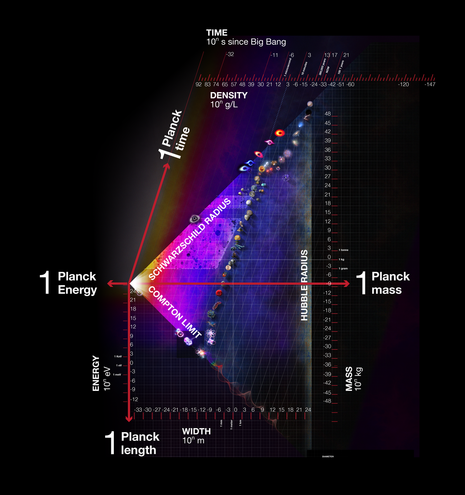
My favorite weird physical scaling limit in computing is that you can't tile a 3D networked grid of computers indefinitely because you eventually create a black hole: https://en.wikipedia.org/wiki/Schwarzschild_radius#Calculating_the_maximum_volume_and_radius_possible_given_a_density_before_a_black_hole_forms. Whereas you can in theory tile the computers in a 2D network indefinitely (edit: nevermind, you have this problem in 2D too, so you need 1D tiling).
Schwarzschild radius - Wikipedia

@pervognsen
why's that not a problem in 2D?

Consider a flat disk of computers with height H and radius r, and density ρ.

V = H * πr²
M = ρ H π r²
to be a black hole, it needs
rc² <= 2GM

r c² <= 2G ρ H π r²
c² <= 2π * G ρ H r
r >= c² / ( 2πGρH )
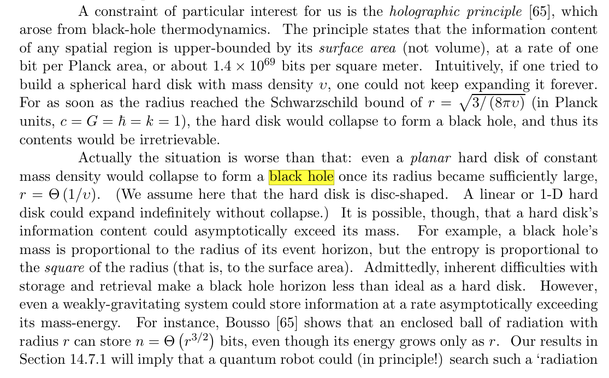
@wolf480pl Thanks, I should have worked through that example. So 1D tiling would still work since with V ~ r, M ~ r you can select the tile mass low enough to satisfy the inequality for all r. I think what I was misremembering related to r^2 scaling limits in computing was something about black hole surface area. That'd somehow gotten compressed in my brain to "2D tiling still works" which, as you pointed out, it doesn't.
@wolf480pl So, with the 1D tiling still working at arbitrary scale, the Turing machine is even more physically realistic than I'd appreciated. :) Or I guess a more useful analogy than a Turing machine is a one-dimensional cellular automaton if we're talking about arbitrarily large-scale parallel computers or networks.
@wolf480pl I found the original thesis I read 20 years ago and half-remembered. He even mentions the planar disk example. The problem being studied also isn't exactly the same as a grid of computing elements.
@pervognsen I'm honestly surprised I haven't seen this mentioned in the recent orbital datacenter discourse.
@pervognsen I misread the Compton Limit as Computation Limit and thought that they somehow linked information theory with general relativity.
@pervognsen so you're saying there's a golden lining