 PugJesus
Another 3 million gold coins to the Germanic barbarians that keep invading us!
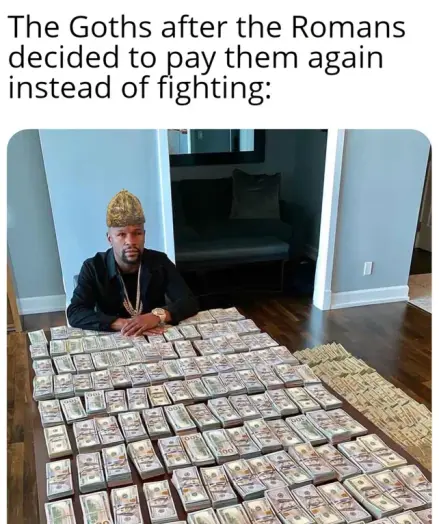
Another 3 million gold coins to the Germanic barbarians that keep invading us!
In the Principate, the first ~2-300 years of the Empire, this was actually a common practice, though not as large lump sums. Instead, Roman-aligned tribes would receive annual ‘subsidies’ in exchange for remaining Roman allies/buffer states against further afield barbarians. Such allied tribes would also often receive trading rights in nearby Roman cities in addition - for exactly the reasons you mentioned. It was a legitimately good way to shore up pro-Roman elites in buffer states and ensure they had enough force to be effective buffer states.
Funny enough, this would sometimes be negotiated in the aftermath of a tribe’s defeat by Roman forces. Gotta show ‘em who’s boss!
Unfortunately, while this practice was effective when the Germanic tribes were not being pushed out of their lands in civilization-level mass migrations, it was distinctly not effective afterwards. And of course, as a pre-established practice, it was so easy to fall back on, even in circumstances far divorced from what subsidies were supposed to achieve…
Penny-wise and pound-foolish, one might say. The ruler escapes having to wage an even more-expensive war than the bribe, but that just means the next ruler (or the same ruler in a few years) will be placed into the exact same position, only with less money in the treasury and a more powerful foe. It also is dependent on the circumstances and willingness of the other polity to maintain the agreement. What’s your leverage after you’ve paid, after all? You could make it a regular payment… but then they ask themselves “What’s MY leverage once I stop attacking? Couldn’t they just cheat me after a year or two of payments, when they feel stronger?” (And certainly, some Emperors tried that - rarely with good results)
There’s also all the knock-on effects. Paying off enemies is immensely demoralizing to the troops (with Alexander Severus, notably, being assassinated over that issue) - doubly so if they have family in the lands that have already been raided, or if they feel their pay is low (such as in the Late Empire when permission to seize necessary goods was more widespread than payment in coin!). While other factors were definitely at play, Rome’s reputation was in-part built on the utter lunatic level of determination they had to prove that they were the ‘ardest around. When they would embark on entire wars and brutal punitive expeditions days into the barbarian frontier just to avenge the mistreatment of a single Roman citizen, the threats of Rome were feared.
When Rome was paying off invading tribes and giving them lands in exchange for peace… it ended up much more as incentive than discouragement for other prospective invaders. An extra inducement to roll the dice, in addition to the desperation… you see it’s worked out well for others. Why not for you and your’s?
what’s your leverage after you’ve paid, after all? You could make it a regular payment… but then they ask themselves “What’s MY leverage once I stop attacking? Couldn’t they just cheat me after a year or two of payments, when they feel stronger?” (And certainly, some Emperors tried that - rarely with good results)
I mean… if it were me? I’d then flood their markets with cheap, mostly disposable stuff that they can get used to and maybe make a good buck selling to the other tribes. Wine, for example. (“for your women and children, lol”) or maybe… spiced oils for their manly-manly hairdos.
It’s a lot like what we did to Japan and Germany in WW2, too. We stop it, make it hurt. then we help rebuild… so you still like us for some reason.
I mean… if it were me? I’d then flood their markets with cheap, mostly disposable stuff that they can get used to and maybe make a good buck selling to the other tribes. Wine, for example. ("for your women and children, lol") or maybe… spiced oils for their manly-manly hairdos.
Ah, but why should they not take from you what you have already expressed a reluctance to defend? Why should they buy anything with gold, when iron gets them it cheaper?
Consumer purchasing power was also concentrated in Rome - the Germanic tribes, many of whom had been driven from their original homes (and sources of wealth) in any case, were hardly wealthy enough to make regular purchases of luxuries. Rome exported wine (which the Germanics were purportedly fond of), but the Germanics had little to make up the trade imbalance to make it a substantial source of income for Rome, or luxury for the Germanic tribes.
On top of that, that presumes a mercantile attitude that is often absent in pre-modern international relations, for the first point raised - iron is cheaper than trade. A society of agriculturist-warriors will prefer to make what they can, and take the rest - exchange with kin groups excluded. Markets are not natural; they’re brought into being by rigorous contract enforcement by a third-party or third-parties. And rigorous contract enforcement usually includes “If you steal, the wrath of the law will come down on your head” - when Rome was the power around, that was a credible threat. When Rome is paying you not to attack… maybe that doesn’t sound so scary anymore.
And then there’s the issue of transport… the legendary Roman roads, oftentimes, were not the highways we think of, with nice stone paving - though they did make a great number of those. They were often gravel or even packed earth - and that was an improvement from the ad hoc paths which came before. The Germanic tribes, not living under Roman rule, did not benefit from such roads… making transport, already a massive expense overland, even more difficult and expensive. And the issue of knowing where each polity is, when their market days are, what language they speak, how safe or dangerous their land is… and in a time when more and more tribes are up and leaving because of external and environmental pressure anyway?
We take a great many things for granted, not just physical infrastructure, but social institutions as well, things that are so natural and intuitive because we were brought up with them that we automatically envision them in the past. I find it a very fascinating topic… obviously, from my rambling. XD
It’s a lot like what we did to Japan and Germany in WW2, too. We stop it, make it hurt. then we help rebuild… so you still like us for some reason.
Well, yes, but there’s also the “We remove your former leaders from power and make any former members of the government bend the knee and parrot our government lines.” Both force and economic integration were key components of turning Germany and Japan into allies - economic integration without force guarantees nothing, as Russian disdain for Ukraine has shown, despite Ukraine being a major trade partner. Force without economic integration, likewise, guarantees nothing - as seen with Iraq’s ambivalent attitude towards the USA, some ~20 years after the occupation.
 FiniteBanjo
 FuglyDuck