 Cassandra is only carbon now
@whitequark That's completely fair.
 Glyph
Glyph@xgranade @whitequark I'm still not really clear on why the incorrect simplifying assumptions about python's runtime that ty makes are just the practical compromises of a sound type checker but the incorrect simplifying assumptions that mypy makes put it in an entirely different category of software
@xgranade @whitequark like "too much busywork for the amount of bugs it finds" is not an experience I have had, but we write very different kinds of code so I'm definitely not arguing with that; I could see that 'ty' or 'pylance' might do far better with your code, or might even have a more rigorous approach to certain aspects of their type algebra. but all three happily give this program (and many like it) the thumbs-up:
x = 1
y = 2
locals()['y'] = 'oops'
print(x + y)
 ✧✦Catherine✦✧
@whitequark @xgranade this is actually why I prefer mypy, specifically because (via plugins) it can accept an extension to the type system implemented with runtime hackery, and handle Zope Interface, while none of the other ones can. pydantic also has a similar thing (and dataclasses were originally supported via the 'attrs' plugin, although everybody else eventually got on board with those).
but I guess when it comes to "helpful" warnings, mypy probably does produce a lot more of those
@whitequark @xgranade in any case, I absolutely understand “the experience of using this sucks”, I just don’t get the category distinction
@whitequark @glyph Sorry, was on a StS2 run, heh. Anyway, my understanding of the difference is that sometimes, when you report a false negative in mypy (that is, a program being rejected despite being well-typed), the response is "well, don't write that program." I struggle to put into words how off the mark that is for a type checker, but it's perfectly sensible for a linter.
@xgranade @glyph a type-checker that rejects well-typed programs is by definition buggy. if it's not fixed then it is unfit for purpose
we could have a broader discussion of what "well-typed" means for Python (it is not clear to me at all) but if the above is an accurate assessment of the consensus in mypy development then it is not a(n even aspirationally correct) type-checker
@whitequark That's what I'm getting at, yeah. For a piece of software to be a type checker, there should not be a single case *ever* of a well-typed program that is rejected *by design*.
@xgranade @whitequark do you have a canonical example of such a WONTFIX?
```
def f() -> None:
return
y = f()
```
main.py:4: error: "f" does not return a value (it only ever returns None) [func-returns-value]
Found 1 error in 1 file (checked 1 source file)
@xgranade @whitequark heh. fair enough I guess, although I am tempted to troll “that’s totally a valid type check once you realize that in certain contexts None means ‘null’ but in others it means ‘void’ “
(formally speaking, -> None is already lightly gibberish as it is an unprincipled pun for NoneType; but in support of your point, ty does accept NoneType but Mypy doesn’t)
@glyph @whitequark But that's my point... Python doesn't even have a void, but mypy acts like it does!
```
from typing import Any
def f() -> None:
pass
y: Any = f()
```
Assigning a value to a variable of type `Any` should always be allowed. That should be true in any gradually typed system.
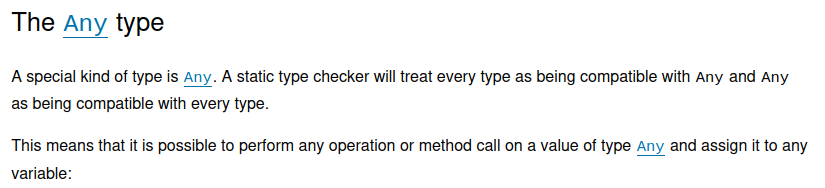
@glyph @whitequark By way of getting at what I mean about expecting there to be rules I can follow, one of those is that if `x = y` typechecks, then `f = lambda: y; x = f()` should also type check.
That doesn't hold, though:
```
from typing import Callable
f: Callable[[], None] = lambda: None
y = f() # error
x: None = None
y = x # ok
```
That means I cannot in general refactor by extracting a value into a function that returns that value, which breaks the whole idea of a type system.
@glyph @whitequark Anyway, sorry for the long reply, but I guess the short version is that I don't think any of the above behavior is consistent with a type system, but it can be consistent with a linter.
That is, knowing the types of a program in Python is not sufficient to know if that program will pass mypy. I have to know about the context in which those types are used, which breaks the abstraction entirely. It makes mypy take on a *much* higher cognitive load.
@xgranade @whitequark No apology necessary whatsoever for a long reply, I asked a complicated question!
@xgranade @whitequark Would you consider pyright's reportSelfClsParameterName warning to also be a violation of this same rule?
@xgranade @whitequark or like… this? https://docs.astral.sh/ty/reference/rules/#ambiguous-protocol-member
that looks a lot like linting
@glyph @xgranade it is normal for a typechecker to include linting rules at the "warn" level. i mean even gcc has those
what is not normal / problematic for me in this context is having those be hard-rejects. "someone dreamed up a rule out of vibes and now i have to mangle perfectly well-formed code" is not something i accept
@whitequark @glyph Part of the ergonomic difference for me is that I do run ruff (sigh) with warnings as errors. Sometimes that results in false negatives (programs rejected that are valid). In those cases, I can leave a # noqa comment indicating why. 90% of the time that's an unused import that's actually used but it doesn't detect it, though I digress.
Declaring something as Any should be the polite way to spell "fuck off, type checker" but even *that* doesn't work in mypy... hence mangling.
@whitequark @glyph That's fair, yeah. I think it's a difference in assigning false positives versus false negatives, but regardless, in either case, we're each making active decisions about how to use data that's noisy by necessity.
@whitequark @glyph I think we have different philosophies on that, yeah... not even that I disagree, I just think of it differently? I'm happy working within what a tool wants me to do, it's something my mathy brain is OK with. Just tell me the goddamned rules.
Whereas that's something mypy does not do. The rules are, to your earlier point, vibed up.
@xgranade @whitequark Would it change your opinion if mypy categorized all its "linting" stuff in a way that made it possible to disable at one go, in the way that it seems like most of the "lint" stuff in ty is classified? Rather than having specific categories and then the generalized ad-hoc "strict" category?
@glyph @whitequark I mean, the example in question is ill-considered in the first place, I think. It's saying that I can assign a value to a variable in some cases but not others, even when the types are held invariant.
That aside, I think if mypy stuck to the documented rules of how Python types behave, *or* didn't call itself a type checker, I'd be much happier. Downgrading ad-hoc errors like func-returns-value to warnings is a good step towards that.
@xgranade @whitequark Would you see https://docs.astral.sh/ty/reference/rules/#invalid-total-ordering as something that should be a 'warning' too?
@glyph @whitequark Nope, that's a very clear type error. @functools.total_ordering expects input that meets a protocol. That error is raised on inputs that do not meet that protocol, irrespective of how I write those values.
@xgranade @whitequark the fact that the type checker contains custom logic for this one protocol that isn't expressed in the type signature isn't an issue?
@glyph @whitequark I don't think so, no... it's a documented behavior of @functools.partial_ordering. In general, one of the main things that typing in Python does is formalize those kinds of requirements. That's basically a typeshed for the stdlib at that point.
The difference is that it doesn't matter how I get the class that violates the protocol, only that it does indeed violate it.
@glyph @whitequark (There's separately a question as to whether the explicit or implicit typeshed is accurate, but I'd consider that to be a bug that I hope would be fixed. Hell, I'd consider mypy's None handling to be a bug if it wasn't a wontfix.)
@xgranade @whitequark does mypy do this with types *other* than None, too? I was joking about 'void' but if this is really the one special case, it seems like that really might be what's going on
@glyph @whitequark I've definitely hit some, and should have written them down...
But yeah, None is one of the worst culprits. I see a lot of unit-vs-void confusion in GitHub issue threads, which doesn't inspire confidence that there might be a consensus to be found around mypy adopting a formal type system such as the one documented at docs.python.org.
@xgranade @whitequark okay I think this would count as another one? https://mypy.readthedocs.io/en/stable/error_code_list.html#check-the-return-type-of-exit-exit-return
@glyph @whitequark Oh, yeah, definitely. It's perhaps imprecise to say `False: bool` when you could say `False: Literal[False]`, but it's not incorrect.
@glyph @whitequark Weirdly, the docs on that hint to a resolution: "yeah, this isn't strictly a type check, but that's a structural limitation of how mypy works with its current infrastructure, and we hope to fix that in the future." I'd be OK with that, then to @whitequark's point it's at least *aspirationally* a type checker even if it doesn't get there. The WONTFIX is really what drives me nuts.
@glyph @whitequark Every type checker will have some bugs or limitations, that's not surprising to me... it's that when one is found, it gets labelled as wontfix bydesign.