Erkenntnis des Tages.
Jetzt wo ich krank bin und den ganzen Tag selbst zur Verfügung habe, habe ich endlich wieder mal die Motivation, die Gitarre zur Hand zu nehmen und herauszufinden, wie bestimmte Songs beginnen.

Nächstlogische Konsequenz: Fuck work.
Arbeit tötet Kreativität, weil man gar keine Zeit/Energie dazu mehr hat. (Gut, vielleicht muss man nicht ganz so harte Konsequenzen ziehen... Aber es ist verdammt frustrierend).
I'm currently extremely frustrated, because the mobile music players don't allow me to "play just this one bar" over and over again - and also seem to lack a distortion-free "play this at half speed" so I can more easily figure out what's going on.

Let's see if PC fares better :|

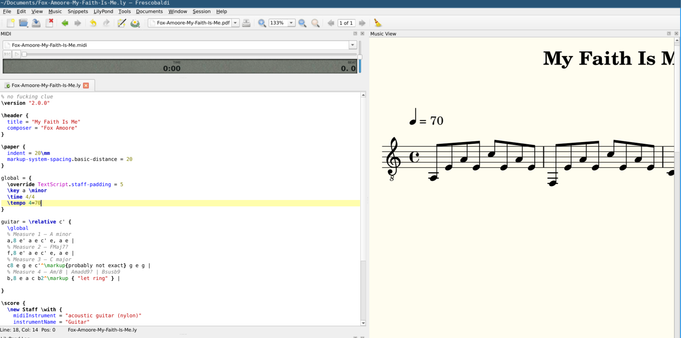
semi-related: Lilypond is extremely frustrating for me, I don't now which options goes in which block.

As someone who is barely used to use #MuseScore, #lilypond is a completely different, confusing beast…
Why are the default distances so small, glueing everything together?
What's a score? What's an instrument? What do all these curly braces mean? How much time will I have to spend to read the docs to understand all this?

o.o

I think I'm slowly getting mad, listening to an arpeggiated chord over and over and over and over and over and over again in an infinite loop until I figured it out x.x

I think I figured it out

#lilypond

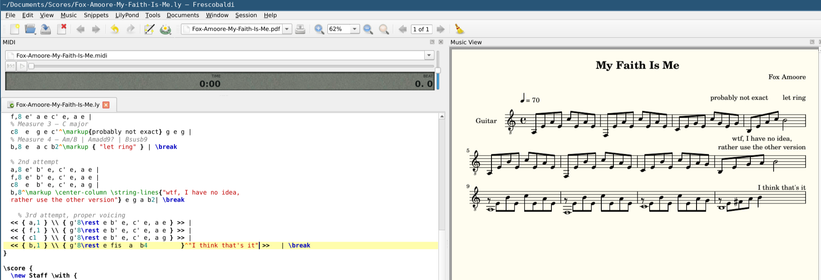
Wait... The stems are on the wrong side!!!
@uvok seems correct to me? or am I just missing something ...
@mist 3rd line, the stems should point upwards, since they're the melody line.
I put the notation groups in around the wrong way.
@uvok Are there any programs that can turn a DSL into sheet music? Cool.
@mark22k That's Lilypond with Frescobaldi as "IDE"/editor.
@uvok so.. just philip glass?
@mist What? Who?
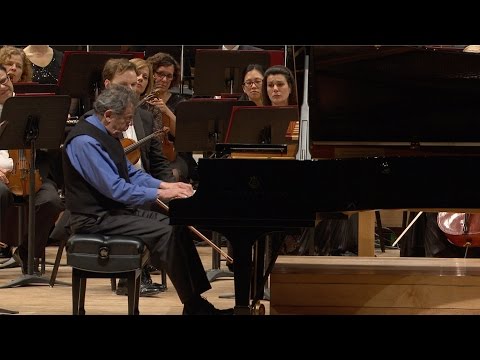
@uvok modern minimalist composer with a *lot* of repeating arpeggios.
https://www.youtube.com/watch?v=8Q0G0-9E5SE
Philip Glass joue Mad Rush

YouTube

@uvok Give it a chance, LP has a very nice documentation. Just start with the Learning manual, and a couple of hours will be enough for about 60% of work

Score is like a namespace for any objects which should be printed. And you can write some music inside:

\score {
{c4 d e f g} \\ {a b c d e}
}

will print two voices simultaneously. If you want, you can name voices with an instrument for midi output or names near the staff

@akamar Still figuring stuff out, for my guitar example with "separate bass voice" I apparently need an additional group with angle brackets.