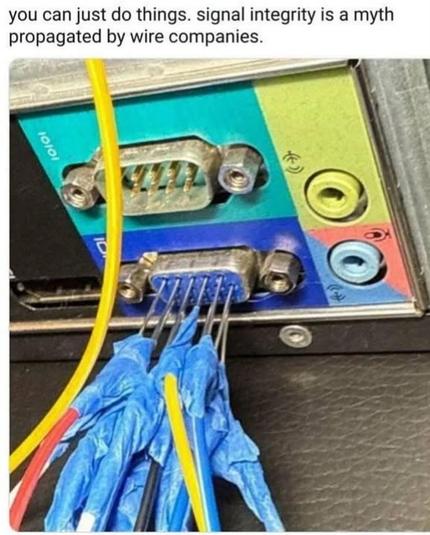
That’s VGA, it’s gonna be fine. Most wires are either ground or not used for actual image data. R, G and B are analog so noise on those just makes the output noisy, no big deal. That leaves us with HSync and VSync. They are digital signals with 3.3V between on and off and only a single pulse per line / frame so they’re also pretty robust against noise.

So unless you’re going for an extremely high resolution on a really cheap monitor over a long distance, the worst that will happen is that your image will look grainy like TV static. It would take quite a bit of interference before the sync signals degrade enough to not get any image at all.

Now I wonder if I can route VGA through unusual items. Cutlery, the railing on a staircase, swords, something like that. As long as I can find six pieces of metal of roughly equal length, it should work.

Q: So do you have any hobbies?

A: Well lately I’ve really gotten interested in routing VGA through unusual items!

Q: Ooooh, that’s so hot right now

Well… I don’t think it would be the weirdest thing I’ve done with my free time. Would probably barely rank in the top three.
I’m listening.

Let’s see:

  • Back in 2007 or 2008 I attempted to create a CPU architecture that directly uses Brainfuck as its instruction set. I had to put it on hold before it was completed because I had a custom FPGA development board with really bad documentation but if I ever get my hands on an affordable FPGA, it will get done eventually.
  • I’ve created a nonogram that solves to a rickroll QR code. I had to rely on the error correction because the exact pattern didn’t result in a well-defined solution but I’ve recently learned about some more parameters that you can tweak on a QR code. So now I just need to acquire or more likely build a QR code generator that lets me manually control those parameters and an automatic nonogram solver so I don’t have to manually solve a bunch of 25x25 nonograms to confirm they have a single solution.
  • My plan for tonight is to start porting a 22-year-old handheld game to a ~35-year-old home console. I’ve acquired a C compiler but will probably have to learn assembly for a CPU architecture that was barely used for anything else. There is no chance to ever share the resulting game without getting sued to hell and back again.
  • I’ve made chainmail bikinis for a couple of friends.

That’s just what I comes to mind at the moment. I’m sure if I spend some time thinking or digging around old hard drives, I can find more.

Brainfuck - Wikipedia

Jumping Cubes is the kind of game that works really well on a PC and has super simple rules but is absolute hell in real life.

That game on the Risk board was fun, though. IIRC North America in particular tended to have those terrible chain reactions that just kept going and going.

I remember that Australia was the exact opposite. It has a single outside connection and once it reaches a stable state, it stays there. Every impulse that goes in will come out again and leave the inside unchanged.
So… how much fabric is in these chain-mail bikinis, exactly?
Because without any, they’re basically going to be see-through, right? Not that I would complain.
No fabric at all, just metal rings and a bit of string. They are far from see-through though because they are pretty dense. If you’re close enough you can see a bit of… anatomy… but it’s more on the side of a coarsly knit sweater than transparent fabric.
I’ve been working on developing a CPU architecture based around my own variant of lisp called “dollhouse lisp” the big twist is that DHlisp executes code by reducing a syntax tree, so all code is destroyed once it’s been executed. It’s a very elegant solution, but a very difficult implementation. (Especially when it comes to loops and garbage collection.)
This is excellent. This reminds me of when I couldn’t get any hard requirements or specs for a back end tool that I was tasked with making, so to spite everyone, and maybe myself, I wrote it in brainfuck. It was rock solid for years, and then I left due to management actively preventing me from furthering my career. I still wonder how long that process kept being used before someone had to look into the source to make changes.

There are worse hobbies. There’s also no shortage of items to try.

Ideas:

  • eyeglasses
  • braces
  • bra underwire
  • Freddy’s hand
  • Edward Scissorhand’s hand
  • fake flowers with a wire core
  • bread bag ties
  • beer cans
  • tire tread reinforcement
  • a knight in chainmail
  • Christmas tree tinsel
  • photoframe
  • tie clip
  • tooth fillings
  • a bicycle
  • a tricycle
  • chain link fence
  • chastity belt
  • hammer
  • aluminum wrapped baked potato
I once routed a SCART signal into cinch with an assortment of different paperclips. Worked perfectly fine
Probably was more robust than an actual SCART cable too!
Don’t forget to try bananas
Through your body with nippleclamps?
I’d need a couple more volunteers to make sure all signals have the same delay.
Ugh… Fine… Let’s get started.

So unless you’re going for an extremely high resolution on a really cheap monitor over a long distance

Speaking of “extremely high resolution on a really cheap monitor,” it took a solid decade and a half before I was able to buy a digital flat-panel monitor capable of resolution comparable to the analog CRT I was using in 2002. VGA was no joke!

(The only problem with QXGA on a 19" CRT, aside from the weight and power draw, was that in a world before deceent high-DPI fractional scaling the text was too tiny to read easily. Other than that, it worked fine.)

The last part reminded me of a night my friends and I played Dead Rising on a CRT. Couldn’t read any text so we were just guessing what to do
Yeah, same here. I had three 21" trinitrons with a max res of 2046 × 1536. I did finally move to LCD monitors when I was able to get something close (1920x1200), but I still miss those things. Except for the massive weight, space, power draw, and heat they put out of course.
Oh man, I’m jealous. I only had two 19" monitors, and they didn’t match. I’ve still got them stored in the basement for eventual use in a retro game cabinet or something, but I’m kicking myself for not swapping them out for Trinitrons when everybody was throwing them out.
I got mine from a guy that had pallets of them and was selling them for cheap because he got them from an action. I definitely lucked out.

I once made my own VGA switch out of a bajillion-pole/throw/whatever switch I found from an old piece of audio equipment. So pressing one button toggled 8 or 16 or some huge number of independent contacts.

I used it to switch between 1280x1024 outputs from my PC or my Xbox 360. Yes I also bought the official Microsoft Xbox 360 VGA adapter so I could play in HD on my CRT monitor, cause I didn’t have an HDTV.

Worked great most of the time, but yeah the switch was a little noisy, and some really freaky stuff happened on the screen if you pressed the switch slowly enough.

This man VGAs!