if the goal of "free software" is to give the user control over how the software behaves then is minecraft[1] more free than, say, gcc[2]? thread locked by moderators after reaching 100 pages of intense debate

[1]: where an end-user can usually install >100 mods with a lot changing the game in nontrivial ways reasonably trivially without major conflicts
[2]: where combining multiple features from different forks requires lengthy conflict resolution usually dependent on deep knowledge of the systems being modified

what im trying to say is github.com/FabricMC/Mixin & github.com/LlamaLad7/MixinExtras rock and we need clones of them for more languages and environments
GitHub - FabricMC/Mixin: Mixin is a trait/mixin framework for Java using ASM

Mixin is a trait/mixin framework for Java using ASM - FabricMC/Mixin

GitHub
@kopper i feel like jvm being jvm makes this stuff a lot easier than like c

@j0 @kopper yea, the jvm has an idea of what a local variable is, and only inlined stuff ever if constants (depends on compiler / obfuscater settings too).

something similar for native is, while not impossible, going to be much harder and much less powerful (again, jvm generally has only one form for certain things, native has as many as codegens * their versions

even just inject at head is going to be difficult because where does function prepare end and body begin ?

@j0 @kopper i think there is much more value in making our software's features more decoupled so instead of rewriting parts, you swap them in and out for ones that suit your needs better
@SRAZKVT @j0 this bit is interesting to me. how granular is the swapping parts bit supposed to be? executables? libraries? what's the real difference between the two?

@kopper @j0 it's imo better to standardise executables because a library's api shape how it is implemented, while executables gives a lot more freedom (heh) on how to do things

but there's cases where we need libraries

there's also the possibility to standardise a daemon's protocol for certain operations, though this is in this case mostly useful for things which would need some form of privilege (like ping)

@SRAZKVT @kopper @j0 spack has done the most work on swapping libraries that i'm familiar with both through the concretization that reconciles compatibility directives and then through the installation process which e.g. rewrites RPATH. there's not really a distinction there between executables and libraries but it's not magic and as you say there are library decisions that affect this
@SRAZKVT @kopper @j0 i also agree that a cli api is standardizeable like a daemon protocol but this is not done for some reason and in fact google engineers will say outright that a cli is not an api when they whine on twitter about linus banning them from the kernel for breaking the perf cli
@SRAZKVT @kopper @j0 if the daemon is the os and the protocol is exec then the cli for an exe is a subset of that daemon protocol
@hipsterelectron @j0 @SRAZKVT i may be getting too "architecture astronaut" here but if you replace the plain text a process (usually) receives as input and output with something structured then how different is it from importing a library and calling a function in it? can't these things be the same? or similar enough to make processes less unwieldy compared to libraries?
@hipsterelectron @j0 @SRAZKVT the original posts were a bit philosophical in nature, currently the differences really seem to boil down to historical accidents more than purposeful design
@hipsterelectron @j0 @SRAZKVT sure it makes sense for, say, a hashmap to be a library (unless i'm not seeing something radical [cool]), but what's stopping, say, an image decoder from being a separate "process" you pipe image data into and get rgb out of?
@hipsterelectron @j0 @SRAZKVT in fact, for the image decoding use case, aren't a lot of them working in a similar fashion already? for sandboxing? what's stopping us from generalizing this approach

@kopper @hipsterelectron @j0 a project of mine (eventual, not yet started, but when i have time i WILL do it) is a format, somewhat similar to pandoc internal, which allows readers, filters, and writers to be separate executables, all of which being replaceable by any part you want. don't want to be able to import latex ? sure, don't install the latex reader. want to make a pipeline with your own filter added into it ? go right ahead

there is no reason the same idea wouldn't work for images, though images are a lot more data than documents

@kopper @j0 @SRAZKVT this is why build systems are generally process executors because the process execution interface is the most general API format which makes it easy for a sandbox to implement
@kopper @j0 @SRAZKVT libraries are specifically useful for operations within your own process memory space. they also execute synchronously on the processor and use the same stack. this is useful in some scenarios. process execution can be synchronous but it's nicer if the language has coroutines because in fact the process execution interface decouples the execution from process-local state. this makes it reproducible and limits the vulnerability surface, but is also exactly what you would need to parallelize it in-process anyway.
@kopper @j0 @SRAZKVT i apologize for the docs sucking they didn't accept my PR to fix it and they recently broke all docs urls https://www.pantsbuild.org/2.30/docs/writing-plugins/the-rules-api/processes
Processes | Pantsbuild

How to safely run subprocesses in your plugin.

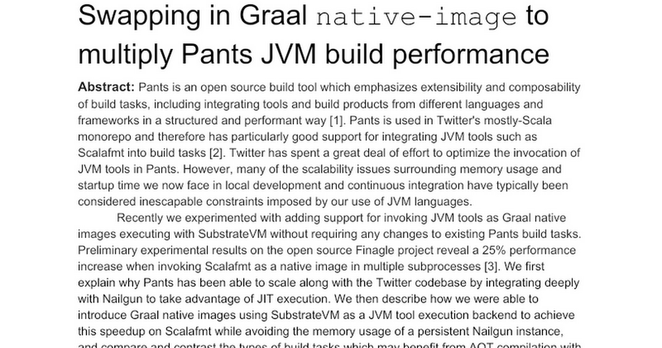
@kopper @j0 @SRAZKVT no fucking way they added a retry flag but only for process execution. i am always proven right. anyway if you have a coroutine framework available then you can leverage asynchrony in ways the individual tool cannot because it cannot control the execution environment https://docs.google.com/document/d/1iWINqg30nXaCYmBxma5h5RgWzx7sgFqWGJcQJ-RYpRE/edit?usp=drivesdk outline for a conference talk i gave at CGO 2019
Swapping in Graal native-image to multiply Pants JVM build performance

Swapping in Graal native-image to multiply Pants JVM build performance Abstract: Pants is an open source build tool which emphasizes extensibility and composability of build tasks, including integrating tools and build products from different languages and frameworks in a structured and performan...

Google Docs
@kopper @j0 @SRAZKVT i actually don't really like this abstraction for file and directory content (which is what is provided as input and collected from output of a process execution) https://www.pantsbuild.org/2.30/docs/writing-plugins/the-rules-api/file-system partially because it is a completely unstructured byte stream and requires context to make sense of. it is a google api we copied
File system | Pantsbuild

How to safely interact with the file system in your plugin.

@kopper @j0 @SRAZKVT the CAS part is precisely what makes it lose context. instead i have a terrible scheme to succeed the zip file format https://codeberg.org/cosmicexplorer/dice/src/branch/main/TODO.org which maintains the tabular structure of a zip while making it somewhat easier to transfer subsections than a zip file where the format allows this but implementations often get confused
dice/TODO.org at main

dice - faster than light archives

Codeberg.org