 themachinestops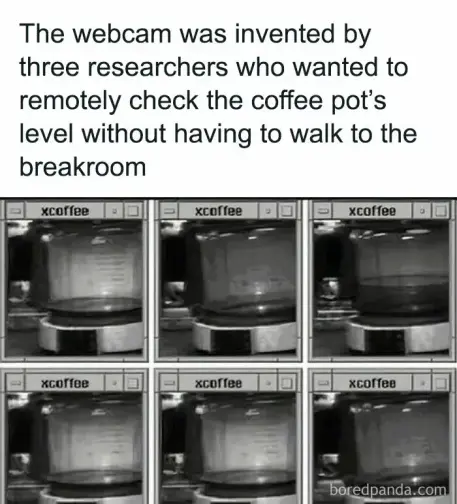
 ∟⊔⊤∦∣≶
My whole life is one big joke.
 Ada
AdaThere was even an entire standards document drawn up (as a practical joke), called the Hyper Text Coffee Pot Control Protocol (HTCPCP 1.0). To this day though, there the server status response 418 - I’m a teapot still exists. It was defined as part of HTCPCP as the error code returned when you tried to get a teapot to brew coffee :)
Web nerds took their coffee seriously! Or maybe they didn’t? Does doing up an entire standards document as an april fools joke count as serious or unserious?
 NichtElias
That’s serious unseriousness, or in other words German humor
 HerrVorragend
Anzeige ist raus
 Valmond
 OpenStars
I’m not laughing.
Humorous RFCs and protocol proposals are an ancient internet tradition: en.wikipedia.org/…/April_Fools'_Day_Request_for_C…
Engineering humour of this sort actually goes back even further – en.wikipedia.org/…/April_Fools'_Day_Request_for_C…
Nerdy humour has probably been around as long as there have been engineers.
 wonderingwanderer
Learning about computer science and finding all the subtle jokes embedded in the naming conventions is peak. These nerds had humor!
Google also has this little easter egg: www.google.com/teapot
 neuracnu
Geeking out over the origins of HTTP 418 kinda got me a job once. But that was back when that kind of stuff, connecting interpersonally with the humans that you work with, mattered during hiring.
 Natanox
Glad my lore has served you well.
Does doing up an entire standards document as an april fools joke count as serious or unserious?
It’s impossible to know until you observe them. They’re Shrödinger’s Nerds.
Nerds making joke standards is nothing unique.
See also: IETF RFC 1149 and IPoAC

 thethunderwolf
that’s not a man-in-the-middle attack (unless the bird is a trained falcon or something), it’s packet loss due to infrastructure damage
I get no respect.
Guys working with computers in this era didn’t know any girls.
worth noting, e-mail however was… If I recall ascii porn was among the first things sent.
Ah, you see. ASCII porn doesn’t need a girl.
Java?
 facow [he/him, any]
See also HTCPCP and HTTP 418 I’m a teapot
 TrackinDaKraken
This was before movable coffee pots became common.
 idunnololz
I have a camera aimed at my stove so I can check if I accidentally left the stove on. It never happens but it does give me peace of mind whenever I leave the hoose and get paranoid.
Yea, but the image was goatse, so we knew pretty quick who did what.
 merc
mercI am. How could you tell? /s
I was thinking to install a “smart” power outlet for the very same purpose, but stoves don’t have exactly standard plugs ;)
Then again, we just moved to a flat with induction stove, where it’s not really a big deal.
Our stove is gas unfortunately. It came with the place and it’s wasteful to replace it if it works so I’m stuck with it for a while :/
I put a Shelly uno in mine on the wire that runs thru the control lock buzzer. I used it to turn on the exhaust fan, but you could also set up an alert.
If your range doesn’t have the buzzer, you could retrofit the switches with ones that have the contacts for it.
Tangentially, I often wonder if technology has increased paranoia.
I can imagine someone worried about people following them might notice a lot more ear pieces, or if the increased knowledge of them has made that kind of fear decrease.
The presentation of schizophrenia is apparently different in less technologically advanced societies, so you might have a point. psychiatryonline.org/doi/full/…/foc.6.2.foc184
Why do modern stoves/ovens have in multiple ways problematic smart stuff, but no proximity sensors?
My stove is a dumb stove. But I’d imagine the reason they dont have it on a smart stove is often times you need to leave things to cook for a while. Eg. Pasta, stews, soups, etc.
An oven is one of the few things I can actually see having an app for being useful. Preheating the oven remotely and getting notified when it is ready sounds really useful.
 Hanrahan
Maybe someone mentioned this, but I’m sure there’s a million ways to tackle this task through Home Assistant and a cheap sensor. That way you get passive notifications instead of having to actively check.
Come up with a way such that i dont have to take apart the stove and im listening.
Definitely don’t have to take anything apart. If you can’t use a smart plug on the outlet, A zigbee temperature sensor mounted above or near the range would do the trick. There’s also methane/gas detectors.
If you’ve never used Home Assistant, it’s super easy to get going and you can automate nearly everything, so getting phone notifications or persistent temp reminders would be a breeze. Let me know if you have questions about that part. I’m by no means an expert, but I’ve been slowly automating everything in my house and it’s been great.
If you’ve never used Home Assistant, it’s super easy to get going and you can automate nearly everything, so getting phone notifications or persistent temp reminders would be a breeze. Let me know if you have questions about that part. I’m by no means an expert, but I’ve been slowly automating everything in my house and it’s been great.
I’m using home assistant for the photos right now. The problem with a temp sensor is that it could stay hot after a while even if the stove is off.
Great, so you’re already halfway there! You may be right on the temp sensor and the gas detector would probably be spotty too. I was thinking you could glue some magnets to the knobs and use a hall effects sensor nearby to map their position, but that would take some tinkering and I personally haven’t done anything like that.
But you mentioned you already have a camera pointed at it, you could add Frigate to Home Assistant and use object detection to notify you about events such as ‘knob turned’ or ‘panel glowing’ for flame detection or even just have it compare snapshots every x minutes and notify you of any change at all. Then you still always have the camera for visual backup as well.
The Trojan Room coffee pot camera existed before the web existed. Before the web it was a client/server protocol on a local network. They only made it into a webcam after the web was invented and started supporting images.
What I remember is that when the first web browsers capable of displaying images were launched, people found a way to sample a single frame from a camera and load it into an image tag to get an extremely slow frame rate camera. People had been trying to make video calling a thing since the 1960s, and I think the first “webcams” were new attempts to demonstrate that. They basically came out at the same time as XCoffee being available on the Internet, but they had more publicity behind them. IMO, what made the coffee pot special was that it was so clearly useless to everybody except a few people in a lab in Cambridge. It was revolutionary that bandwidth and camera hardware was so cheap that someone could allow anybody on the planet to just check out the level of their coffee machine on demand at any time.
I just love those old OS designs. Mostly Windows 3.11 and AmigaOS 3.2
This looks like motif which IMO is comfy asf
You might be right. Anyway, Motif was nice too.
I don’t, but this one is a comfy space. Not too much visual clutter like pseudo-shadows and also more accessible than most modern themes.
 Twig
Twig TheBrideWoreCrimson
From 2021, to be exact.