 📑 EvoDevo Papers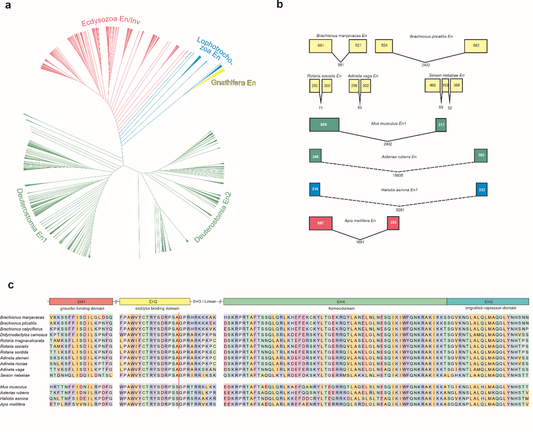
Engrailed expression in the protonephridial system and foot neurons of the rotifer Brachionus manjavacas - Discover Developmental Biology
The homeobox gene engrailed is a multifunctional regulator with diverse developmental roles across Bilateria, ranging from epithelial boundary formation and neural regionalization to lineage-specific innovations such as arthropod segmentation and molluscan shell-field patterning. Despite this broad functional repertoire, its deployment within Gnathifera has remained largely unknown. Here, I characterize the genomic architecture, protein structure, orthology, and embryonic expression of the single engrailed gene in the monogonont rotifer Brachionus manjavacas. Phylogenetic analyses recover the sequence within the protostome engrailed clade, confirming its orthology. The gene retains the full canonical bilaterian motif complement, including EH1, EH2, the homeodomain (EH4), and the C-terminal EH5 region, and exhibits an intron within EH2 whose position and phase are invariant across protostomes and deuterostomes, indicating deep evolutionary conservation despite extreme variation in intron length among taxa. Embryonic in situ hybridization and immunofluorescence staining reveal a distinctly noncanonical expression pattern. Instead of segmental or ectodermal boundary stripes, engrailed is localized to the protonephridial terminal organs, canal cells, and Huxley’s anastomose (a characteristic interconnection within the protonephridial canal system), and appears transiently in two neurons of the developing foot. These domains display epithelial, ciliary, and neural characteristics, consistent with multifunctional cell identities typical of rotifers. Comparative analysis across Metazoa shows that engrailed expression broadly converges on epithelial and neural boundary contexts, suggesting that such local boundary-type functions may represent the ancestral deployment of the gene. Together, these findings broaden the known developmental repertoire of engrailed and highlight the value of rotifers for comparative studies of bilaterian gene function.