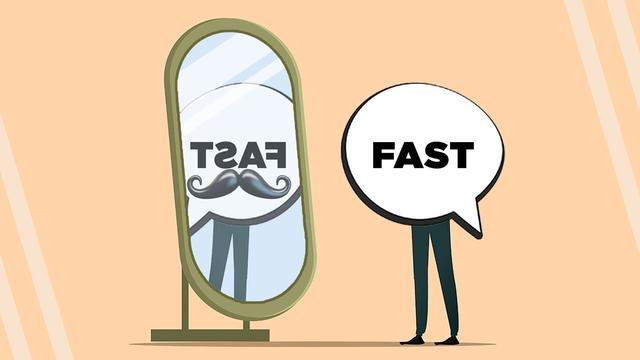
I'm a writer, so of *course* I care about words! But I'm a writer, so I also think that words are improved by their malleability, duality and nuance.

--

If you'd like an essay-formatted version of this thread to read or share, here's a link to it on pluralistic.net, my surveillance-free, ad-free, tracker-free blog:

https://pluralistic.net/2026/03/19/jargon-watch/#corporate-bullshit-receptivity-scale

1/

This is one of the things I love about being a native English speaker - this glorious mongrel language of ours is full of *extremely* weird words, like "cleave," which means its own opposite ("to join together" and "to cut apart"). English is *full* of these words that mean their own opposite, from "dust" to "oversight" to "weather":

https://www.mentalfloss.com/language/words/25-words-are-their-own-opposites

2/

40 Words and Phrases That Are Their Own Opposites

You're about to stumble into the looking-glass world of contronyms—words that are their own antonyms.

Mental Floss

This is what you get when you let a language *run wild*, with meaning determined (and contested) by speakers. Not for nothing, my second language is Yiddish, another glorious higgeldy-piggeldy of a tongue with no authoritative oversight and innumerable dialects.

Semantic drift is a feature, not a bug. It's how we get new words, and new meanings for old words. I love semantic drift!

3/

I mean, I'd better, since, having coined "enshittification," I'm now destined to have a poop emoji on my headstone. Having coined a word - and having proposed a precise technical meaning for it - I am baffled by people who make it their business to scold others for using enshittification "incorrectly." "Enshittification" is less than five years old, and we know when and how it was invented.

4/

If you like it when *I* make up a word, you can't categorically object to other people making up new meanings for this word. I didn't need a word-coining license to come up with enshittification, and you don't need a semantic drift license to use it to mean something else.

I wrote a whole danged essay about this, but still, hardly a day goes by without someone trying to enlist me in their project to scold and shame strangers for using the word incorrectly:

5/

> The fact that a neologism is sometimes decoupled from its theoretical underpinnings and is used colloquially is a feature, not a bug. Many people apply the term "enshittification" very loosely indeed, to mean "something that is bad," without bothering to learn – or apply – the theoretical framework. *This is good.* This is what it means for a term to enter the lexicon: it takes on a life of its own.

6/

> If 10,000,000 people use "enshittification" loosely and inspire 10% of their number to look up the longer, more theoretical work I've done on it, that is one million normies who have been sucked into a discourse that used to live exclusively in the world of the most wonkish and obscure practitioners.

7/

> The only way to maintain a precise, theoretically grounded use of a term is to confine its usage to a small group of largely irrelevant insiders. Policing the use of "enshittification" is worse than a self-limiting move – it would be a self-inflicted wound.

https://pluralistic.net/2024/10/14/pearl-clutching/#this-toilet-has-no-central-nervous-system

Colloquialization doesn't *dilute* language, it *thickens* it. Using a powerful word to describe something else can be *glorious*. It's allusion, metaphor, simile.

8/

Pluralistic: Dirty words are politically potent (14 Oct 2024) – Pluralistic: Daily links from Cory Doctorow

It's poesie. It's *fine*. Bemoaning the "tsunami" of bad news doesn't cheapen the deaths of people who die in real tsunamis. Saying that the Trump administration "nuked" the Consumer Finance Protection Bureau doesn't desecrate the dead of Hiroshima and Nagasaki. Calling creeping authoritarianism a "cancer" doesn't denigrate the suffering of people who have actual cancer.

9/

What's more, devoting your energies to "correcting" other people's allusive language makes you a boring, tedious person. Sure, you can have a conversation with a comrade about making inclusive word choices, but interrupting a substantive debate to have that discussion is *unserious*. The words people use matter (I care a lot about words!) but they matter less than the things people mean.

10/

Keep your eye on the prize (metaphorically) (for avoidance of doubt, there is no prize) (both the prize and the eye are metaphors).

(By all means, get angry at people who intentionally use slurs. None of this is to say that you should tolerate - or be subjected to - language that is intended to dehumanize you.)

It's time we admitted that it's no good replacing an offensive term with a phrase that no one understands.

11/

Calling it "child sexual abuse material" is a good idea, but no one *actually* calls it that. The customary phrase is *actually* "child sexual abuse material, which most people call 'child porn,' but which we should really call 'child sex abuse material.'" If your goal is to avoid saying "child porn" (a laudable goal!), this isn't achieving it.

12/

None of this means that I am immune to being rubbed up the wrong way by other people's language choices. Having been mentored by the science fiction great Damon Knight, I have been infected by many of his linguistic peccadillos, which means that if you say "out loud" in my earshot, I will (mentally) "correct" it to "aloud" (yes, "out loud" is fine, but Damon had a thing about it and it got stuck in my brain).

13/

I am especially perturbed by "business English," the language of the commercial class, their cheerleaders in the press, and (alas) many of their critics. Anytime someone refers to a sector as a "space" (as in "I'm really getting into the AI space") it's like they're making me chew tinfoil. Superlatives like "thought-leader" are so self-parodying I have to check every time someone utters one aloud (see?) to verify that they're not being sarcastic.

14/

Objects of derision should be referred to by their surnames, *not* their given names ("Musk" is vituperative, "Elon" is friendly - though, thanks to the glorious and thickening contradictions of language, calling someone by their surname *can* also be affectionate). I steer clear of jargon used by firms to lionize themselves, like "hyperscaler."

I share the impulse to impose my linguistic preferences on the people around me.

15/

I just (mostly) suppress that impulse and try to focus on substance rather than style, at least when I'm trying to understand others and be understood by them. But yes, I do silently judge the people around me for their word choices - *all the time*.

16/

That's why I immediately pounced on "The Corporate Bullshit Receptivity Scale: Development, validation, and associations with workplace outcomes," an open access paper in the Feb 2026 edition of *Personality and Individual Differences* by Shane Littrell, a linguistics postdoc at Cornell:

https://www.researchgate.net/publication/400597536_The_Corporate_Bullshit_Receptivity_Scale_Development_validation_and_associations_with_workplace_outcomes

17/

Littrell set out to evaluate "corporate bullshit," a linguistic category that is separate from mere "jargon." Jargon, Littrell writes, is a professional vocabulary that serves a useful purpose: "facilitat[ing] communication and social bonding, increas[ing] fluency, and help[ing] reinforce a shared identity among in-group members."

18/

Bullshit, meanwhile, is "semantically, logically, or epistemically dubious information that is misleadingly impressive, important, informative, or otherwise engaging." There's a whole field of bullshit studies, with investigations into such exciting topics as "pseudo-profound bullshit" (think: Deepak Chopra).

Littrell borrows from that field and others to investigate corporate bullshit, formulating a measurement index he calls the "Corporate Bullshit Receptivity Scale."

19/

In a series of three experiments, Littrell sets out to determine who is the most susceptible to corporate bullshit, and what the correlates of that receptivity are.

Littrell concludes that corporate bullshitters themselves are pretty good at identifying bullshit (they have a high "Organizational Bullshit Perception Score"). In other words, bullshitters know that they're bullshitting.

20/

When a corporate leader declares that:

> This synergistic look at our thought leadership will ensure that we are decontenting and avoiding reputational deficits with our key takeaways as effectively as we can in order to sunset our resonating focus.

they know it's nonsense.

This reminded me of the idea that cult leaders tell obvious lies to their followers as a way of forcing them to demonstrate their subservience.

21/

When Trump demands that his followers wear clown shoes:

https://www.msn.com/en-us/news/politics/trump-is-obsessed-with-these-145-shoes-and-won-t-let-anyone-leave-without-a-pair/ar-AA1XOEBm

Or that they pretend that "mutilization" is a word:

https://www.wonkette.com/p/is-trumps-save-america-fck-america

He's engaging in a dominance play that forces his feuding princelings and their lickspittles to humiliate themselves and reaffirm his supremacy.

22/

MSN

There are plenty of rank-and-file workers inside corporations who have high OBPSes and know when they're being bullshitted, but Littrell also identifies a large cohort of low-OBPS workers who are absolutely taken in by corporate bullshit.

Here we get to a fascinating dichotomy. Both the low-OBPS and high-OBPS workers can be described as being "open minded," but "open" has a very different meaning for each group.

23/

Workers who are good at spotting bullshit score high on open-mindedness metrics like "willingness to engage" and "willingness to reflect," both characteristic of the "fluid intelligence" that makes workers good at solving problems and doing a good job.

Meanwhile, workers who are taken in by bullshit are "open minded" in the sense that they are bad at analytical reasoning and thus easily convinced.

24/

These people test poorly on metrics like "logical reasoning" and "decision-making," and score high on "overconfidence in one's intellectual and analytic abilities." They are apt to make blunders that "expose organizations to financial, reputational, or legal risks."

But they're also exactly the workers who score high on "job satisfaction," "trust in one's supervisor," and "degree to which they are inspired by corporate mission statements."

25/

These people are so open minded that their brains start to leak out of their ears. Or, as Carly Page put it in *The Register*: "jargon sticks around not just because executives enjoy using it, but because many people respond to it as if it were genuine insight":

https://www.theregister.com/2026/03/15/corporate_jargon_research/

26/

Those who 'circle back' and 'synergize' also tend to be crap at their jobs

: Cornell Uni researchers pivot to pluck low-hanging fruit to optimize bandwidth

The Register

This creates a feedback loop where bosses get rewarded for using empty and maddening phrases, and their workforce gets progressively more skewed towards people who are bad at spotting bullshit *and* at exercising their judgment on the job. It's quite a neat - and ugly - explanation of why bullshit proliferates within organizations, and how organizations come to be completely overrun with bullshit.

27/

This is a fascinating research paper, and while I've focused on its conclusions, I really suggest going and reading about the methodology, especially the tables of "corporate bullshit" phrases they generated for their experiments (Tables 1, 2 and 3).

28/