 Out of Print Archive (meppi64)
Review for Sonic the Hedgehog on Master System on Mean Machines 15 -December 1991 (UK)
You can download this issue here:
https://www.outofprintarchive.com/catalogue/meanmachines.html

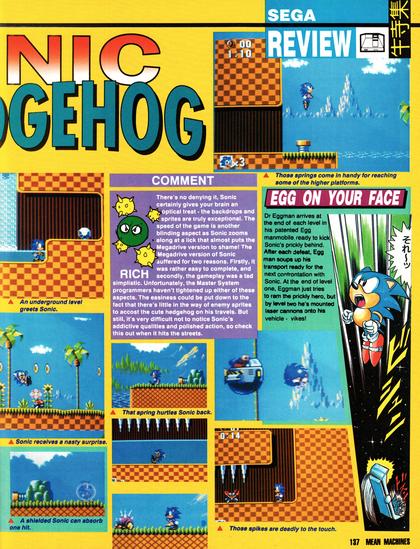

Review for Sonic the Hedgehog on Master System on Mean Machines 15 -December 1991 (UK)
You can download this issue here:
https://www.outofprintarchive.com/catalogue/meanmachines.html
Indeed. But that's how they appear in the printed magazine.
I could "fix" them, but unless it's actual damage after printing, or things like ink smears during the printing process, I prefer to keep these kinds of things as they are so they represent the magazine as closely as possible.
Oh no worries.
This particular error does show up on several occasions as well, where it's even more noticeable.
These are the types of mistakes in magazines that really do look out of place and seem to be errors that wouldn't happen when creating the magazine.
But if you realise that the pages were crafted by hand with pieces of paper that had images and printed out text on it, it quickly becomes obvious how such a thing would happen.
This massive feature might shed some light on it:
https://www.timeextension.com/features/the-making-of-mean-machines-the-magazine-that-sold-console-gaming-to-the-uk
Especially around half way in, just above the image of the magazine with the holographic Mario.
""Given that the team at EMAP was, in the early years of the magazine, working with equipment that might cause William Caxton to stifle a chuckle, it's understandable that the stress regarding the production of each issue was felt rather keenly by Rignall and his team. "We had monochrome 286 PCs, just about good enough for playing Prince of Persia and not much else – though I recall that Jaz had a colour screen and a top-end 386 for gaming," says Leadbetter. "We would type up reviews, then Jaz or Paul Glancey would sub the copy, then copy and paste it into a package called Ventura, which produced the 'galleys' – the text as you would see it on the page. It was then printed on a gigantic, super-expensive laser printer and given to the artists, who would cut out all the text and stick it on a page, mark it up for colour and add the screenshots."
...
...
"We shot these using a Minolta camera, onto 120mm film. I dimly recall we'd get maybe 15 shots on a roll, then we'd pop across to a studio in Farringdon Road and get them processed. If you were lucky, you may have seen the odd naked lady."
"Taking screenshots of games is my recollection of one of my earliest staff writer tasks," says Scotsman Angus 'Gus' Swan, who joined the magazine in 1992. "It was done in the games room with the aid of a camera, tripod and ripped bit of black cloth to drape over the monitor and camera, Victorian photographer-stylee. People were continually walking in to play games, and it was a bit shambolic really."
...
...
Lawrence has similar memories. "The Holy Grail was what we called 'perfect pause', which is when the screen just froze when you paused the game. A blinking 'pause' sign was acceptable. Loads of games would pull up some pointless stat screen or a crappy bit of artwork, or an unnecessarily ornate 'GAME NOW PAUSED!!!' logo, and your heart would sink. Once you'd got the screenshots developed, they were filed in hand-labelled envelopes in these massive filing cabinets, which you'd have to search through any time you had to look for a screenshot of an old game. And Odin help you if Oz [Browne, art editor] had labelled the envelope. He had a rather idiosyncratic attitude to checking the spellings of titles so they could have been filed under literally any letter of any alphabet."
...
...
The process of putting together this 'cut and paste' style publication might sound painfully old-school, but it was far from being the worst example of the period. "Even though our production process seems positively Neanderthal these days, it was really advanced for its time," Rignall says. "When I started at CVG, we were using typewriters, typesetters, copy editing using a red pen – basically doing everything the really old-fashioned way. Mean Machines was the first EMAP magazine to essentially be produced using computers and desktop publishing software, and even though the initial outlay for the gear was quite expensive, everything paid for itself within a couple of months. That helped make the magazine very cost-effective, which resulted in it generating a considerable profit, which Lord EMAP very much appreciated."
...
...
Lawrence keenly remembers the massive change that occurred when this new technology was introduced. "When we first got our Macs, we had people come in to train us in how to use them. When they showed us that you could do things like bold text right there on the screen, we freaked out. It was like the chimp-people and the obelisk in 2001: A Space Odyssey, except the chimp-people didn't immediately use the obelisk to sample 30 seconds of William Shatner's version of 'Mr Tambourine Man' to use as an error message."
hehe, yeah, I couldn't even get the small relevant part into a single post. 😅
 Nathan Buuck