 Solar Storm Scout
☀️ SOLAR INDICES (1/5)
SFI: 176
A-index: 3
K-index: 1
foF2: 9.3 MHz
MUF (DX): 37.2 MHz
D-Layer: 5%
📊 NOAA Scales
📻R0 Radio Blackout
☢️S0 Radiation Storm
🧲G0 Geomagnetic Storm
☀️ SOLAR INDICES (1/5)
SFI: 176
A-index: 3
K-index: 1
foF2: 9.3 MHz
MUF (DX): 37.2 MHz
D-Layer: 5%
📊 NOAA Scales
📻R0 Radio Blackout
☢️S0 Radiation Storm
🧲G0 Geomagnetic Storm
📻 BAND CONDITIONS (2/5)
160m: 🟢 Good
80m: 🟢 Good
40m: 🟢 Good
30m: 🟢 Good
20m: 🟢 Good
17m: 🟢 Good
15m: 🟢 Good
12m: 🟡 Fair
10m: 🟡 Fair
6m: 🔴 Closed
🎯 Best Now: 80m, 40m, 30m, 20m
Based on MUF=37.2MHz
📡 D-REGION ABSORPTION (3/5)
🟢 Low (Night)
⏰ Low nighttime - 04:30Z
💡 All bands good
Real-time HF absorption from solar X-rays
🔴Red=High (HF challenging) 🟡Yellow=Moderate 🟢Green/Blue=Low (HF good)
Higher absorption = lower frequencies work better
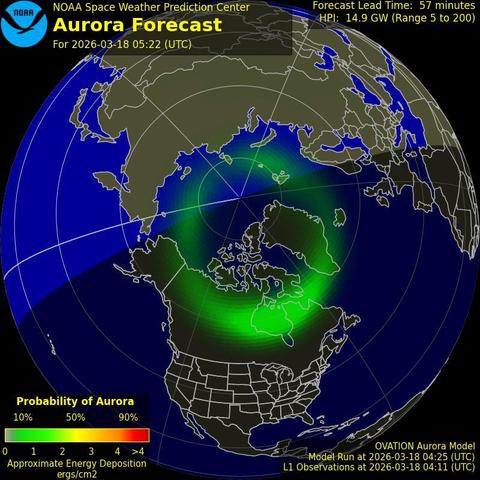
🌌 AURORA FORECAST (4/5)
⚪ QUIET
Power: 14.0 GW
K-index: 1
Minimal
📻 Normal VHF
🟢Green=2m/6m scatter possible 🟡Yellow=Enhanced 🔴Red=Intense aurora
Point antennas north, use SSB/CW modes. Best during K≥4 activity.
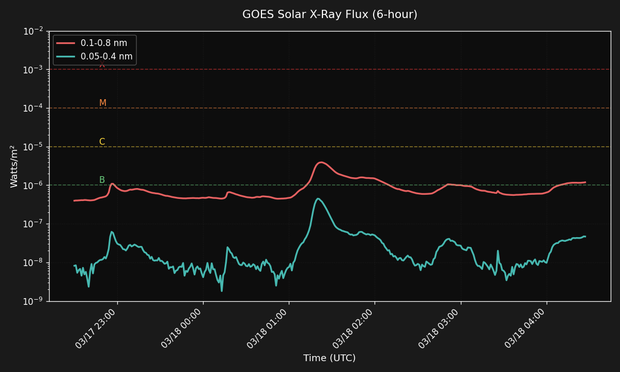
☀️ X-RAY FLUX (5/5)
Past 6hr
Current: C1.2
🟢 SMALL FLARE
Minimal impact
Flare Classes: X=Major (HF blackouts) M=Medium (regional HF degradation) C=Minor (slight absorption) B=Weak (normal)
Red line=0.1-0.8nm Cyan=0.05-0.4nm. Spikes=flares causing radio blackouts. Higher flux=worse HF.
NOAA SWPC 04:30Z
 fourmiune