 Beep
BeepDivide & Conquer
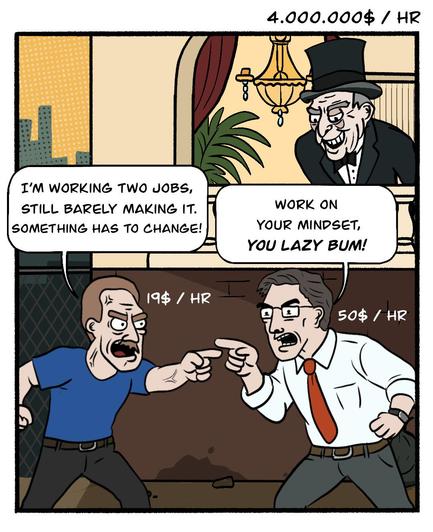
The goal is to evenly distribute the wealth such that everyone has what they need to survive and then if you still have enough wealth left over (if the wealthy class were dismantled we would), you make sure everyone has enough to be comfortable. You take the business assets and you share ownership with the people working in those businesses. You establish democratic structures inside those businesses such that the workers choose who is in charge and what everyone is paid. Any amount of money an individual makes is supplemental to basic income that pays for your needs. Establish a wealth cap such that if your income exceeds it, the funds are distributed back down to the needs of society. Things like education and medicine could be entirely funded through excess earnings and a proper tax structure. A wealth cap means that oppressive amounts of liquid funds can’t be used to control people or lobby governments.
These are very very basic ideas. Not at all difficult to wrap your head around. And people are angry because we are constantly being told by the boots on our necks that it won’t work and that’s why we won’t even try. But in reality, the reason we won’t try is because the wealthy will lose their massive wealth. Wealth that most of them lucked into. This has nothing to do with how hard you work or how smart you are. It has everything to do with who is in control and who is not.
The goal is to evenly distribute the wealth such that everyone has what they need to survive and then if you still have enough wealth left over (if the wealthy class were dismantled we would), you make sure everyone has enough to be comfortable. You take the business assets and you share ownership with the people working in those businesses.
I think that’s a very nice idea. But I think you’re going to have a very hard time getting enough people to support it.
For a very long time I considered myself a democratic socialist. I joined the Democratic Socialists of America eight years ago, but I left after just a few years. To me, democratic socialism just made so much sense. I thought, this is the solution. I was convinced that Democratic socialism, along with environmental sustainability, was the future. Boy, was I wrong. Very few people shared my view. After a while I realized it was futile.
Most people who would read this cartoon don’t want to overthrow and replace the system, they just want the money. They’d prefer the $4 million, but they’d settle for the $50 /hr. You can tell them there’s a better way, but your words will just fall on deaf ears. They ain’t interested. They just want the money.
There won’t be an awareness campaign followed by a wave of socialist political movements that sweep the parliaments and governments of the world. There won’t be a glorious proletarian revolution, which sees the workers seize the means of production. A post capitalist society will one day emerge, but it will only be after capitalism has collapsed, taking the modern world down with it. Maybe on the other side of that, democratic socialism might be possible, in some small pockets of what’s left of humanity. But it will only be on small scales. Democratic socialism is incompatible with empires, and other large, complex civilizations. So any democratic socialist societies that do exist will be relatively small. Not that’s a bad thing. Not at all. In fact, I think it’s much more sustainable. But that means no dynamic, fast growing, expansionist civilizations. Again, better, more sustainable, but much different than the world we know today.
But if this happens at all, it’ll be long after I’m dead.
The “socialism only works at small scales” argument is tired, lazy, and boring.
Explain why. Be honest with me and yourself. And if you start in about “but the oil is funding that”, yes exactly. That’s how it should work, the USA gives away billions of dollars to capitalists every day with it’s mineral riches.
Democratic socialism (or social democracy… the definitions are not crisp or distinct) is already working in several Nordic countries of millions. Together they have populations of tens of millions. We can argue definitions if you like, but they’re much closer. So much closer that I’ll take that as the first several steps in our journey as a society.
Even if for some weird reason democratic socialism won’t ‘work’ at the size of hundreds of millions when it works at the scale of tens of millions, capitalism is currently falling flat in the USA and dozens of other countries, and offers much worse outcomes for 99.9% of it’s population all the while.
Explain why socialism works in large scales. What’s your best example of a LARGE SCALE socialist society ever in the history of Earth? You’re very favorite. Norway?
(not a trick question)
Democratic socialism is already working in several Nordic countries of millions.
Those countries are social democracies, not democratic socialist. Democratic socialism and social democracy are different systems. I know it sounds like splitting hairs, but they really are distinct.
Social democracy is a mostly capitalist economy with a democratic government that has a progressive tax system that funds a social welfare system and basic, universal public services. Social democracy does exist in many nations around the world today. Even the US has hada version of this model in the past.
Democratic socialism is a socialist economy with a democratic government. Most services would be provided by community or government owned non-profit organizations. Some for-profit businesses might exist but they would be worker owned. Unlike social democracy, Democratic socialism has never actually been tried. It’s entirely theoretical.
Together they have populations of tens of millions.
Yeah, tens of millions. Not 350 million like the US. Of the top ten democracies, according to the democracy index, all have populations under 20 million, and most have populations under 10 million. Clearly, social democracy has a population limit. I believe democratic socialism would too.
Correlation does not imply causation. Show me a mechanism, with evidence. The mechanism I propose is that if a society looks even slightly too leftist the billionaire class does everything they can to destroy or sabotage it.
Also, there isn’t a crisp definition or delineation between a social democracy and a democratic socialist one. Again- quibble over definitions as much as you want. A social democracy is several important steps in the right direction.
And capitalistic centrism / authoritarianism is NOT “working” globally. It’s just managed to kick the can down the curb for a while.
Correlation does not imply causation.
That doesn’t mean the correlation is irrelevant. The fact is, not a single one of the top ten democracies on the planet today have populations above 20 million. Not a single one. Source. I don’t necessarily know why that is, but it is.
I don’t think modern global capitalist civilization will peacefully transition to social democracy, or democratic socialism, whatever you want to call it. I think the capitalist global economy will continue growing until we hit some hard limits to growth, at which point it will collapse, which could be sooner than most realize. It’s not going to be pleasant. Global population could decrease significantly, average life expectancy could decline, as could total global industrial output and average living standards. Who knows what will come out on the other side of that.
Correlation does not imply causation. Show me a mechanism, with evidence.
I was thinking about it and it came to me. It’s actually simple math.
Norway is the world’s top democracy, according to the world democracy index. Norway has a total population of about 5.6 million people. Their parliament has 169 seats. That means each seat represents about 33,000 people. The US, on the other hand, has a total population of about 341 million people. Our House of Representatives has 435 seats. That’s almost 784,000 people per seat. If each US House seat represented 33,000 Americans, our House would need over 10,000 SEATS! Obviously, that’s not realistic. It’s also not realistic to act like a representative can represent 780,000+ people the same as 33,000 people.
There’s your evidence.
Social democracy can, and does work, under the right circumstances. One of those is a reasonable population level. For social democracy to work, you need democracy. It’s in the dang name. But a representative democracy where each representative needs to try and represent 637,000 people is unreasonable. If you want social democracy to work, you need to get the democracy part working, and that requires a manageable population.
So, let’s say each representative would represent no more than 50,000 people. It’s an arbitrary number but I’m just picking something for the sake of argument. We also wouldn’t want the legislative body to be too large and unwieldy, so let’s say it shouldn’t have more than 200 seats. That means the total population shouldn’t exceed 10 million.
No, not proof. That’s hardly an argument. You pulled numbers out of your ass and pretended they’re the right ones with no further consideration or evidence given.
I could as easily say that 10 million per rep and 1000 reps should work with the right system and infrastructure. That gives me a number that I like… But it’s not evidence.
You pulled numbers out of your ass and pretended they’re the right ones with no further consideration or evidence given.
No, I researched the numbers of the Norway government and US government. Feel free to verify them on your own. You will find they are accurate.
I could as easily say that 10 million per rep and 1000 reps should work with the right system and infrastructure.
Ok, well, can you provide a single example? I’ve provided one, and I could provide more. Every one of the top ten democracies have a significantly lower number or represented people per elected representative than the US. There’s only one democracy that has a higher number of represented people per representative than the US, and that’s India, with a total of about 1.7 million people per representative. I should note that India ranks 41 on the democracy index, and has the classification of “flawed democracy.” Also, no one considers India to be a social democracy, that I could find.
But there’s no evidence if Norway had more representatives, or more people per representative, that their democracy would crumble.
I truly, honestly, believe a democracy doesn’t have to be small to be effective or social. There are many smaller democracies that don’t score well, such as most of South America, the Caribbean, much of Africa, etc.
I think that sets apart those democracies on the list you keep referencing is sane election policies, money and religion separated from politicians as much as possible, free journalism, an engaged voting base, a recall system, and basically any electoral system not first past the post.
So far you’ve provided examples, and I truly appreciate that. I also appreciate you being earnest and willing to have a real conversation about this. I’m truly not trying to be dismissive or disrespectful.
There are many smaller democracies that don’t score well, such as most of South America, the Caribbean, much of Africa, etc.
Sure, I acknowledge that. I’m not saying that a smaller population guarantees a successful democracy, nor a social democracy, but I think it is one of the requisites. Those other things you mentioned are probably requisites as well.
Again, I think it comes down to simple math. A single representative can’t represent 600,000 people as effectively as 30,000. More people means greater diversity of thoughts and ideas, beliefs, ideologies, interests, etc. And that’s especially true if the people hold mutually exclusive ideas. For instance, a representative can’t represent both a white supremacist and black civil rights leader simultaneously. Their goals and world view are diametrically opposed. A representative can’t represent both at the same time, at least not on the matter of civil rights. Similarly, a representative can’t represent both a social democrat and a neoliberal capitalist simultaneously. Their goals are in direct opposition to one another. The social democrat wants higher taxes and a stronger social safety net, the neoliberal wants lower taxes and a smaller safety net.
 TheDemonBuer
 Jyek
Jyek kata1yst
 Mulligrubs