 Christian Lawson-Perfect
What do you think is the first counterexample to the statement "half of a big number is also a big number"?
Is this the same question as "what's the smallest big number"?
If not, why not?
@christianp Basically yes, same question, I think.
Besides other options graciously offered here I can think of one more. I encountered the term big numbers, or large numbers, if you allow me the liberty, in the title of the law of large numbers. So, what if we define it like this:
A number can be called a big number if the outcome from a sample of that size is within the standard deviation from the predicted mean. Or something along this line.
@christianp I asked the Jr your question.
On the obvious request to define "big number" I said "you define". Here's what I got in response:
If all positive numbers (or rational numbers as another example) are big numbers then there's no counterexample. Now go to bed dad.
@quincy I deliberately asked a fuzzy question 😉
Can you think of any examples?
@christianp A natural number seems big to me if it would take a considerable (fuzzy concept again?) stretch of time to count manually, say 1000.
But 4 can already be a big number if it counts the number of pizzas in my lunch (whereas 2 would be only moderately big, maybe). That would seem to put an upper bound of 4 on my answer.
@christianp For this, let's define "big number" very scientifically as a number big enough I have to abstract it away somehow. That is, I can't think directly of N raw objects, I have to think of 𝑥*𝑦 raw objects or 𝑏ᵏ objects.
To comfortably do this, I'll put that number below or equal to 10. Maybe some people can visualize individual things above that, but I think that's generous as I believe the average number is ~4.
Thus, the first counterexample to "half of a big number is also a big number" from the direction of the big numbers would be 20/2, since that's the largest "big number" that could be directly halves into a small number. Coming from the smaller numbers, 11/2 would be the first counterexample.
It may seem odd to define a big number this way, but why not? Every other method is just as arbitrary. Might as well tie it loosely to our psychology.
Perhaps unintuitively, this definition of "big number" causes a number to become big again if it's divided too much, since I doubt many people could visualize complex fractions of things.
@christianp if you are a cat, 8 is too many to count to, but 4 is the number of paws you have.
Or, fractionally less facetiously, https://numberwarrior.wordpress.com/2010/07/30/is-one-two-many-a-myth/ for cultures who go “one, two, many”, where many is clearly a big number but half of many might be two.
 robinhouston
 Ben Curthoys
 soaproot
 cmdrSprocket
 Chris D.
 Chris Brooking
 Σ(i³) = (Σi)²
 Mikha Ky.
 Quincy ⁂
 Niles Johnson
 Anna Liberty
 M Schommer
 sven_a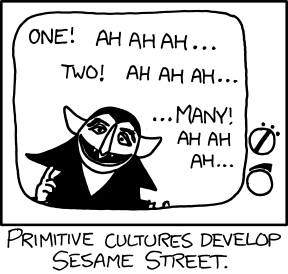
 ohnonotagain42
 Matteo Capucci