I would like to point out something very serious. Years ago I developed a technique for shifting serial data into a 74hc595 chain without use of a microcontroller. I have not been able to help but notice that people have been using raspberry pi's instead of my simple circuit.
For the same reason you DONT actually need 32G of ram to run a web browser, you don't need to use a Pi to convert serial data to parallel. I mean cmon, Its using a 555 as a BUFFER. a BUFFER!
https://github.com/ruenahcmohr/serial-595-9600
Please conserve the technology people.
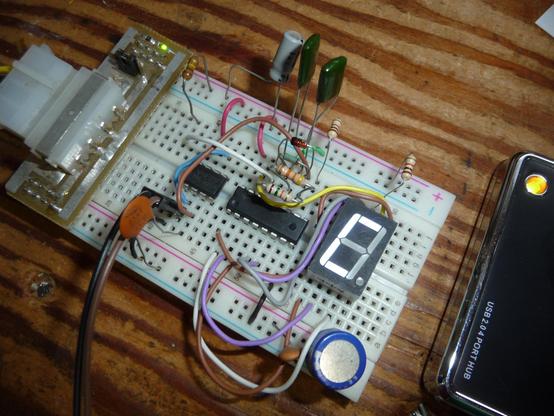

an example application is the 1-bit computer. The version that includes serial upload uses 75hc595 to load the parallel memory chip with the firmware. The 1-bit has no bootloader.

https://github.com/ruenahcmohr/OneBit

@RueNahcMohr but you need cleverness, and that one sometimes seem to be in short supply these days.
@f4grx ah, unless its in a datasheet...
@RueNahcMohr I almost understand how this works! I don't quite see how the clock stays low with the data & latch changing, but that might be not understanding the full signal out of the 555.
Are the 22nFs just there for smoothing?
Anyway, I can see how cool this is, and as someone without any real education in electronics, I'm impressed by the clever simplicity.
@sashabilton The 555 just inverts the serial data (side effect) and makes sure the voltages go from 0 to 5 (many of the serial converters output a high of only 3V) The RC magic distinguishes all the times into pulses. The magic is putting software on the sending side that "remodulates" the data
@RueNahcMohr thank you! I really feel like a major ah-ha moment in learning electronics is when I understand the RC combo magic. I think I can sort of see that the Rs reduce the voltage, and the Cs filter that reduction? But it's nebulous. Even if it's simple. The trouble of going from binary programming to analog physics.
@sashabilton The RC combination causes a low transition of the votlage, but the diode speeds it up one way. So, you can make a signal that (for example) goes low immediately, but delays before going high. This can be used to distinguish long and short pulses. This circuit uses two of those, one delay on the logic 1's and one for the logical 0's.
@RueNahcMohr so that's a quality of diodes I didn't know. I thought they just blocked flow in one direction. In my opinion it's your level of detailed expertise that means you are able to simplify and reduce these kinds of circuits Vs using a microcontroller.
@RueNahcMohr I need much more information to understand why I am so stupid.

@adingbatponder
- no microcontroller
- serial wire input
- as many parallel outputs as you want for doing things like programming memory chips.

- Rue didn't include reading data, which, technically should be possible.

@RueNahcMohr Yesss love to see some transistor golf. Those fast-on/slow-off (or vice versa) delays have served me well many times as dead time generators in half-bridge switching logic.