After around 23 years, I think I finally made a decision to switch from #Linux to #OpenBSD. It gives me this fantastic feeling of discovering new horizons and seems much more coherent. Also has no #techbros behind it.
I might even remove Linux from main SSD and leave it only on my USB disk to play one old Windows game that I have.
It seems like the only thing I will miss is battery life on Linux. But I'm ready for this tradeoff.

@as400 have fun.🙂 

btw... man apmd

@Tionisla

Thank you  
"apmd -A" is already running.

@as400 very good decision. Zsh and alacritty too. I3, no idea, I'm using pekwm.
Would you be agreed to share your dmesg on https://dmesgd.nycbug.org/
NYC*BUG dmesgd

New York City BSD User Group dmesgd

@videlft

I'm already having so much fun 

I just submitted my dmesg.

@as400 very good CPU throttling, acpi, WiFi, nice screen, so much ram. Wonderful machine

@videlft

Indeed, I suspect #OpenBSD does not use all C-states and P-states.

On Linux going from 80% to 20% charge I was getting around 7 hours of uptime easily when using "powersave" power profile and running most of the stuff on efficiency and low power cores.

@as400 does obsdfreqd can improve the situation? This is not directly linked , but this could help to throtle before going to sleep mode. https://dataswamp.org/~solene/2022-03-21-openbsd-cool-frequency.html
Solene'% : Keep your OpenBSD system cool with obsdfreqd

A new daemon to keep your system cool and improve battery life

Solene's Percent %

@videlft

It doesn't throttle lower than apmd by itself. So no real sense to use it.

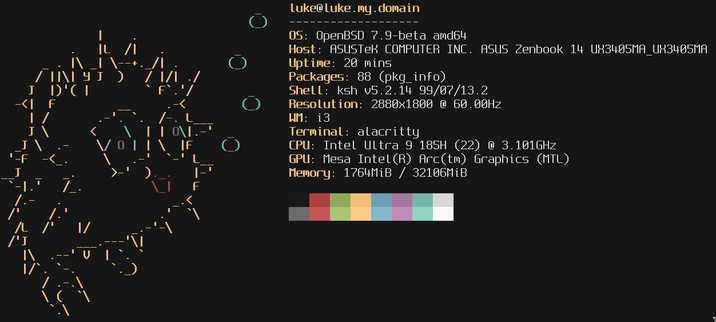
@as400 OpenBSD supports that CPU?

@zyx

Not sure what you mean by support ?

@as400 like does the GPU and CPU properly work? e.g they don't run at full clock speeds all the time (or only at base speeds) and does GPU hardware acceleration work for video playback and stuff

@zyx

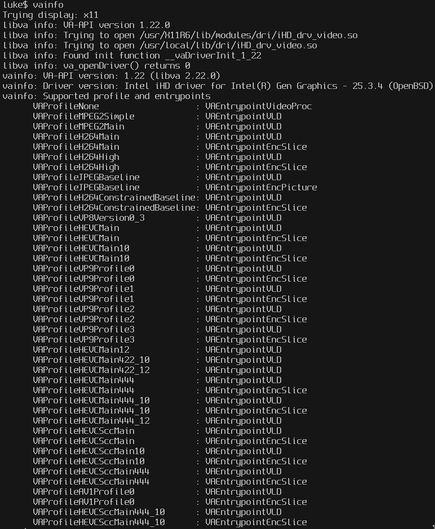
Look at below screenshots. CPU is scaling but it almost never goes as low as 400MHz. I guess this is because kernel is not tickless ? So, as I mentioned earlier, #OpenBSD is not as power efficient as Linux.
VAAPI works as you can see. Now, the question is whether browsers use it. I'm not sure.

@as400 @zyx the biggest issue is that Openbsd don't make difference between the Efficient and the Performance cores with these new CPU from Intel and AMD.

A demanding task could just run on the slowest core...

To add to this mess, the 185H have 3 types of cores :
6 x 4.8 GHz Intel Redwood Cove P-Core
8 x 3.8 GHz Intel Crestmont E-Core
2 x 2.5 GHz Intel Crestmont E-Core

A cool and "simple" new feature for #openbsd could be to disable some cores via sysctl

@krum @as400 @zyx how do other OSes allocate work to the E- and P-cores?

@aaronm04
@krum @zyx

I'm not 100% sure but I think it's, at least partly, done in CPU firmware.

On Linux I was mostly using e-cores and lpe-cores. I was pinning tasks like mangowc, firefox, wayland to e-cores and waybar, syncthing to lpe-cores.

That way I was getting around 7 hours using 60% of battery. Actually these CPUs can be very power efficient when not using big cores at full swing.

@as400 I need to see how much of a pain it'll be to do my day job on #FreeBSD or #OpenBSD...
@as400 I did the experiment a few years ago. Everything except audio was perfect. Alas their filesystem is ... fragile. If you're used to journaling, you're in for a bad time after your first "wild" shutdown...

@phf

Let's hope no bad times will happen :)